Articles in Reach4Work

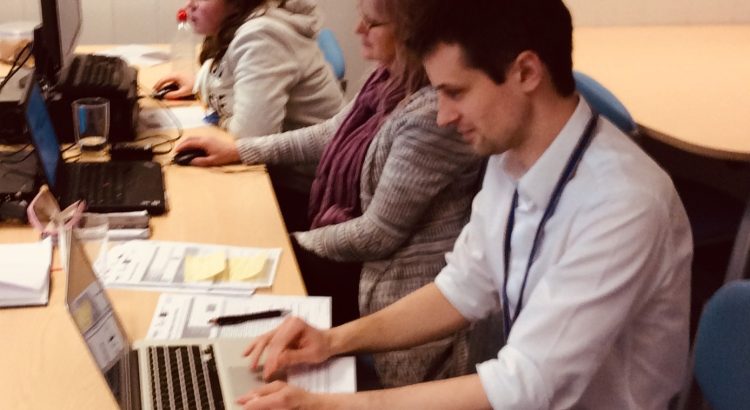
Three people sitting at a long desk working on laptops and desktop computers. There are papers and glasses of water also on the table.

About Reach4Work

Since 2010, BuDS has helped its volunteers towards work. Our Reach4Work project, created in 2018, codified and developed that help, creating a professional wrap-around service for our disabled volunteers who want to move into or closer to work.

BuDS is exceptionally successful at moving disabled jobseeker volunteers into or closer to work…

Read More
A green background with white text of "Easy read" in the top left corner, and a white silhouette of a person reading on the right hand side. Copyright Devon Partnership NHS Trust

About EasyRead

BuDS publishes some of our articles in EasyRead format. These articles are produced by our volunteers, and so our capacity is limited. Over time we will publish more EasyRead articles. Please be patient with us whilst we grow this project.

Read More
A white woman wearing headphones with a microphone looking into the camera and speaking

About The Enquiries Project

The BuDS Enquiries Team answers questions and queries from disabled people about a very wide range of issues. We try to fill the gaps left by other support services and helplines, so we often support disabled people with complex and difficult issues.

Getting Help From The Enquiries Project

Any disabled person in England can contact the Enquiries project for help. Parents, carers, and supporters can also contact us on behalf of a disabled person. We don’t have strict rules about who we can help: we will always do our best to support you and will let you know immediately if, for any reason, we can’t.

The Enquiries project is staffed entirely by volunteers, many of them disabled people themselves. We are often very busy and there may be a delay in getting back to you. We are sorry about this, but we can only do so much. The Enquiries project is not a crisis or emergency service.

Read More
An autistic school child in uniform looks at their teacher

About The BuDS SEND Transitions Service

The BuDS SEND Transitions Service is a three-year project funded by The Rothschild Foundation. The purpose of the SEND Transitions Service is to improve the experience of disabled children and young people moving through key transitions within school education and from school education into work or further/higher education. It will do this by: 

  • Investigating and reporting on services supporting disabled children and young people.
  • Assessing to what extent the needs of disabled children and young people are met by existing services.  
  • Proposing new and improved services to eliminate gaps and address deficiencies, including new BuDS and Reach4Work services.

The SEND Transitions Service is made up of workstreams from a number of BuDS projects, principally Fair4All Education and Reach4Work.

To learn more about the Reach4Work workstream, which is looking at disabled young people’s transition from education to employment, click here.

A learning disabled child smiling into the camera and holding up her hands, which are brightly painted with several colours

About Fair4All Education

The Fair4All Education project tackles the most important educational issues facing disabled children and young people, and their parents/carers, in Bucks.

The core of the Fair4All Education project is a ‘working community’ of professionals, parents, carers and disabled young people who are passionate about making a real difference. Working under the BuDS umbrella, the Fair4All Education team works together to define an agenda for action and plan how change will be made to happen.

Read More

About Fair4All Events

Disabled people are often excluded from outdoor public events. This is not because they do not want to attend these events, but because the way the event is organized and staged creates barriers that make it difficult or impossible for them to attend. BuDS’ free-to-use Fair4All event project helps event organisers remove those barriers and attract more disabled people to their events, making them more successful. There are over 40,000 disabled people in Buckinghamshire and over 100,000 families with a disabled member, so being more accessible can significantly boost an event’s popularity and attendance.

Event organisers are often not aware that they are creating barriers which are reducing the appeal of their events. Event management training and qualifications do not usually cover disabled accessibility and inclusion. Disabled people are so used to events not being accessible that most do not even try to attend, which means event organisers do not see the difficulties that disabled people face.

Read More

About IAG Covid-19

The IAG team works tirelessly to produce easy to read, fact-checked and reliable articles about issues relevant to disabled people. During the Covid-19 pandemic, these have included weekly risk posts which break down the latest case, hospitalisation, death and vaccination statistics; analyses of Government policy, and scientific updates about the coronavirus. To read these posts, please see below or visit our Facebook page using the button below:

If you would like to volunteer for the IAG team as a researcher or writer, please visit our volunteering page to find out more.

About The Fair4All Card

What is the Fair4All card? 1. Helps disabled people prove what adjustments they are legally entitled to. 2. Secure photo card for disabled people. 3. Explains how other people can help. 4. Simple statements means it can be used anywhere. 5. Doesn't list any disabilities or conditions.

What is the Fair4All Card Scheme?

The Fair4All Card is a secure, evidence based card that can be used by any disabled person to communicate the reasonable adjustments they need.

We created the scheme in August 2020 and have grown from offering around 12 reasonable adjustments to now offering over 40.

Find out more about the scheme below.

Read More
A woman smiling at the camera, working at a desk with a desktop computer in front of her. Stock image copyright Bipolar New Life Outlook website (not affiliated)

BuDS, Bipolar and Me: My Journey With Reach4Work

Written by Cat Hartwell-Veale, BuDS Reach4Work Personal Development Advisor


On December 12, 2023, I was diagnosed with bipolar disorder. I remember the day so clearly: I had an appointment with a psychiatrist to talk about why I was struggling with my moods, finding stressors challenging, and afraid of damaging my relationships with people I love. After an hour speaking with a team of four strangers, I came away with a diagnosis. I started medication immediately and was told to report back in a few weeks to see how I was getting on. 

Three months later, I was made redundant from my job. 

Read More
A woman looking at a laptop on a desk. On the laptop is a video call with 3 people shown. Image copyright Entrust IT Group.

‘Reach4Work Helped Me Break Through The Barriers To Work’

Written by Harry, a BuDS Reach4Work volunteer.


“In recent years, awareness of disabilities has increased, and it is becoming a much more accepted part of our lives. However, there is still work to be done.

Many disabled people struggle to break into the world of work, and this is where BuDS comes in. A successful charity that operates primarily in Buckinghamshire, they have dedicated themselves to the support of disabled people and their issues with preparing for the world of work.

Read More
A blue button marked "Sign Up" in white letters, with a stylised hand about to press it

Sign Up To Reach4Work

Signing up to Reach4Work is very easy. Just tell us that you are interested in joining Reach4Work, and we will get in touch with you. We will get back to you as quickly as we can, but it can take up to a week if we are busy.

The easiest way to sign up is to complete the form below, making it clear that your enquiry is about Reach4Work. Please tell us if you would like us to communicate with you in a particular way, e.g. no phone calls or by social media messaging.

You can also email volunteering@buds.org.uk or leave a voicemail on 01494 211179.

    Which has four wheels, car or bike?

    This little quiz is to help prevent spam on this site

    GDPR CONSENT
     By using this form you agree with the storage and handling of your data by this website.

    See our Privacy Policy

    Graphic headed "Thomas’ Blog: Making Videos For BuDS With The Reach4Work Digital Team". Text boxes read "My time at BuDS... [is helping] me to improve my motivation and confidence to work independently " and "These are all valuable skills that will help me to get employment either now or in the future"

    Making Videos For BuDS With The Reach4Work Digital Team

    Written by Thomas, a member of the BuDS Reach4Work Digital team. 

    Disclaimer: this is a personal blog by a BuDS member. The views expressed are personal, and don’t necessarily represent those of BuDS or our Trustees. 


    Since I joined the Reach4Work Digital Team in January, I have been working both on my own and with a the Digital Team, to create Videos. We usually work as a team in co-production, creating different components for the final video I have worked on several different videos. In blog I would like to talk to about a video we have just finished about Agile Project Management, to add to an article the team had previously written.

    Read More
    Graphic headed "Huw's Blog: My Experience Of Joining BuDS" with the volunteers' week logo. Text boxes read "I started volunteering with the Reach4Work team 2 weeks ago" and "Whilst I am at BuDS I will be able to gain some valuable skills that I will be able to use in any future job that I may get"

    My Experience of Joining BuDS

    Written by Huw Feakes for Volunteers Week 

    Disclaimer: this is a personal blog by a BuDS member. The views expressed are personal, and don’t necessarily represent those of BuDS or our Trustees. 


    “My Name is Huw, I first heard about BuDS through my employment coach at Talkback, this is because I am looking to gain some experience to help me get a paid job in the future. After taking a couple of weeks to officially join I started volunteering with the Reach4Work team 2 weeks ago. 

    Read More
    A person looking at a laptop. On the laptop screen are pictures of 4 people in a video call.

    Why Is Now The Best Time To Volunteer & Join Reach4Work?

    Written by David Bennett

    Disclaimer: this is a personal blog by a BuDS member. The views expressed are personal, and don’t necessarily represent those of BuDS or our Trustees.


    The Covid pandemic triggered a truly remarkable effect upon the workplace. Before Covid, everybody was expected to attend an office and sit at a desk where they could be seen to be “working”. In some enlightened workplaces, the advent of remote communication technology allowed employees to work from home. This managerial concession had led to some workers being allowed to occasionally work from home when circumstances demanded it. Indeed, there were some that were allowed to work 100% from home but these were the exception rather than the rule. With the onset of the pandemic, it became imperative if work was to continue, then employees had to be enabled to work from home. Due to technological advances, this proved far easier than managers thought. 

    Read More
    The Neurodiversity In Business Community Partner logo. It is a purple circle with a series of coloured arches around an image of a brain. The words "Neurodiversity in Business" are in the purple circle. The words "community partner" are in a blue banner across the lower portion of the circle.

    BuDS Joins Neurodiversity in Business (NiB)

    Buckinghamshire Disability Service (BuDS) has become a Community Partner of Neurodiversity in Business (NiB), the voluntary industry forum supporting the participation of neurodivergent individuals in the workforce.

    NiB draws on the cumulative knowledge of neurodivergency experts like BuDS and leading companies to share best practices and improve the employment and experience of neurodiverse people. 

    Neurodivergency is a term used to describe a range of neurological conditions including autism, ADHD, dyslexia, dyscalculia and Tourettes.

    Read More