Three people sitting at a long desk working on laptops and desktop computers. There are papers and glasses of water also on the table.

About Reach4Work

Since 2010, BuDS has helped its volunteers towards work. Our Reach4Work project, created in 2018, codified and developed that help, creating a professional wrap-around service for our disabled volunteers who want to move into or closer to work.

BuDS is exceptionally successful at moving disabled jobseeker volunteers into or closer to work…

Read More
A green background with white text of "Easy read" in the top left corner, and a white silhouette of a person reading on the right hand side. Copyright Devon Partnership NHS Trust

About EasyRead

BuDS publishes some of our articles in EasyRead format. These articles are produced by our volunteers, and so our capacity is limited. Over time we will publish more EasyRead articles. Please be patient with us whilst we grow this project.

Read More
A white woman wearing headphones with a microphone looking into the camera and speaking

About The Enquiries Project

The BuDS Enquiries Team answers questions and queries from disabled people about a very wide range of issues. We try to fill the gaps left by other support services and helplines, so we often support disabled people with complex and difficult issues.

Getting Help From The Enquiries Project

Any disabled person in England can contact the Enquiries project for help. Parents, carers, and supporters can also contact us on behalf of a disabled person. We don’t have strict rules about who we can help: we will always do our best to support you and will let you know immediately if, for any reason, we can’t.

The Enquiries project is staffed entirely by volunteers, many of them disabled people themselves. We are often very busy and there may be a delay in getting back to you. We are sorry about this, but we can only do so much. The Enquiries project is not a crisis or emergency service.

Read More
An autistic school child in uniform looks at their teacher

About The BuDS SEND Transitions Service

The BuDS SEND Transitions Service is a three-year project funded by The Rothschild Foundation. The purpose of the SEND Transitions Service is to improve the experience of disabled children and young people moving through key transitions within school education and from school education into work or further/higher education. It will do this by: 

  • Investigating and reporting on services supporting disabled children and young people.
  • Assessing to what extent the needs of disabled children and young people are met by existing services.  
  • Proposing new and improved services to eliminate gaps and address deficiencies, including new BuDS and Reach4Work services.

The SEND Transitions Service is made up of workstreams from a number of BuDS projects, principally Fair4All Education and Reach4Work.

To learn more about the Reach4Work workstream, which is looking at disabled young people’s transition from education to employment, click here.

A learning disabled child smiling into the camera and holding up her hands, which are brightly painted with several colours

About Fair4All Education

The Fair4All Education project tackles the most important educational issues facing disabled children and young people, and their parents/carers, in Bucks.

The core of the Fair4All Education project is a ‘working community’ of professionals, parents, carers and disabled young people who are passionate about making a real difference. Working under the BuDS umbrella, the Fair4All Education team works together to define an agenda for action and plan how change will be made to happen.

Read More

About Fair4All Events

Disabled people are often excluded from outdoor public events. This is not because they do not want to attend these events, but because the way the event is organized and staged creates barriers that make it difficult or impossible for them to attend. BuDS’ free-to-use Fair4All event project helps event organisers remove those barriers and attract more disabled people to their events, making them more successful. There are over 40,000 disabled people in Buckinghamshire and over 100,000 families with a disabled member, so being more accessible can significantly boost an event’s popularity and attendance.

Event organisers are often not aware that they are creating barriers which are reducing the appeal of their events. Event management training and qualifications do not usually cover disabled accessibility and inclusion. Disabled people are so used to events not being accessible that most do not even try to attend, which means event organisers do not see the difficulties that disabled people face.

Read More

About IAG Covid-19

The IAG team works tirelessly to produce easy to read, fact-checked and reliable articles about issues relevant to disabled people. During the Covid-19 pandemic, these have included weekly risk posts which break down the latest case, hospitalisation, death and vaccination statistics; analyses of Government policy, and scientific updates about the coronavirus. To read these posts, please see below or visit our Facebook page using the button below:

If you would like to volunteer for the IAG team as a researcher or writer, please visit our volunteering page to find out more.

About The Fair4All Card

What is the Fair4All card? 1. Helps disabled people prove what adjustments they are legally entitled to. 2. Secure photo card for disabled people. 3. Explains how other people can help. 4. Simple statements means it can be used anywhere. 5. Doesn't list any disabilities or conditions.

What is the Fair4All Card Scheme?

The Fair4All Card is a secure, evidence based card that can be used by any disabled person to communicate the reasonable adjustments they need.

We created the scheme in August 2020 and have grown from offering around 12 reasonable adjustments to now offering over 40.

Find out more about the scheme below.

Read More
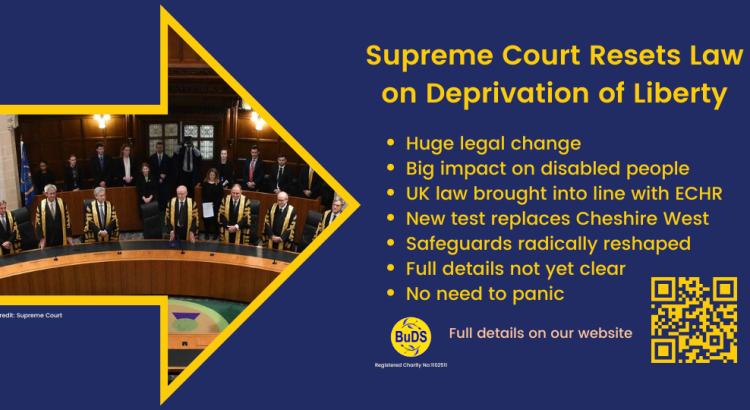
A blue and yellow BuDS infographic. There is a picture of the Supreme Court judges on the left. On the right is a text box reading "Huge legal change. Big impact on disabled people. UK law brought into line with ECHR. New test replaces Cheshire West. Safeguards radically reshaped. Full details not yet clear. No need to panic"

The Supreme Court’s Decision About ‘Deprivation of Liberty’

The Supreme Court has made a key decision about when people legally can be said to be ‘deprived of their liberty’. Deprivation of liberty means that a person isn’t free to do or go where they wish because an official body or law is stopping them. A person locked up in a prison is the most obvious example of someone deprived of their liberty. However, other examples might be disabled people held under the Mental Health Act, or a disabled person who lives in a locked care home.

BuDS wants disabled people to get fair, accurate and balanced information. Media coverage of this important court case is often misleading or incomplete, so we have written our own guide. We have used only legal sources to do so.

Read More
An image of two hospital beds beside each other, with a white curtain partially separating them.

BuDS’ Statement on DWP Work Coaches in Mental Health Hospitals

User led disability charity Buckinghamshire Disability Service (BuDS) has criticised as ‘frightening and counter-productive’ Liz Kendall MP’s statement to the BBC that DWP Work Coaches will be offering employment support to inpatients in mental health hospitals.

In a statement issued by the charity, the Chair of Trustees, Andrew Clark, said:

“As a charity, we feel well qualified to speak on this matter. Not only does BuDS include people with mental health conditions, many of whom have been inpatients, but we support many people with mental health issues into work through our Reach4Work project. That project was led until recently by a person with bipolar affective disorder – see https://buds.org.uk/buds-bipolar-and-me-my-journey-with-reach4work/

Read More
Ten and twenty pound notes spread out with coins on top of them

Card Only Payments May Discriminate Against Disabled People

Since the beginning of the Covid 19 pandemic, many shops, services, and businesses have started accepting only debit or credit card payments. This was originally done to reduce the small risk of passing on the virus by handling coins and notes.

However, many businesses quickly realised that not accepting cash has other advantages for them, such as cutting staff time, reducing theft risks, and reducing bank charges. For this reason, many shops and businesses have decided to stay ‘card only’ and not accept cash payments.

However, only accepting card payments may be discriminating against some disabled people who are unable to use cards because of their disability.

Read More