Three people sitting at a long desk working on laptops and desktop computers. There are papers and glasses of water also on the table.

About Reach4Work

Since 2010, BuDS has helped its volunteers towards work. Our Reach4Work project, created in 2018, codified and developed that help, creating a professional wrap-around service for our disabled volunteers who want to move into or closer to work.

BuDS is exceptionally successful at moving disabled jobseeker volunteers into or closer to work…

Read More
A green background with white text of "Easy read" in the top left corner, and a white silhouette of a person reading on the right hand side. Copyright Devon Partnership NHS Trust

About EasyRead

BuDS publishes some of our articles in EasyRead format. These articles are produced by our volunteers, and so our capacity is limited. Over time we will publish more EasyRead articles. Please be patient with us whilst we grow this project.

Read More
A white woman wearing headphones with a microphone looking into the camera and speaking

About The Enquiries Project

The BuDS Enquiries Team answers questions and queries from disabled people about a very wide range of issues. We try to fill the gaps left by other support services and helplines, so we often support disabled people with complex and difficult issues.

Getting Help From The Enquiries Project

Any disabled person in England can contact the Enquiries project for help. Parents, carers, and supporters can also contact us on behalf of a disabled person. We don’t have strict rules about who we can help: we will always do our best to support you and will let you know immediately if, for any reason, we can’t.

The Enquiries project is staffed entirely by volunteers, many of them disabled people themselves. We are often very busy and there may be a delay in getting back to you. We are sorry about this, but we can only do so much. The Enquiries project is not a crisis or emergency service.

Read More
An autistic school child in uniform looks at their teacher

About The BuDS SEND Transitions Service

The BuDS SEND Transitions Service is a three-year project funded by The Rothschild Foundation. The purpose of the SEND Transitions Service is to improve the experience of disabled children and young people moving through key transitions within school education and from school education into work or further/higher education. It will do this by: 

  • Investigating and reporting on services supporting disabled children and young people.
  • Assessing to what extent the needs of disabled children and young people are met by existing services.  
  • Proposing new and improved services to eliminate gaps and address deficiencies, including new BuDS and Reach4Work services.

The SEND Transitions Service is made up of workstreams from a number of BuDS projects, principally Fair4All Education and Reach4Work.

To learn more about the Reach4Work workstream, which is looking at disabled young people’s transition from education to employment, click here.

A learning disabled child smiling into the camera and holding up her hands, which are brightly painted with several colours

About Fair4All Education

The Fair4All Education project tackles the most important educational issues facing disabled children and young people, and their parents/carers, in Bucks.

The core of the Fair4All Education project is a ‘working community’ of professionals, parents, carers and disabled young people who are passionate about making a real difference. Working under the BuDS umbrella, the Fair4All Education team works together to define an agenda for action and plan how change will be made to happen.

Read More

About Fair4All Events

Disabled people are often excluded from outdoor public events. This is not because they do not want to attend these events, but because the way the event is organized and staged creates barriers that make it difficult or impossible for them to attend. BuDS’ free-to-use Fair4All event project helps event organisers remove those barriers and attract more disabled people to their events, making them more successful. There are over 40,000 disabled people in Buckinghamshire and over 100,000 families with a disabled member, so being more accessible can significantly boost an event’s popularity and attendance.

Event organisers are often not aware that they are creating barriers which are reducing the appeal of their events. Event management training and qualifications do not usually cover disabled accessibility and inclusion. Disabled people are so used to events not being accessible that most do not even try to attend, which means event organisers do not see the difficulties that disabled people face.

Read More

About IAG Covid-19

The IAG team works tirelessly to produce easy to read, fact-checked and reliable articles about issues relevant to disabled people. During the Covid-19 pandemic, these have included weekly risk posts which break down the latest case, hospitalisation, death and vaccination statistics; analyses of Government policy, and scientific updates about the coronavirus. To read these posts, please see below or visit our Facebook page using the button below:

If you would like to volunteer for the IAG team as a researcher or writer, please visit our volunteering page to find out more.

About The Fair4All Card

What is the Fair4All card? 1. Helps disabled people prove what adjustments they are legally entitled to. 2. Secure photo card for disabled people. 3. Explains how other people can help. 4. Simple statements means it can be used anywhere. 5. Doesn't list any disabilities or conditions.

What is the Fair4All Card Scheme?

The Fair4All Card is a secure, evidence based card that can be used by any disabled person to communicate the reasonable adjustments they need.

We created the scheme in August 2020 and have grown from offering around 12 reasonable adjustments to now offering over 40.

Find out more about the scheme below.

Read More
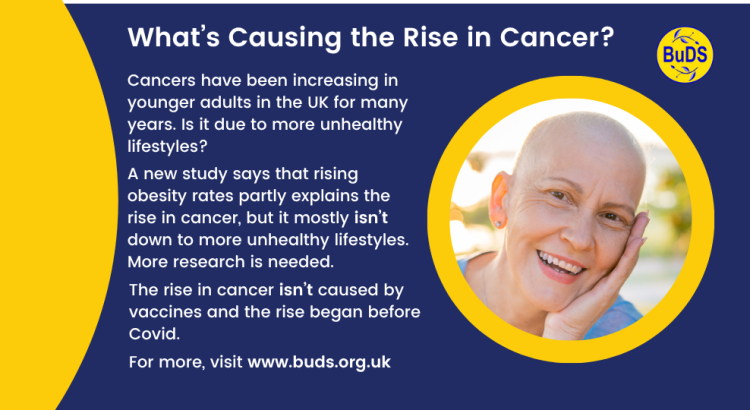
A blue and yellow infographic with the BuDS logo. the headline is "What's Causing the Rise in Cancers' next to a picture of a bald smiling woman cradling her head with her hand.

What’s Causing the Rise in Cancer?

New Study Gives Better Understanding

A major new research study has given scientists and doctors a better understanding of why cancers have been on the increase in the UK and many other countries for many years.

Cancers On The Rise

Cancers of all kinds have been increasing in adults in the UK and in other countries for many years. The reasons for this rise are unclear and there are many different theories among scientists and doctors.

It is well-known and proven that lifestyle risk factors like smoking, diet, alcohol use, exercise and obesity increase the risk of developing cancer. One theory is that people are simply becoming unhealthier, that is to say they are exposed to more of these lifestyle risk factors. If that is the case, say some scientists, growing un-healthiness might be a simple reason why cancer rates have gone up.

The Study

Published in the British Medical Journal for Oncology, the study tested the theory that growing un-healthiness explains why cancer rates are going up. The study looked specifically at younger (20 – 49 years old) adults in the UK between 2001 and 2019. It asked whether increases in lifestyle risk factors in these adults over this period explained why cancer rates increased in this group in that period. In other words, were these younger adults living less healthy lives over that period and that was why they were getting more cancers?

The researchers first worked out which cancers had become more common in adults aged 20 to 49 years old in the period from 2001 to 2019 – there were eleven. They then looked at how lifestyle risk factors were affecting this age group over the same period, and whether lifestyle risk factors affected more people or less. They then ran a statistical analysis to see if the rate of increase in cancers in matched up to the changes in lifestyle risk factors, taking into account other factors which might confuse the comparison.

The study showed that, apart from obesity, lifestyle risk factors were affecting the same number or fewer younger adults from 2001 to 2019. In other words, younger adults were not living un-healthier lives and exposing themselves to more lifestyle risks over that period, except that more of them were seriously overweight.

Cancers related to obesity did increase as expected. There was a clear link between more younger people being overweight and more younger adults getting cancer.

However, cancers not linked to obesity also increased in younger adults between 2001 to 2019, even though lifestyle risk factors affecting those adults did not increase in that period. This shows, according to the researchers, that changes in lifestyle risk factors do not explain most of the rise in cancers in younger adults between 2001 to 2019, although some of the rise was due to more younger adults being obese.

The study recommends that more research is done to explain why cancer rates are increasing in younger (20 – 49 years old) adults in the UK and in many other countries. The study also recommends that people should be encouraged and helped to avoid cancer lifestyle risk factors and in particular to maintain a healthy weight, to reduce their risk of developing cancer.

What Does This Mean For You?

Whatever your age, your lifestyle has a lot to do with your risk of developing cancer. This study has identified obesity, or being seriously overweight, as having a proven link to being at higher risk of developing cancer. So, keeping your weight in a healthy range is important. You can find resources to help you manage your weight below.

While this study has shown that there is not such a clear connection between other lifestyle risks and the causes of cancer, it is an established medical fact that reducing your lifestyle risks will reduce your risk of developing cancer. You can find resources to help you reduce your cancer risks below.

Covid & Cancer

This study looked at adults between 2001 and 2019, before the Covid pandemic, and therefore does not say anything about any link between Covid & cancer. Covid is still a new virus, and time is needed to assess and prove its effects. It will not be possible for some years to look back on the health records of people who caught Covid and show whether they experienced higher rates of cancer than people who did not catch Covid.

It is known that there are several biological means by which Covid might cause cancer, and it is not unusual for viruses to cause or be linked to cancers. For example, one study showed that Covid causes inflammation inside the body which can cause dormant cancers to become active and spread to other parts of the body. This study proved that cancer relapse rates were 1.5 times higher in cancer survivors who caught Covid compared to cancer survivors who did not catch Covid.

It is not yet possible to say that Covid causes cancer or affects cancer survival rates. However, avoiding Covid infections is a good thing to do in any case, as the virus is well-known to have many damaging impacts beyond the immediate acute symptoms.

Resources

Here are some resources and information which may help you. Click the button to visit them.
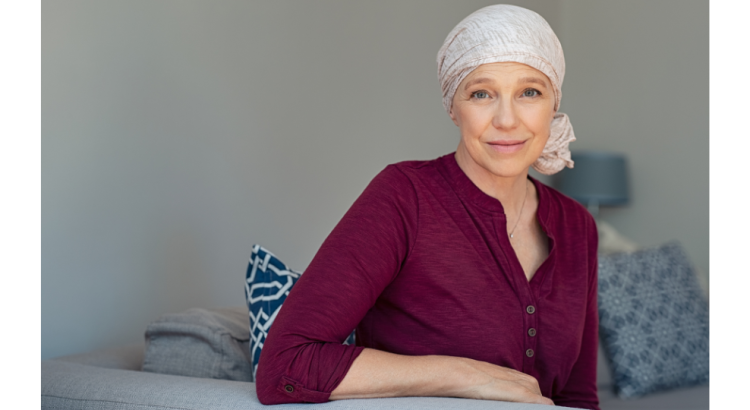
A caucasian woman wearing a red blouse and white headscarf looking gravely into the camera, against a neutral grey background

Covid & Cancer

There is now compelling medical evidence that Covid-19 infections can reactivate dormant cancer cells, and trigger the growth of secondary cancers (metastatic progression). In studies, cancer survivors who contracted Covid had a statistically significant higher risk of cancer-related deaths compared to uninfected cancer survivors.

This is such an important issue that BuDS has decided to run an awareness campaign over the autumn and winter. The aim of the campaign will be to warn cancer survivors of the very real additional danger that Covid poses to them.

We have worked hard to give you accurate information. However, you should always speak to your own GP, oncologist, or cancer clinic to get personal medical advice. We are not doctors, and we cannot give you medical advice.

Read More