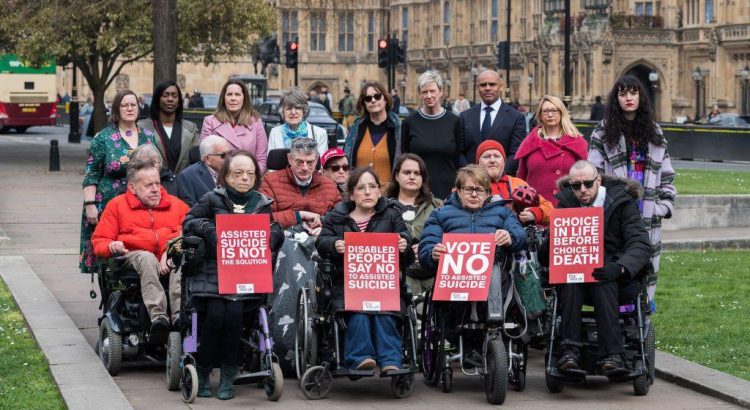
Please don’t re-introduce an assisted dying Bill into Parliament. As disabled people from across England, including many with degenerative and terminal conditions, we urge you to address this highly complex and controversial issue in a mature and measured way. Rushing ahead with badly-drafted and dangerous Bills is not the way to help disabled and dying people.
You will know that previous attempts to legislate in this area by Private Members Bill have not succeeded. The Manx Bill in the Tynwald has been ruled incompatible with the Human Rights Act, the Bill in the Scottish Parliament was rejected by MSPs, and Kim Leadbeater’s Westminster Bill died an inevitable death in the Lords. We say inevitable because, as all Parliamentarians will know, Private Members Bills have limited time and cannot successfully deliver large, complex and difficult changes to the law. At 59 clauses and 8 schedules, and an additional 79 amendments tabled by its own sponsor in the Lords, the Leadbeater Bill demonstrated the truth of that statement.
As a community of disabled people, we have always called for a proper national conversation about assisted dying, and its relationship to medically-assisted suicide, before any legislation is tabled. It is an extraordinarily complex and emotive issue needing mature and well-informed consideration. There are many points of views and expert opinions which need to be sensibly balanced.
We feel that a neutral commission or enquiry needs to lead this national conversation and to draft any legislation which, after proper consideration, is found necessary. A Government Bill can then be professionally and competently drafted to implement a scheme which can command the support of key stakeholders and which, as a result, can pass more smoothly through both Houses. Other European countries who have introduced assisted dying schemes have all followed this model, with consultation and implementation timetables ranging from 4 to 12 years.
If you have been successful in the ballot for Private Members Bills, we therefore urge you to not introduce a further Assisted Dying Bill. The best interests of dying people, and of the whole country, are now served by a mature and informed process resulting, if that is thought necessary, in a government Bill setting out a workable scheme around which there is a strong measure of agreement.
Going ahead with a rushed Private Members Bill now will not help dying people, because no Private Members Bill can actually deliver the complex and lengthy legislation needed. The Bill, if it is passed at Second Reading, will simply become enmeshed in controversy and complications for months before it inevitably fails again, tying up precious Parliamentary time and MP’s energy, which could be far better used. It is unlikely that Government will be able to give a future PMB the extraordinary help with timing and procedure which Kim Leadbeater’s Bill enjoyed. There is also real doubt whether the Commons has the appetite for such a Bill. Kim Leadbeater’s Bill did not enjoy an absolute majority at Third Reading and the number of MPs willing to support related EDMs has steadily fallen.
Going ahead with an assisted dying Bill to introduce, in stark terms, institutionalised medically-assisted suicide for NHS patients is also fraught with presentational problems. Disabled people’s views and interests have been savagely ignored by the Bill’s sponsors to date; going ahead with another Bill without even the courtesy of consulting disabled people’s organisations would be seen as another direct attack on disabled people, helping cement an anti-disabled narrative which is doing the Government no favours. The public would also wonder why, with so many critical and urgent issues facing the country, MPs were spending so much time on an assisted dying scheme for NHS patients: a policy which has never appeared in a manifesto and which 96% of the public have said is not a priority for them.
We close this letter by repeating that the best way to help dying people now is not to introduce another Private Members Bill on assisted dying. It is to encourage the establishment of a mature and informed national conversation about assisted dying which can generate a scheme, and a Government Bill, which commands majority support and which can be cleanly and effectively delivered.
Lobbyists and a few MPs are saying that they want to introduce another Assisted Dying or Assisted Suicide Bill into Parliament, despite the failure of the last Bill. BuDS and other disabled-led organisations oppose this. Read on for more information.
How Could We Get Another Bill?
Lobbying organisations who want to legalise medically-assisted suicide, and a few MPs who support them, have said that they want to introduce another Assisted Dying or Assisted Suicide Bill into the next session of Parliament.
Parliament sessions are rather like school terms. Most Bills which do not become law in one session fall, or cease to exist, at the end of that session. This is what happened to the Terminally Ill Adults (End of Life) Bill, the Private Members Bill (PMB) introduced in the last session of Parliament by Kim Leadbeater MP.
The current session of Parliament began on 13 May 2026. The Government did not announce in the King’s Speech that they would be introducing a Government bill to introduce assisted suicide in this session, so that seems to be ruled out. However, if an MP who wins the ballot to introduce a Private Members Bill in this session choose to introduce a bill about assisted suicide, the whole cycle could begin again.
The ballot for MPs to win the opportunity to introduce a PMB will be held on 21 May 2026. Between 450 to 500 MPS are eligible for the ballot and there are only 20 places, of which realistically only the top five have a good chance of getting a Bill through to law. So, MPs have around a 1 in 95 chance of being picked and then getting a Bill through.
29 MPs have said that they will introduce an assisted suicide bill if they are successful in the ballot. This means that there is about a 1 in 4 chance that one of the top five MPs in the Private Member’s Bill ballot will be an MP who has said they will introduce a new assisted suicide bill. However, of course, we cannot be sure that, even if picked, those MPs will follow-through on their promise. A lot has happened since February 2026, not least the local council elections and the current Labour leadership campaign.
Do We Need Another Bill?
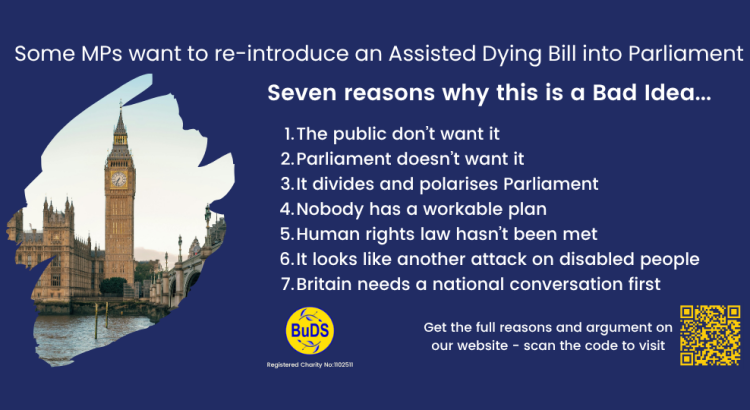
BuDS, and other disabled-led organisations, are very firmly of the opinion that another assisted dying or assisted suicide Bill is NOT needed. We say this for seven main reasons:
1. The Public Don’t Want It
Reliable polling by Statistica and More in Common about the issues most important to British people shows that the top ten issues are: the economy, immigration, health & the NHS, defence & national security, taxation, housing, crime, environment/climate, education, and the cost of living. Legalising assisted dying or assisted suicide is not identified by any poll as an important issue for the British public. When asked directly if assisted dying is an important issue for the country at the moment, 96% of people told a More in Common poll that it was not.
Assisted dying is a hugely complex, difficult and complex issue. The Prime Minister and Government put a huge amount of time, money and effort into supporting Kim Leadbeater’s former Bill, but failed to produce a workable piece of legislation which professionals said they could work with and which had broad popular support. The next Bill will face the same problems, complexities and resistance as the first Bill, using up Ministerial time, officials’ time and a huge amount of Parliamentary time.
If politicians pursue a subject like assisted suicide which the vast majority of people don’t think is important, it will look like they are wasting their time, and Parliament’s time, on a ‘hobby-horse issue’ which only lobbyists and die-hard supporters care about. With so many huge and important issues facing the country, politicians risk being seen as out of touch and uninterested in the issues which face ordinary people.
2. Parliament Doesn’t Want It
The lobbyists backing assisted suicide have said incessantly that ‘the House of Commons backed Kim Leadbeater’s Bill’, that it has ‘democratic legitimacy’, and that the House of Lords should yield to the views of the elected Commons.
All these claims are false. The reality, which the lobbyists refuse to admit, is that a minority of MPs voted for Kim Leadbeater’s Bill at Third Reading in the Commons, the last Commons vote held. A majority of MPs in the Commons is 326, but only 314 voted for the Bill. This means that Kim Leadbeater’s Bill cannot be said to have the backing of the House of Commons, only of a minority of MPs.
Furthermore, Kim Leadbeater’s Bill was passed by the Commons at Third Reading by a majority of only 12 MPs. It cannot be said to have ‘democratic legitimacy’ on such a close minority vote. It is worth remembering that the Assisted Suicide Bill introduced into the Scottish Parliament was roundly rejected by MSPs.
Support in Parliament for assisted dying or suicide, as measured by votes, signatures of motions, and positive speeches, has fallen significantly since 2024. Months of debating and the testimony of experts has perhaps shown MPs that the subject is far more difficult, complex and controversial than it first appeared. The loud slogans of the lobbyists (who have spent around £5 million on adverts, public relations and campaigns) have been proven empty and simplistic.
Another assisted suicide bill therefore will struggle to make progress in Parliament. Kim Leadbeater’s Bill benefited from the strong personal support of the Prime Minister, Kier Starmer, who made support for the Bill something of a loyalty issue for Labour backbenchers. The Government also gave official support to the Bill and, through the Whips, helped it through the House with considerable extra time. A future Bill is unlikely to enjoy these privileges, even if Mr Starmer remains as PM.
3. It Will Polarise and Split Parliament and Politics
Assisted dying or suicide is an issue about which many people have strong views. It is an issue which divides opinion. The evidence from Kim Leadbeater’s Bill is that assisted suicide, especially a scheme which legalises the medical euthanasia of NHS patients, fiercely divided and polarised Parliament and political parties, especially the Labour party. Another Bill will reignite all the arguments, debates and disagreements of the past.
Many days of Parliamentary time, and many hours of media coverage, will be dominated by political disagreement and conflict on a matter of policy which the public has clearly said is not important to them. Parliament has much more important causes on which to spend its limited time and energy.
At a time when there are huge critical issues which do divide the country, when people are looking to politicians and politics for leadership and unity in the national interest, it would be appallingly bad optics for Westminster to spend days and weeks quarrelling over assisted suicide for NHS patients, a policy which has never appeared on any party manifesto or featured in an election campaign.
4. Nobody Has A Workable Plan
Kim Leadbeater’s Bill when first introduced into the Commons in November 2024 set out a scheme where High Court judges, sitting with experts, would individually scrutinise and approve a tiny number of assisted suicides. When the Bill went into Commons Committee, this entire scheme was swept away and another scheme was set out in the Bill, where vaguely defined ‘expert panels’ would check only whether the right procedure had been followed in assisted suicides. By the time the Bill got to the Lords, the scheme had become a full-blown medically-assisted suicide service for thousands of people, provided by the NHS for NHS patients and part of the NHS bureaucracy.
Here’s a table showing what various organisations thought about the Bill:
Organisation
Opinion
Royal College of Psychiatrists
“cannot support this bill”
Royal College of Physicians
“not in line with good clinical … practice.”
Disability Rights UK
“one of the most damaging pieces of legislation in recent times”
British Geriatrics Society
“It does not include adequate safeguards”
MIND
“It’s really clear the safeguards … are not adequate”
BEAT and other eating disorders groups
“people with eating disorders … are at grave risk”
Liberty
“For the law to protect everyone, it needs to be fixed and certain-but this Bill is anything but”
Prof Sir Louis Appleby, Government suicide prevention adviser
“very dangerous”
Lords Delegated Powers Committee
“insufficient detail … for proper Parliamentary Committee scrutiny”
Standing Together Against Domestic Abuse
Are the safeguards adequate? “No”.
National Down Syndrome Policy Group
“Should we be helping you to be less of a burden to the state?’ That is what it looks like to a lot of people with Down syndrome.”
King’s College London’s Complex Life and Death Decisions Group
“not fit for purpose”
Sir James Munby, former president of family division of the High Court
“lamentably short of providing adequate safeguards”
Association for Palliative Medicine
“The APM opposes any change in the law … 84.3% [of members] oppose a change in the law.”
Gold Standards Framework Centre
“lack of effective safeguards”
Simon Stevens, ex-NHS CEO
“Evident and substantial risk”
British Association of Social Workers
[Asked about the safeguards:] “Not enough”
OSJCT (Britain’s 2nd biggest not-for-profit care provider)
“Risks to older, vulnerable people … are substantial”
Table source: Dan Hitchins
Any future Bill would have to put forward either one of the three former plans, all of which have been demonstrated to be unworkable, or come up with a fourth option created in the last few weeks, without any public or expert consultation. Such a fourth plan would be as doomed as the other three.
5. The Bill doesn’t meet Basic Human Rights Requirements
Before a Bill is given Royal Assent, a Secretary of State on behalf of the Government must formally certify that it meets the UK’s human rights obligations under common law, the Human Rights Act, and the European Convention on Human Rights. While neither the Westminster nor Holyrood Bills reached that stage, a similar assisted suicide Bill did pass through the Tynwald, the Isle of Man’s tiny Parliament. However, the Lord Chancellor was unable to certify that the Bill met basic human rights requirements. Given the similarity of the Bills, that decision means that the Westminster and Holyrood Bills would also fail to meet human rights requirements. A complete redraft by highly skilled lawyers would be needed.
6. It Looks Like Another Attack on Disabled People
Every single disabled-led organisation in the UK, representing millions of disabled people, has rejected the Westminster and Holyrood Bills. Disabled people have vehemently protested about the Bills, and disabled MPs and Peers inside Parliament have led the resistance to them. The opinions of disabled people matter. Only disabled people are eligible for euthanasia. The lives of disabled people are most affected by any assisted dying or assisted suicide bill. Any scheme brought forward should command the confidence and support of disabled people as a first, basic, quality measure.
Yet disabled people and their organisations have not even been consulted. Bringing another Bill back without any attempt to address the real concerns of disabled people looks like another attack on disabled people, and brings the Government and Parliament into disrepute.
7. There Still Hasn’t Been A National Conversation about Assisted Suicide
As a society, Britain has worked for many decades to prevent suicide. Changing the law so that people can encourage and support people to take their own life is a huge change in culture and attitude. That change, and its implications, needs to be properly explored and discussed before any legislation is introduced, if that’s even necessary.
BuDS has long called for a national conversation on assisted suicide, led by a Royal Commission, Select Committee enquiry or similar. Proper research can be commissioned to establish the need, if any, for assisted suicide. Doctors and other professionals can be properly consulted. The public can learn more about the various options and reach an informed view for themselves. Then, at the conclusion of this national conversation, the Government can decide whether to legislate to change the law, in full knowledge of the ideas and options which are safe and command support, and those which do not.
It is futile, time-wasting and divisive to keep allowing single-issue lobby groups, and their celebrity supporters, to keep hijacking Parliament with emotional, unworkable and dangerous Bills. Dying people deserve a grown-up, mature conversation and measured response.
BuDS Disability Service has welcomed the Parliamentary failure of the Terminally Ill Adults (End of Life) Bill today, Friday 24 April. This Bill is commonly known as the Assisted Dying or Assisted Suicide Bill. This failure at Westminster marked the defeat of all the Suicide Bills attempted to be rushed through British parliaments by lobbyists in the last two years.
Welcoming the Parliamentary failure, BuDS said:
“The failure of the Bill is good news for dying people, for the NHS and for Britain. We say this for two main reasons:
This Bill would have done nothing to address the humanitarian concerns that many people have about end-of-life care. It was a lobbyist Bill designed to introduce suicide on demand for NHS patients, something which no political party or politician had ever even mentioned before this Bill was introduced.
The Bill was dangerous because it did not protect the basic human rights of British people. This was said from the start by disability and human rights groups like BuDS but was dramatically proven when the Lord Chancellor had to prevent a similar Bill, in the Isle of Man Parliament, from becoming law on these exact grounds”.
Much has been said about how this Bill has been ‘blocked’ by unscrupulous Parliamentary tactics, especially by ‘unelected Lords’. The reality is rather different. This Bill was not Government legislation, but a Private Members Bill (PMB). PMBs cannot be used to make complex and controversial legal reforms because they do not have enough Parliamentary time, even in the best of circumstances, to make such broad changes. The Terminally Ill Adults Bill was doomed to fail from the start by the incompetence of its sponsors and multimillionaire lobbyist backers, not by any Parliamentary blocking.
The passage of this Bill through Parliament has proved that the welfare of dying people and the protection of vulnerable people cannot be left to opaquely-funded, multimillionaire lobbying groups, especially those ideologically committed to suicide and euthanasia. A properly informed national conversation about end-of-life care and assisted suicide must happen before there is any future attempt at legislation. A Royal Commission or similar independent official body must now look at all the issues, consult widely, gather objective evidence and make recommendations. BuDS and other disabled-led organisations are ready to play their part in that conversation.
More great news, as the Assisted Suicide Bill in the Westminster Parliament also falls, joining the Scottish Bill which was voted down last week.
The multimillionaire lobbyists behind these Bills are spreading an untrue story that the Westminster Bill failed because it was ‘talked out’ by opponents in the House of Lords. This story is objectively untrue for the following reasons.
BuDS roundly condemns the unprecedented and extraordinary threat to use the Parliament Act to bypass the House of Lords and force the Assisted Dying/Suicide Bill through Parliament. Such important legislation must not be railroaded in this way. We call on Kim Leadbeater MP and Lord Falconer, the sponsors of this Bill, to abandon this outrageous and unworkable idea.
BuDS also condemns the underhand methods used to bring this Bill before Parliament and prevent a proper national debate about the difficult and sensitive issue of assisted dying/suicide.
We call on politicians of all parties to recognise this Bill has reached the end of its life, and to step back so that a careful and well-informed national conversation about assisted dying/suicide can take place in the future.
We encourage disabled people and their families/carers to keep in touch with their local constituency MP. There are many key issues affecting disabled people at the minute, such as the proposed benefit cuts, the changes to the NHS and social care, and, of course, the Assisted Dying Bill currently going through Parliament. It is really important that constituency MPs know how disabled people feel about these changes. Disabled people make up about a fifth of all voters in the UK, so our opinions matter.
The table below gives you the names, constituencies, and websites of MPs in and around Buckinghamshire. The button below the table will take you to the Parliament website, where you can find details of your MP if they are not listed.
If you would like any help contacting your MP, or would like BuDS to get involved in anything that matters to you, please use the contact form at the end of this page.
BuDS has written to Sir Lindsay Hoyle MP, Speaker of the House of Commons, to ask him to use his powers to clarify the title of Kim Leadbeater’s Assisted Dying Bill. We feel the present title is misleading and argumentative, in breach of Parliamentary rules.
BuDS, a user-led disability charity which advocates for disability rights, has called on Kim Leadbeater MP to withdraw her Terminally Ill Adults (End of Life) Bill to allow the establishment of a Royal Commission or similar to look into all the issues around assisted suicide, to be followed by a Government Bill based on the Commission’s recommendations.
Kim Leadbeater MP has tabled a Private Members Bill in the House of Commons concerning assisted suicide. The text of the Bill has not been published so all we know about it so far is the short and long titles as set out on the House of Commons website[1]. What do they tell us?