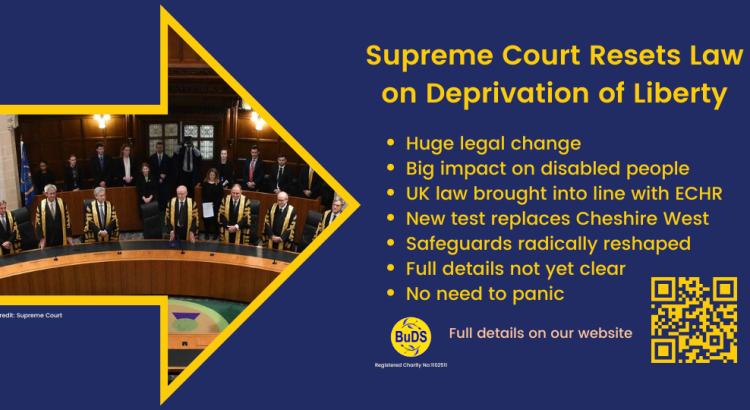
A blue and yellow BuDS infographic. There is a picture of the Supreme Court judges on the left. On the right is a text box reading "Huge legal change. Big impact on disabled people. UK law brought into line with ECHR. New test replaces Cheshire West. Safeguards radically reshaped. Full details not yet clear. No need to panic"

The Supreme Court’s Decision About ‘Deprivation of Liberty’

The Supreme Court has made a key decision about when people legally can be said to be ‘deprived of their liberty’. Deprivation of liberty means that a person isn’t free to do or go where they wish because an official body or law is stopping them. A person locked up in a prison is the most obvious example of someone deprived of their liberty. However, other examples might be disabled people held under the Mental Health Act, or a disabled person who lives in a locked care home.

BuDS wants disabled people to get fair, accurate and balanced information. Media coverage of this important court case is often misleading or incomplete, so we have written our own guide. We have used only legal sources to do so.

Read More


The statue of Justice atop the Old Bailey courthouse in London.

What Is The Equality Act 2010?

Overview

People are legally protected from discrimination in the workplace and in larger society by the Equality Act of 2010. 

The Equality Act 2010 replaced over 116 separate pieces of legislation with a simpler single piece of legislation. The 9 main pieces of legislation that were merged to create the new Act are: 

  • The Equal Pay Act 1970 
  • The Sex Discrimination Act 1975 
  • The Race Relations Act 1976 
  • The Disability Discrimination Act 1995 
  • The Employment Equality (Religion or Belief) Regulations 2003
  • The Employment Equality (Sexual Orientation) Regulations 2003 
  • The Employment Equality (Age) Regulations 2006 
  • The Equality Act 2006, Part 2 
  • The Equality Act (Sexual Orientation) Regulations 2007 
Read More
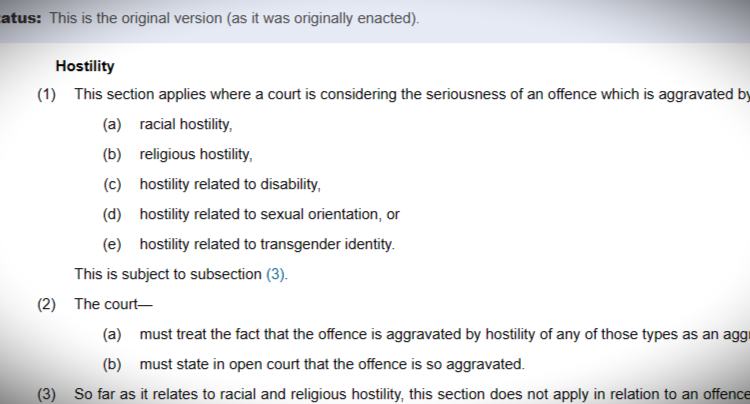
A screenshot of s. 66 of the Sentencing Act 2020

Proving An Offence Was Aggravated Within The Meaning Of s. 66 Of The Sentencing Act 2020

Crown Prosecution Service (CPS) guidance about whether an offence was aggravated within the meaning of s.66 of the Sentencing Act 2020 can be found below. This article was written by Olivia Hopwood, a law student, and verified and approved by a leading criminal law solicitor on behalf of BuDS. It is written mainly for professionals and practitioners, and some may find the language difficult to follow. If you need any help with this article, please contact us.

This article is intended as a supplement to a main article – read it here.

Read More
A screenshot of s. 66 of the Sentencing Act 2020

S. 66 Sentencing Act 2020 – Case Law

Case law relating to s. 66 of the Sentencing Act 2020 can be read below. This article was written by Olivia Hopwood, a law student, and verified and approved by a leading criminal law solicitor on behalf of BuDS. It is written mainly for professionals and practitioners, and some may find the language difficult to follow. If you need any help with this article, please contact us.

This article is intended as a supplement to a main article – read it here.

Read More