

Politicians of all political parties are talking about cutting ‘welfare’ (correctly known as social security) to pay for higher defence costs. BuDS has studied this issue and come up with another way to look at it.
This article is a ‘thought experiment’, not a detailed economic plan. While all the data used is from official Government sources, and the calculations (methodology) is sound, we are not trying to set out a detailed plan for Government. What we are doing is helping people understand the reality of a complicated situation, and to look at it in another way from that presented in the media.
Spending More on Defence
The Government has committed to spending 3.5% of Britain’s Gross Domestic Product (GDP) on defence by 2035. This would be about £95 to £100 billion per year. Britain currently spends 2.5% of GDP on defence, or around £60 billion per year. Many politicians feel that the international situation means that Britain needs to spend more money on defence. Recently, the Defence Secretary and Minister for the Armed Forces have both resigned because they felt Britain wasn’t spending enough on defence.
For Britain to meet its target of spending 3.5% of GDP per year on defence, the Government would need to spend an additional £35 to £40 billion per year. Some politicians are saying that Britain could afford to spend more on defence if we cut the amount spent on ‘welfare’. By ‘welfare’, politicians typically mean social security, the money spent to make sure people have safe and secure lives, such as pensions and benefits.
Social Security (‘Welfare’) Spending
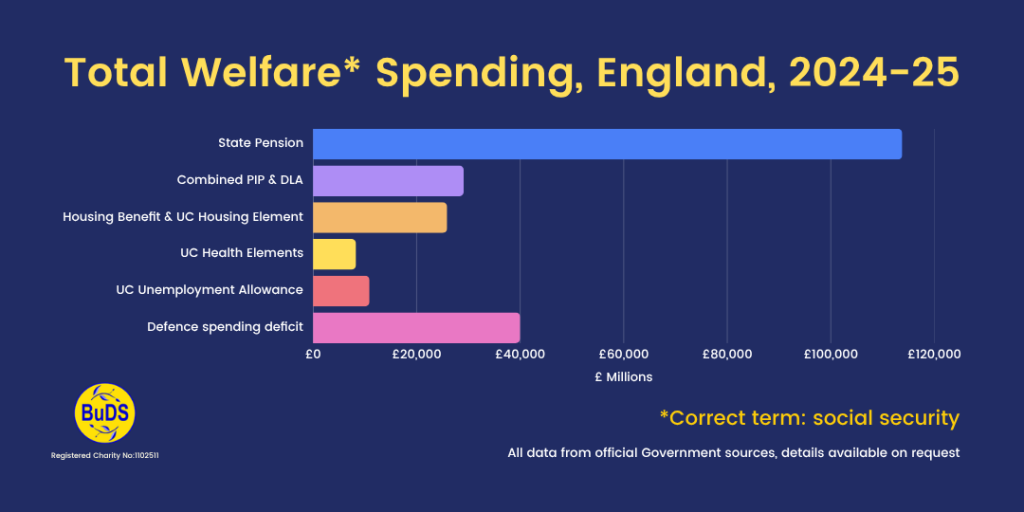
As shown in Figure 1, Britain spends £188 billion per year on five main social security benefits in England. This is more than three times greater than defence spending per year in the UK, so you can see why politicians might think ‘welfare’ could be cut to pay for defence.
However, of the £188 billion spent in England, 60% – £113.8 billion – is spent on the state pension. Cutting pensions so that pensioners received less money, or no pension at all, is not an idea favoured by many politicians. The most that politicians would likely consider is reducing the amount that pensions rise every year, and even this is highly controversial. If pensions cannot be touched, then ‘cutting welfare’ must mean cutting social security benefits for working age and disabled people.
Figure 1 shows that five of the biggest social security benefits in England cost around £74 billion per annum. (The defence spending deficit of £40 billion is also shown for comparison). So, could these ‘welfare benefits’ be cut to pay for defence?
Cutting ‘Welfare’ Benefits by Half
Cutting these five big social security benefits for working-age and disabled people in England by half would raise around £37 billion pounds, close to the sum needed for defence. What would be the practical consequences of making such cuts?
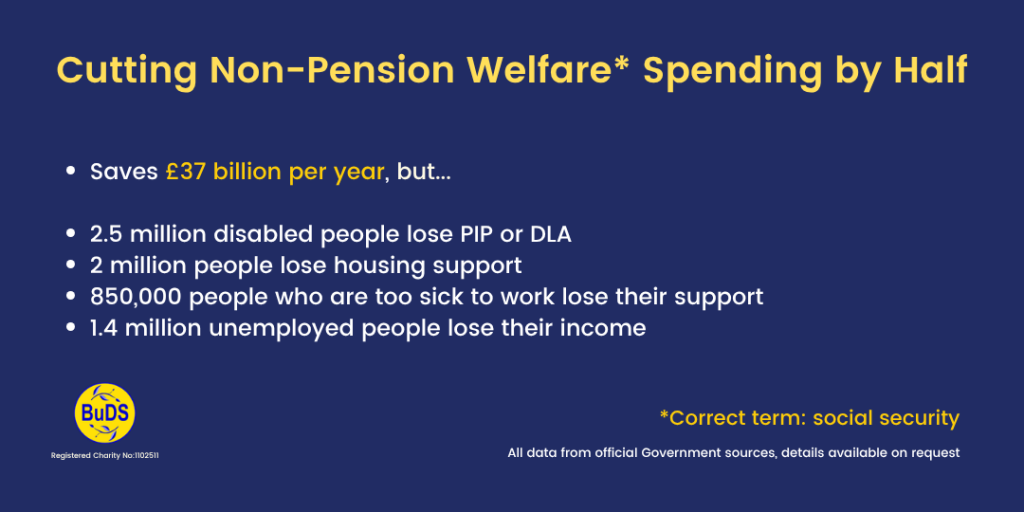
Figure 2 shows that this sort of cut would hit disabled, ill and unemployed people hardest. Around 6.8 million people would lose all or most of their income from benefits, including 2.5 million disabled adults and children, who would lose DLA or PIP. 2 million of the poorest people would lose the housing benefit on which they rely to pay their rent. 850,000 people who the DWP accept are too sick to work would lose their sickness benefits, and 1.4 million unemployed people would lose their ‘dole’ or unemployment benefit. Overall, nearly 7 million people, including millions of disabled people, would be be forced into acute crisis, losing their homes and their ability to pay their bills.
Crisis Support, or Social Unrest?
Forcing nearly 7 million people into acute need would be the biggest social crisis in England since WW2, possibly since the 19th century. Starving, homeless, and desperate people will seek help wherever they can, from councils, the NHS and the voluntary sector. The Government then has the choice to turn these people away, or to provide them with emergency crisis help.
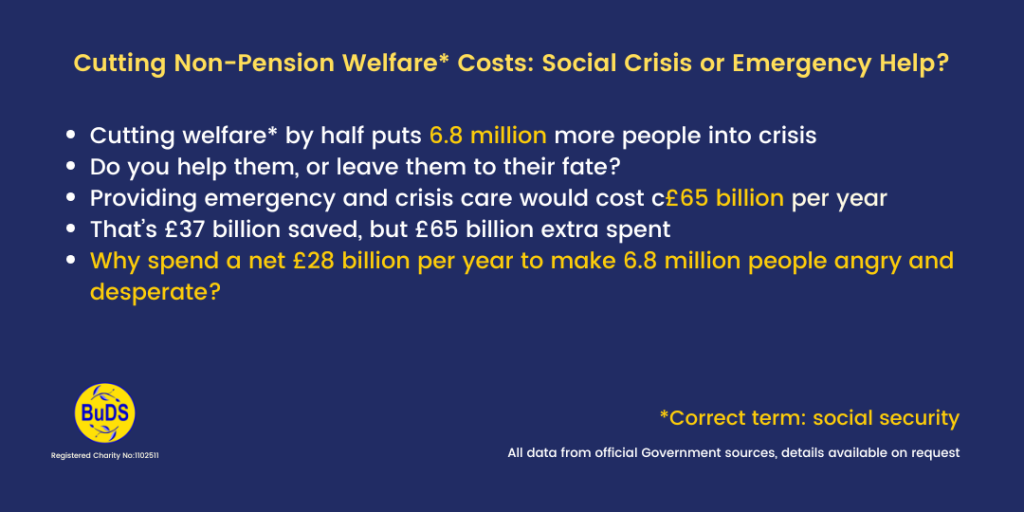
Figure 3 shows that providing crisis and emergency support to people is always more expensive than helping them to live independently. Using the lowest of the Government’s own figures, we estimate that providing basic crisis support to the 6.8 million people who have lost social security (‘welfare’) benefits would cost around £65 billion per year. In reality, the cost would probably be significantly higher, as we have not added the extra costs to the police and criminal justice system in preventing or addressing unrest and riots.
The True Balance
Our figures show that it is certainly possible for the Government to cut social security benefits to save £37 billion for defence. But while the DWP might save £37 million with one hand, councils and the NHS would spend £65 billion with the other hand, supporting the millions of people who had lost their social security. Overall, HM Treasury is down at least £28 billion per annum. Ironically, defence might have to be cut to pay for the costs of supporting all the people made homeless, desperate and angry by the cuts to raise money for defence.
The bottom line is that cutting social security simply shifts costs from one budget to another. Supporting people in crisis is significantly more expensive than helping them have social security and live independently. That’s why we have a benefits system in the first place, to save money. Government cannot simply ‘cut welfare’ to find money for defence. It is economical ignorance to think this is possible.
Another Way
While BuDS are not economists, HM Treasury and the OBR publish data about how much money might be raised from changing the tax and duty system. As Figure 4 shows, £23 billion per year could be raised from wealth, business, and windfall taxes, and from reducing tax avoidance. Given that wealthy people and businesses benefit from the defence of the UK just as much as ordinary people, we think Government should be expecting the wealthy and prosperous to do their bit for the country before asking the poorest to live even more frugally.
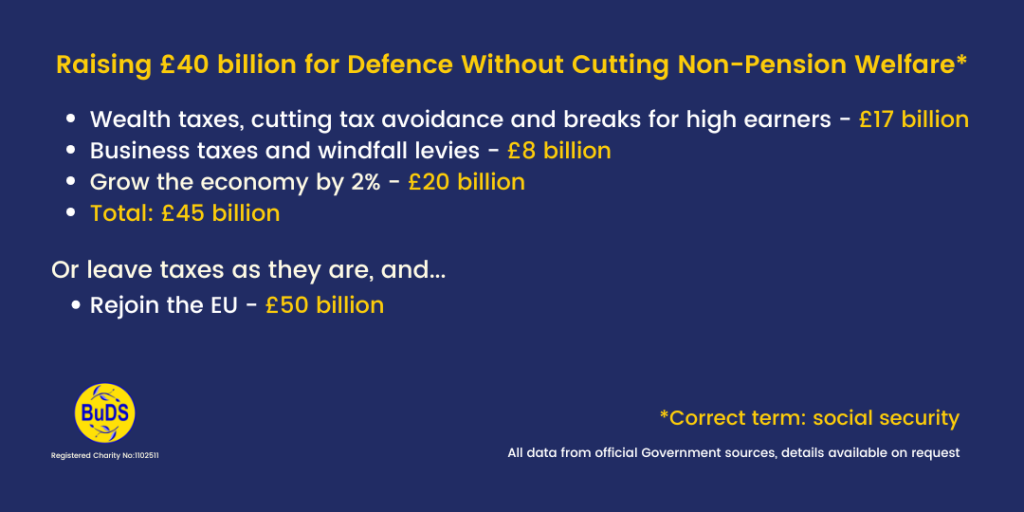
However, by far the best way to raise more money for defence is to grow the British economy. Every 1% rise in gross domestic product raises an additional £10 billion in taxes and duties – without changing any taxes. BuDS calls on politicians to make Britain more successful, rather than wringing cash out of the poorest and most vulnerable people.
BuDS has always been studiously neutral about Britain’s membership of the European Union, and it is not for us to advise politicians on this contentious issue. However, the facts are plain. The Government’s own estimates, and those of nearly all credible economists, is that rejoining the EU will increase British GDP by at least 5% over a period of time. This alone would raise billions for defence, without any need to raise taxes or cut social security. In view of these facts, politicians need to explain their thinking on this matter.
The BuDS View
BuDS is an evidence-led charity. Having looked at the evidence, it is obvious that cutting social security (‘welfare’) benefits will end up costing the country more than it saves and will also stir up considerable division and social unrest. Government cannot simply ‘cut welfare’ to find money for defence. It is economical ignorance to think this is possible. Morally, a policy that deliberately disadvantages the most vulnerable in society while protecting the interests of the wealthy and corporations cannot be defended.
If politicians want more money for defence, that money most effectively can be found by raising taxes on the wealthy, along with improving Britain’s overall success and prosperity. An obvious way to improve Britain’s prosperity is to rejoin the EU.
BuDS isn’t a party-political organisation, and we are scrupulously neutral about political party issues. But we do take an interest in political issues which affect disabled people, and we do campaign and lobby about those political issues, as long as that doesn’t give the impression that we support or oppose any particular political party or parties. This approach is actively encouraged by the Charity Commission under charity law. This article should be read in this light.