
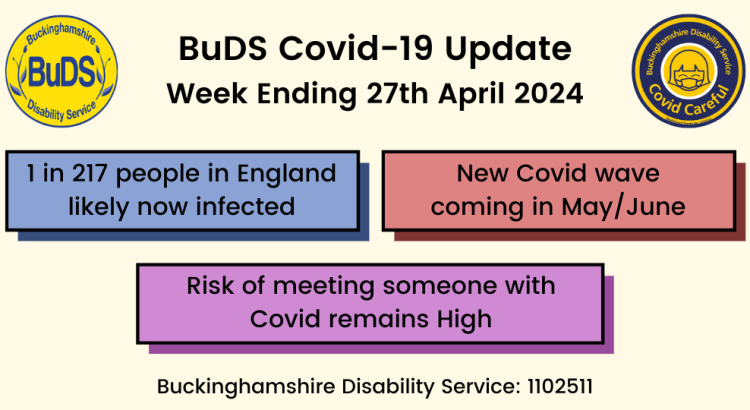
A new Covid wave is probably coming in England. That’s our tentative view after looking at all the available data. At the moment, Covid levels appear to be remaining roughly the same, and the risk of meeting a Covid-infected person in your everyday life remains HIGH. Everyone still needs to continue to take precautions to avoid catching Covid, because Covid has not gone away. Around 1 in 200 people in England are infected with Covid, as of 21 April. See below for more on how we calculated this.
As an example of the current risk of catching Covid, a typical busy supermarket will have around 2 infected people breathing out virus for you to breathe in. In a full single decker bus, there will probably be 1 infected person breathing out virus. In a busy train carriage, there will be around 1 infected person breathing out virus. In these circumstances, unless you wear a respiratory filter mask, you have a high risk of catching Covid. Cloth and surgical masks do not protect you.
The Government is ruthlessly suppressing Covid-19 data, but there are still a few indicators. Having looked at the Notification of Infectious Diseases (NOIDS) report dated 21 April, plus UKHSA and NHS data about cases and hospitalisations, we feel able to be able to make an informed estimate of current Covid-19 infection levels in England. We feel that our estimate of roughly 1 in 200 people in England with Covid as of 21 April is a credible assessment of the current risk for the purposes of giving disabled and clinically vulnerable people information to manage their own risk. If you would like to know more about our methodology, please contact us.
The JN.1 Covid variant has dominated England for the last few months, and caused the gigantic winter peak. Most people’s temporary acquired immunity to JN.1 is now starting to weaken and disappear. At the same time, some sub-variants of JN.1 (called the FLiRT variants) and a new Omicron BA.2 variant (BA.2.86) are growing rapidly. BuDS shares the view of many commentators that infection levels across England will start to rise in the next few weeks. This combination of reduced acquired immunity and new variants means that everyone, even people who have caught Covid recently, will probably catch it again this summer unless they take precautions.
BuDS is predicting a probable major wave of Covid infections in late May and June. School, college, and university exams will provide a perfect superspreader environment for the virus. It is possible that Covid infection levels will remain high through the summer and early autumn as well. This is what happened in Summer 2022 in very similar circumstances, when BA.5 replaced BA.2. Levels of up-to-date vaccination are much lower than they were in 2022, so it is possible that some people will become more seriously ill than in 2022.
Remember, Covid is airborne: the virus spreads mainly through the air. An infected person in an unventilated place creates a large invisible cloud of virus which hangs in the air like smoke, ready for you to breathe in. Because the NHS has not improved the ventilation in its buildings, hospitals and GP practices are extremely dangerous places to catch Covid. NHS staff are now required to work even if they have Covid and there are no Covid precautions in place at most NHS buildings. Do avoid hospitals and GP practices unless your visit is essential and wear a tight-fitted filter mask (FFP2 or FFP3) or respirator all the time if you have to go there.
BuDS strongly recommends that disabled and clinically vulnerable people avoid public transport and indoor spaces unless they are wearing a filter mask (FFP2/3) or respirator. For more advice on how to avoid catching Covid, use this link.
To understand more about our Covid risk levels and what they mean, use this link.
For more Covid information and help, please contact BuDS and we will be happy to help.