
Last week, we reported the end of Omicron BA.2 wave that has caused so much illness and death in the UK in May. This week, we are sadly reporting the START of the NEXT WAVE, made up of new Omicron variants including BA.5.
The number of infected people is now going up all over the UK. Here in Bucks, we now have 1 in every 61 people infected with Covid-19. This means the risk of catching Covid when out and about in Bucks continues to be VERY HIGH.
With cases on the upturn, BuDS urges everyone to be Covid-Cautious and keep taking sensible precautions against catching Covid-19. To repeat: the chances of coming across a person with Covid in your everyday life is VERY HIGH. Wear a FFP2 or N95 filter mask in public places, breathe clean air, avoid crowds and busy places, work from home if you can, and protect your older and vulnerable relatives and friends. BuDS will continue to update you every week.
Key Facts About The Next Wave
The beginning of the next Covid-19 wave has now arrived, with cases going up across the UK. This wave is made up of new Omicron variants such as BA.2.12.1, BA.4, and BA.5. Here are some proven scientific facts about the next wave:
- The new variants are even more infectious than BA.1 and BA.2, so it will be even easier to catch them from other people.
- Studies show that having been infected with Omicron BA.1 or BA.2 offers you only weak protection against catching one of these new variants. So, if you caught Covid at any point this year, you will almost certainly be able to catch it again during this new wave. Remember, each time you catch Covid, it does more damage to your body, and you are at a higher risk of death, severe illness or Long Covid.
- The new variants, particularly BA.5, are much more able to avoid vaccine protection. Vaccines will still give you reasonably good protection against the most severe life-threatening Covid illness, but they will not give you strong protection against being very ill at home, and possibly having to miss work or education for long periods. This particularly applies to people whose vaccine protection hasn’t been recently boosted by another vaccine dose.
- The risk from Long Covid is as high as ever with the new variants. So many people – over 2 million in May – are now developing Long Covid that vital industries like transport, retail, education, and the NHS are struggling to find workers.
- The new variants are at least as dangerous as Omicron BA.1 and BA.2, which killed many tens of thousands of people and permanently disabled hundreds of thousands of people. BA.5 has been found in some studies to attack the lungs particularly severely. In other countries where these new variants are already spreading, like the US and South Africa, higher percentages of people are needing hospital treatment or are dying than for Omicron BA.1 and BA.2.
BuDS expects the ‘New Variant Wave’ to last throughout the summer and start to decline in the autumn. However, given how Covid rapidly mutates and adapts, we expect there to be an autumn and then winter wave. This cycle of waves of infection (technically known as a pandemic) will keep on happening for years unless the Government takes action to slow down the spread of Covid-19 and better protect people through vaccination.
A Message For People Who’ve Had Covid-19
Many people have now had Covid twice, three or four times. This might not seem to matter if all you feel is mildly ill each time. But every time you catch Covid is a huge gamble. This infection might be the time that you get more seriously ill straight after catching Covid. Or this might be the time that Covid triggers conditions like brain, lung, kidney or liver damage, a stroke, or a heart attack. New research shows that the first time you catch Covid, you have about a 1 in 10 chance of developing a long-term condition. With each subsequent time you catch it, that risk goes UP.
You may have survived Covid once with little problems. You might survive Covid the next time with little problems. But if you catch Covid regularly throughout 2022, sooner or later the odds WILL catch up with you. Scientists say Covid is the largest mass-disabling event ever in human history, worse than polio or HIV. Please take sensible precautions to avoid catching Covid and opt out of the death-and-disability lottery.
Get A Protective Mask!
Wearing a protective face mask which filters the virus out of the air you breathe is one of the two best ways to protect yourself from Covid (the other is being fully vaccinated and boosted). One of BuDS’ partners, Cambridge Masks Co, are currently offering up to a 70% discount on high-quality, fully-certified reusable PPE face masks. There is a link at the end of this article to Cambridge Masks’ website to learn more and get the discounts.
The Risk In Bucks
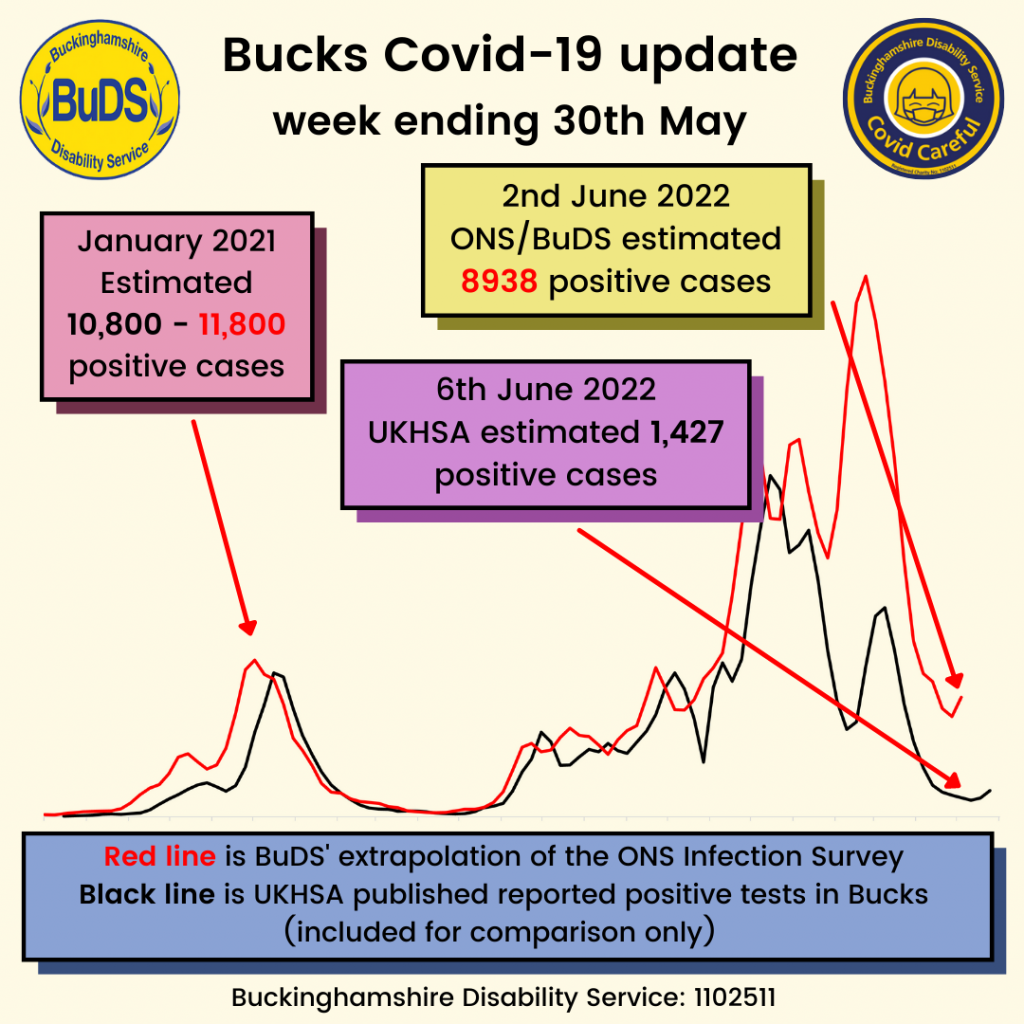
BuDS uses the most up to date 5-day rolling average ONS Infection Survey data covering the period to 2 June. This is of course 11 days ago, but it is the most reliable data available.
Using this data, we calculate that 1 in 61 people in Bucks have Covid, which is 8,938 people.
You can see how current numbers compare to the other waves of Covid-19 in Bucks by looking at the graph. We have included the number of positive tests reported purely for comparison – these test results are no longer of any value in tracking the virus, although it’s interesting that the next wave is even showing in UKHSA test data as well as ONS.
How Likely Are You To Meet An Infected Person?
Your chance of meeting an infected person when you are out and about in Bucks is VERY HIGH.
If we assume that every infected person is active in their local community, these figures will help you understand the risk of meeting one.
- How many infected people in every 1000?[1] – 16
- How many infected people in Aylesbury?[2] – 986
- How many infected people in High Wycombe?[3] – 1,972
- How many infected people in Amersham?[4] – 445
- How many infected people in Chesham?[5] – 439
- How many infected people in Buckingham?[6] – 247
- How many infected people in Burnham?[7] – 187
- How many infected people (adults or children) in a large school?[8] – 25
- How many infected people in a busy town centre?[9] – 164
- How many infected people at a large public event?[10] – 329
- How many infected people in a busy shopping centre?[11] – 16
- How many infected people in a busy supermarket?[12] – 5
How Is The NHS Coping?
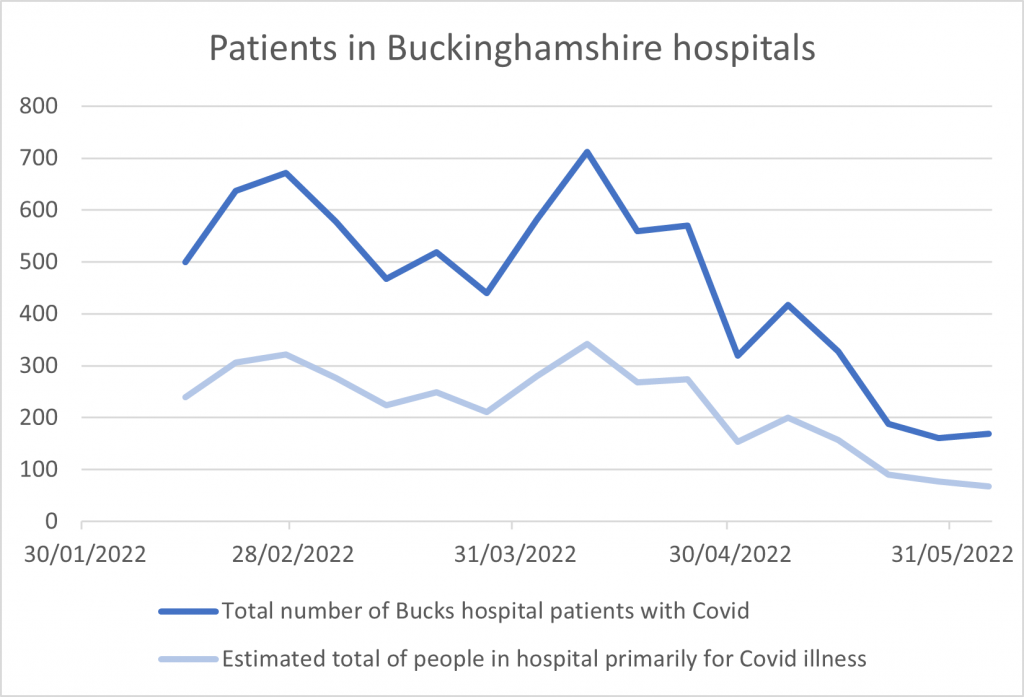
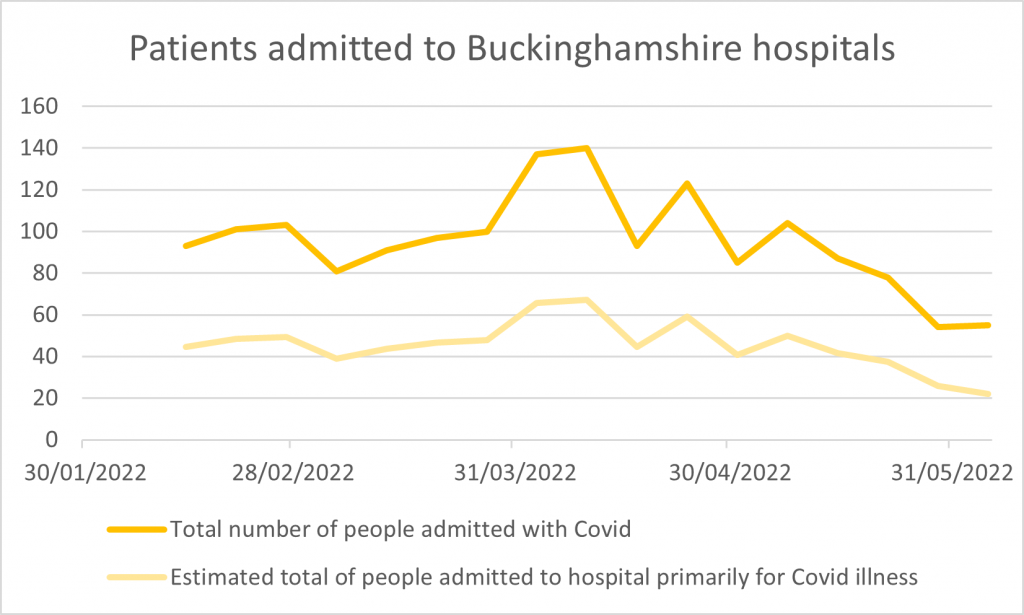
The number of patients in Bucks hospitals with Covid-19 is beginning to rise again, although the number of patients admitted with Covid-19 is fairly stable. These figures are for 5 June, the latest available:
Total number of Bucks hospital patients with Covid – 169.
This total includes people admitted with Covid and those who caught it in hospital. It is 5.0% higher than the previous week (161). Not all these people will be seriously ill with Covid – see below.
Total number of people admitted with Covid – 55
This total is of people who had Covid on admission to hospital, whether they were admitted because of Covid illness or found to have Covid when admitted for another reason. Not all these people will be seriously ill with Covid. This figure is 1.9% higher than last week (54).
Estimated total of people in hospital primarily for Covid illness – 68
This figure is 12.5% lower than last week (77).
As of May 5, the NHS estimate that around 40% of patients infected with Covid in hospitals in the SE of England are there primarily because of Covid illness. We have applied this percentage to the total number of patients in Bucks hospitals who are infected with Covid. All these people are likely to be seriously ill with Covid.
Estimated total of people admitted to hospital primarily for Covid illness – 22
This figure is 15.1% lower than last week (26).
As of May 5, the NHS estimate that around 40% of patients infected with Covid in hospitals in the SE of England are there primarily because of Covid illness. We have applied this percentage to the total number of patients in Bucks hospitals admitted with Covid to give you a rough idea of how many people are being admitted to hospital because of Covid illness. All these people are likely to be seriously ill with Covid.
You can see how hospitalisation numbers have changed in 2022 on the graphs below.
Keeping Covid-19 under control is vitally important for the NHS and for everyone. If the number of Covid-19 patients gets too high, or high numbers of NHS staff are off sick or self-isolating, or both, hospitals cannot keep patients safe, and care is threatened for all patients.
Covid-19 Deaths In Bucks
We use death statistics for the last two weeks rather than just the last week, so you get a more accurate figure. Over all three counting measures, the number of deaths in Bucks is sadly remaining high. Notably, this week we again only have data for 13 days, rather than the 14 we usually use, so the figures below are likely to be lower than the true values.
There are three ways of counting the number of Covid-related deaths in Bucks.
- 11 June, 4 people died within 28 days of testing positive for Covid-19, bringing the total number of deaths to 1,319. Because people are increasingly living longer even with severe Covid illness, this is the least accurate total.
- Between 29 May and 11 June, 11 people died within 60 days of testing positive for Covid-19, bringing the total number of deaths to 1,663. This total is the most clinically appropriate because of the length of time people now live with severe Covid illness.
- Between 13 May and 27 May, 6 people died with Covid as a cause of death as recorded by doctors on their death certificates, bringing the total to 1,488. This is the most reliable total, but the data is always two weeks old.
Deaths from Covid in Bucks continue at the rate of one to two every DAY. At least one person has died of Covid in Bucks every single day in the last twenty-four weeks.
How Many People Are Vaccinated In Bucks?
For the seventh week running, vaccination has made virtually no progress in Bucks across all age groups.
Effectively, vaccination has ground to a halt in Bucks.
Here are the latest vaccination figures for 12 June:
- Young children (aged 5 to 11) – 11.8% have had 1 dose; 0.4% have had two doses, and 0.002% have had three doses. 99.99% (51,181) are not fully vaccinated and vulnerable to Omicron
- Secondary-age children (aged 12 to 15) – 63.7% have had 1 dose; 45.4% have had two doses and 0.7% have had three doses. 99.3% (30,358) are not fully vaccinated and vulnerable to Omicron
- Older Teenagers (aged 16 to 17) – 76.4% have had 1 dose; 63.0% have had two doses and 19.0% have had three doses. 81.0% (11,590) are not fully vaccinated and vulnerable to Omicron
- Adults (aged 18 to 70) – 86.2% have had 1 dose; 83.9% have had two doses and 68.7% have had three doses. 31.3% (118,604) are not fully vaccinated and vulnerable to Omicron
- Older Adults (aged over 70) – 96.9% have had 1 dose; 96.3% have had two doses and 94.0% have had three doses. 6.0% (4,762) are not fully vaccinated and vulnerable to Omicron
As the figures above show, virtually all children and young people in Bucks have very low protection against Omicron. Nearly a third of adults also have very low protection against Omicron, and most worryingly, thousands of older adults still have very low protection against Omicron.
Remember, those who received their third booster jab before 19 April 2022 are, week by week, becoming less protected against Omicron. While their protection against being severely ill and being admitted to hospital is still reasonably good, their resistance to catching Omicron and being ill at home is shrinking.
Offers & More Information
If you’d like to know more about the issues below, use the appropriate link.
To find out more about the discounts for certified FFP2 and N95 face masks for disabled and clinically vulnerable people, use this link: https://buds.org.uk/face-mask-offers/
How we calculate our figures and how we check them for accuracy – https://buds.org.uk/risk-post-statistical-methods-explanation/
All our Covid-19 articles – https://buds.org.uk/category/our-work/iag-covid-19/
To see our Covid-19 risk levels, use this link: https://buds.org.uk/covid-19-risk-levels-in-bucks/
We Are Here To Help!
BuDS can help you by answering questions, providing information, helping you find practical support or help in a crisis or being a friendly voice if you’re lonely or isolated. If you’d like any help or support from us, message us through social media, e-mail buds-support@buds.org.uk or leave us a voicemail on 01494 211179. We’ll do our very best to help you.
References
[1] Population of approx. 543973 based on 2018 survey data, https://www.bbc.co.uk/news/uk-51768274
[2] Population of approx. 60,000 people, from https://www.aylesburytowncouncil.gov.uk/about-aylesbury/#:~:text=Aylesbury%2C%20the%20County%20Town%20of%20Buckinghamshire%2C%20is%20a,of%20over%2060%2C000%2C%20the%20largest%20in%20Aylesbury%20Vale.
[3] Population of approx. 120,000 people, from https://www.wycombe.gov.uk/pages/About-the-council/Transparency-and-open-government/Open-data/Statistics-and-census-information.aspx
[4] Population of 27,077 as of the 2011 Census, from http://old.buckscc.gov.uk/media/1000352/Local-Community-Area-Data.xls
[5] Population of 26,718 as of the 2011 Census, from http://old.buckscc.gov.uk/media/1000352/Local-Community-Area-Data.xls
[6] Population of approx. 15,000 people, from https://www.buckingham-tc.gov.uk/
[7] Population of approx. 11360 as of the 2011 census, from https://wikishire.co.uk/wiki/Burnham,_Buckinghamshire#cite_note-ons-1
[8] Assuming pupils plus staff equals 1500 people in total
[9] Assuming 10,000 people present at any one time
[10] Assuming 20,000 people present at any one time
[11] Assuming 1000 people present at any one time
[12] Assuming 300 people present at any one time