
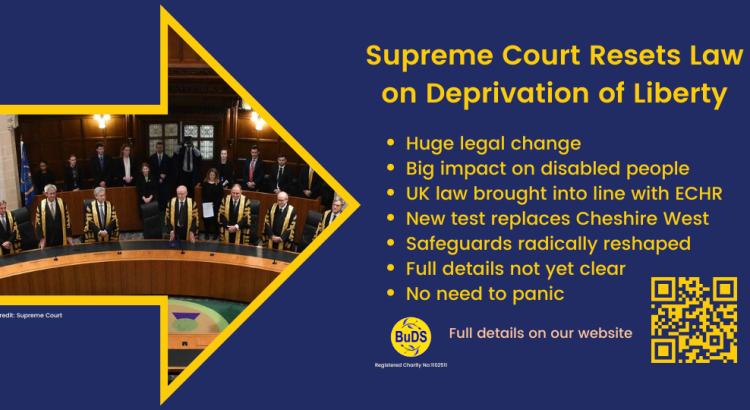
The Supreme Court has made a key decision about when people legally can be said to be ‘deprived of their liberty’. Deprivation of liberty means that a person isn’t free to do or go where they wish because an official body or law is stopping them. A person locked up in a prison is the most obvious example of someone deprived of their liberty. However, other examples might be disabled people held under the Mental Health Act, or a disabled person who lives in a locked care home.
BuDS wants disabled people to get fair, accurate and balanced information. Media coverage of this important court case is often misleading or incomplete, so we have written our own guide. We have used only legal sources to do so.
The Case in a Nutshell
People in the UK have the right not to be locked up or detained against their will except in accordance with British law. That British law must follow Article 5 of the European Convention on Human Rights. In 2014, the UK Supreme Court interpreted Article 5 in a particular way. The Court’s interpretation was binding and so the Government and British courts have used that interpretation since 2014. Now, the Supreme Court has said that their 2014 decision was wrong, and that Article 5 needs to be interpreted in another way.
What Some Disability Charities Are Saying
Three charities who were involved in the court case – Mencap, MIND, and the National Autistic Society – have condemned the Supreme Court decision. These charities say that the Supreme Court’s decision ‘puts at risk the freedom, safety, and rights of thousands of disabled people’. There has been a lot of media coverage repeating the same idea, that the decision is an attack on disability rights.
BuDS thinks this misrepresents the situation. The Supreme Court has made a legal decision based on a legal interpretation of the European Convention on Human Rights. This cannot be characterised as an attack on disabled people or disability rights.
The best way of understanding this situation is that the Supreme Court took the wrong view in 2014, and that mistaken interpretation has now been corrected. The ‘rights and safeguards’ which the big charities say have been ‘taken away’ were at least partly based on the wrong law.
What Was the Law Before this Court Decision?
The Mental Capacity Act 2005
In 2005, Parliament passed the Mental Capacity Act. This Act created a new legal framework for people who could not make decisions for themselves. Such people are said to ‘lack capacity’ to make decisions.
When a person lacks capacity, the Mental Capacity Act says that someone else can make decisions on their behalf, acting in their ‘best interests’. There are lots of safeguards and procedures to protect the interests of people who lack capacity.
An important point is that the Mental Capacity Act starts from the position that everyone has the capacity to make decisions for themselves unless it is shown otherwise. If a doctor, hospital, social worker or care home thinks a person can’t make a particular decision right now, it is up to them to show it.
Proving that someone ‘lacks capacity’ is normally done by a professional involved in a person’s care, such as a doctor or social worker. The professional has a conversation with the patient or person being cared for. In that conversation, the professional will assess whether the person right now can understand and remember the decision that needs to be made, whether they can understand, remember and properly weigh up the arguments for and against the decision, and whether they can communicate their decision. If a person can’t do these things because of an impairment of their mind, they may be found to ‘lack capacity’ to take that decision right now.
Capacity Is Decision & Time Specific
The Act doesn’t allow professionals to assume that people can’t make decisions for themselves for an unlimited time. If another decision needs to be taken later on, the person’s capacity to make that later decision should be checked again. Professionals should not assume the person still lacks capacity.
The Act also doesn’t allow professionals to assume that a person who can’t make a particular decision about one matter (eg their medical treatment) therefore can’t take decisions about other matters (for example, about their money). Although the Act doesn’t use this wording, professionals often talk about ‘decision-making domains’, meaning the types of decision that people may or may not be able to make for themselves. Typical ‘domains’ include medical care and treatment, finances, personal relationships, housing, benefits and money. Professionals have to look at people’s ability to make decisions in each of these areas separately, and not assume that a ‘lack of capacity in one domain’ automatically means a lack of capacity in other domains.
Misuses of Capacity Law
Despite the law being very clear, professionals often misuse the idea of capacity.
One of the most common mistakes that professionals make is to extend a person’s inability to make certain specific decisions into a general inability to make related decisions. For example, if a person is judged as unable to make decisions about where they live, or to enter into a legal agreement to rent a house, they are almost always taken to be unable to make any significant decisions about their home. If a person is assessed as unable to make decisions about their medical treatment, they are often assumed to be unable to make decisions about staying in hospital voluntarily. This may be true as a matter of fact, but the law requires separate assessments to be made.
Another assumption that is made by professionals is that people who cannot take some important decisions for themselves should automatically be regarded as unable to agree to living conditions which restrict their liberty. The Mental Capacity Act looks at capacity on a case-by-case basis, so this assumption goes against the way the Act works. However, many professionals think this assumption is an important safeguard for vulnerable people. If a person lacks capacity in any area, the argument runs, it is safer to assume that they cannot agree to be detained, which triggers the DOLS or Court of Protection safeguards.
Despite the Act not treating capacity as a single status, some professionals still talk about ‘global incapacity’, meaning that a person cannot take any decisions for themselves at any time. While some disabled people with a very high level of impairment – eg severe brain damage – may not be able to make any decisions for themselves as a matter of fact, the law does not treat capacity in this way.
Wishes and Feelings
Even when a person cannot make decisions for themselves, the Mental Capacity Act requires anyone making a decision on their behalf (‘in their best interests’) to take into account the person’s wishes, feelings, beliefs and values in making that decision. So, for example, if a person is unable to decide for themselves where they live, but has always expressed a wish to live in Liverpool, it would be appropriate for the person taking the decision on their behalf to try to respect their feelings and find them a home in that city.
Deprivation of Liberty Safeguards – DOLS
Sometimes, a hospital, council or care home wants to stop a person leaving the place where they are living or being treated because they think that is in the person’s best interests. They may be vulnerable or unsafe in public places, for example, or a danger to themselves. If that person ‘has capacity’ to decide to leave, then the hospital or care home cannot legally stop them leaving (unless another legal power can be used, for example under the Mental Health Act). But if professionals think the person cannot make a decision about leaving, that is to say they ‘lack capacity’, then their detention must have legal authorisation. This authorisation is obtained through DOLS for hospitals and care homes, and through the Court of Protection for other places.
The Mental Capacity Act was amended in 2007 to introduce a strict legal procedure that had to be followed if a hospital, council, or care home wanted to detain a person who cannot decide for themselves to leave. A new schedule to the Act introduced lots of safeguards and procedures to protect the interests of anyone who was ‘deprived of their liberty’. These are called the ‘Deprivation of Liberty Safeguards’ or DOLS.
Cheshire West
In 2014, the Supreme Court made a key decision in the Cheshire West case. The court set out a wide but ‘bright line’ test about whether a person was ‘deprived of their liberty’ or not. That test said that if a person was:
- under ‘continuous supervision and control’ by an official body, and
- not free to leave the place they are in
they were deprived of their liberty. This test became known as ‘the acid test’ of whether a person was deprived of their liberty or not.
If a person who was deprived of their liberty under the ‘acid test’ cannot agree or consent to these restrictions because they ‘lack capacity’ under the 2005 Act, their detention must be authorised either by the Court of Protection or, for people in hospital and care homes, through the Deprivation of Liberty Safeguards process.
What the Supreme Court has Changed
The Supreme Court, in a unanimous decision, has said that the court’s previous decision in the Cheshire West case was wrong. While the Court’s judgement is very complicated, BuDS feels that they have changed the law in three important ways:
- A New Approach to Severely Mentally Impaired People
- A New Subjective Test – Allowing More People to Agree to Being Deprived of their Liberty
- A New Objective Test for Deprivation of Liberty
A New Approach to Severely Mentally Impaired People
Under existing practice, disabled people who are in a coma, catatonic, long-term unconscious, minimally conscious, or so profoundly mentally or cognitively disabled to the extent that they cannot leave a place even if free to do so are nevertheless treated as people who have been ‘deprived of their liberty’ by the hospital or care home looking after them.
DOLS or Court of Protection safeguards often applied to people in these circumstances. The Supreme Court, applying European case law, has now said that such people may be better regarded as not having any liberty that could be taken away, because they are ‘not capable’ of leaving even if they had the opportunity. The Court said such people may not be regarded as being ‘deprived of their liberty’ and, if so, formal DOLS or Court of Protection authorisation would not need to be obtained, although other protections might still apply.
The Court also said that hospital patients who were temporarily unconscious, or temporarily confused, perhaps from sedation, were not ordinarily deprived of their liberty if staff kept them in hospital for care. This wouldn’t apply if the facts showed that patients were clearly under detention, for example if they were detained after they had recovered consciousness.
The Court was clear that disabled people who were mentally capable of deciding to leave a place, but who could not physically do so, for example because of paralysis, would be deprived of their liberty if prevented from leaving against their will, even if they need an aid or assistance to do so. The Court said in some cases there was a positive duty to support disabled people who validly wished to leave, for example by providing a wheelchair to a person who required it to leave a hospital, or to guide a blind person to an exit.
A New Subjective Test – Allowing More People to Agree to Be Deprived of their Liberty
In a significant departure from previous law, the Supreme Court has followed European case law and introduced a separate (‘autonomous’) test that professionals should use to assess whether a person can agree to restrictions on their movement. Because the test looks at the experience of the person who is subject to the restrictions, it is known as a ‘subjective test’.
The Court made it clear that, while the Mental Capacity Act remains in place for some decision-making, the specific question of whether a person can agree with restrictions on their movement should be decided by using this new subjective test.
BuDS thinks this new subjective test is best understood as having three parts:
- Is the person ‘conscious of their environment and do they have a basic understanding of their living circumstances’?
- Can they ‘express their view about their situation’, ie the restrictions on their life?
- Are they able to show ‘their acceptance of the situation they are in’, even by showing ‘happiness’ or ‘unhappiness’?
If a person meets this test and shows that they agree with the restrictions on their life, even just by a ‘tacit positive indication of wishes and feelings showing contentment with the arrangements’, then the Court says that they should not be regarded as having been ‘deprived of their liberty’. If so, formal DOLS or Court of Protection authorisation would not need to be obtained, although other protections might still apply.
Even some people who have been assessed under the Mental Capacity Act as lacking the capacity to make decisions about their care and treatment, or housing, may be regarded as able to give their consent to being deprived of their liberty, as long as the test above is satisfied. In the words of the Court (para 201), if a person has “a basic level of awareness and consciousness of their living arrangements that is sufficient to enable them to know and communicate whether they are happy or unhappy with them, they may be treated as able to give or withhold valid consent to confinement by an expression of their wishes and feelings.”
The subjective test set out by the Supreme Court is a very major change to how things are done now. BuDS feels that there will need to be major changes to guidance and procedures across the NHS and care sectors.
A New Objective Test for Deprivation of Liberty
In Cheshire West, the court laid down a wide but ‘bright-lined’ acid test of ‘deprivation of liberty’ to help professionals know when DOLS safeguards were necessary. The Cheshire West case judges thought that the need to protect vulnerable people through DOLS and Court of Protection safeguards justified setting such a test.
The Supreme Court has now said that the Cheshire West decision was wrong, and that a different test, the Guzzardi test, should apply. The Guzzardi test was set out by the European Court of Human Rights in 1981 and has applied in other ECHR countries for many years. The Supreme Court was not therefore abolishing safeguards for vulnerable people but replacing them with a different and well-tested model.
This test is not concerned with how the person living under restrictions thinks about those restrictions – that is covered by the ‘subjective’ test mentioned above. The Guzzardi test is about whether, objectively, the person is really deprived of their liberty, or not. It is therefore known as the ‘objective’ test.
A Prisoner in a Cell
The Supreme Court’s reading of the Guzzardi judgement is that a prisoner in a prison cell is the starting point for any thinking about whether a person has been deprived of their liberty. The closer a person’s everyday experience is to that of a prisoner in a prison cell, the more likely it is that they have been deprived of their liberty. On the other hand, the further a person’s everyday experience is from that of a prisoner in a prison cell, the less likely it is that they have been deprived of their liberty. Professionals need to look at the individual facts and circumstances of each case to decide, objectively, if there is a deprivation of liberty. This is a very different approach to the ‘hard edged’ test set out in Cheshire West, which simply refers to people being ‘not free to leave’.
Degree Matters
Under the Cheshire West acid test, any continuous control or supervision of a person, coupled with an inability to leave, meant that they were deprived of their liberty. The Supreme Court now says that the extent or degree of control of the person’s movements has to be considered. If, for example, a person is prevented from leaving their home at particular times, but not generally, that situation would need to be examined on its merits to see if it counted as a deprivation of liberty. Other facts which the Court says are relevant is whether the person is isolated or regularly sees people, including social contacts. For example, is a person who cannot leave a house alone, but who can go out with family and friends, ‘deprived of liberty’?
Restrictions of Movement versus Deprivation of Liberty
Although the ‘acid test’ set out in Cheshire West referred to ‘not being free to leave’, courts tended to interpret this phrase quite strictly, so that even minor restrictions on a person’s ability to leave, like a locked exit door on a care home, could be seen as making the residents ‘not free to leave’, which in turn could lead to a finding that they had been deprived of their liberty.
Following Guzzardi, the Supreme Court has now drawn a difference between ‘restrictions on liberty of movement’ and ‘restrictions on liberty’. The Court now says that restrictions on movement which do not significantly intrude into the life of individuals (what the court called ‘fairly limited restrictions’) are less likely to create a ‘deprivation of liberty’. So, locking the exit door of a care home, which had little real impact on the lives of residents, now objectively would not necessarily be seen as a ‘deprivation of liberty’.
Objections Matter
The Supreme Court is clear that decisions about whether someone is being deprived of their liberty must look at and weigh up all the facts of the situation. One factor which the Supreme Court has highlighted in its judgement is whether the person subject to restrictions objects or not to the restrictions, or whether or not they feel themselves to be forced or coerced.
If there is objective evidence of restrictions on freedom of movement, such as locked doors or escorts, but the person does not object to these restrictions, that might be seen as evidence that the restrictions do not amount to a deprivation of liberty because the person agrees with them. If, on the other hand, the person does clearly object to the same restrictions, the Court said that this should usually point towards a deprivation of liberty.
How Important is the Supreme Court Decision?
The Supreme Court’s decision in this case is one of the most significant legal decisions for many years. It resets the law on deprivation of liberty and overturns long-established case law. With over 400,000 people a year subject to a deprivation of liberty in England and Wales, the practical consequences of the change alone will affect very large numbers of people. New guidance, procedures and practice will have to be introduced across the NHS, in care homes and in many councils. Lawyers and courts will have to change and adapt their practice too.
While the Supreme Court decision is a huge deal legally and professionally, BuDS’ biggest concern is how it affects the interests of disabled people. Nearly everyone subject to a deprivation of liberty is a disabled person, so this decision is a massive disability rights issue.
BuDS view now is that it is too early to tell whether this decision will be positive or negative for disabled people’s rights. We do not agree with the rather kneejerk reaction of the big charities, who are already saying that this Court decision is an attack on disabled people or an erosion of our rights. Until the decision is fully studied, and we know the Government’s reaction to it, it is far too early to be making bleak or cataclysmic predictions like that. It will be a long time before the implications of the Court decision are fully understood and implemented.