
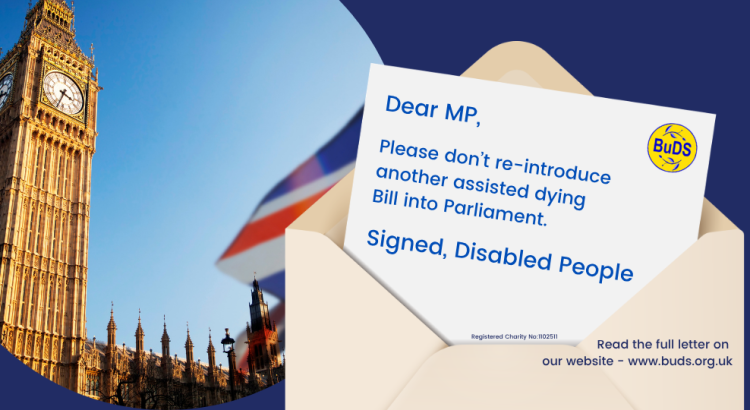
Dear Members of Parliament
Please don’t re-introduce an assisted dying Bill into Parliament. As disabled people from across England, including many with degenerative and terminal conditions, we urge you to address this highly complex and controversial issue in a mature and measured way. Rushing ahead with badly-drafted and dangerous Bills is not the way to help disabled and dying people.
You will know that previous attempts to legislate in this area by Private Members Bill have not succeeded. The Manx Bill in the Tynwald has been ruled incompatible with the Human Rights Act, the Bill in the Scottish Parliament was rejected by MSPs, and Kim Leadbeater’s Westminster Bill died an inevitable death in the Lords. We say inevitable because, as all Parliamentarians will know, Private Members Bills have limited time and cannot successfully deliver large, complex and difficult changes to the law. At 59 clauses and 8 schedules, and an additional 79 amendments tabled by its own sponsor in the Lords, the Leadbeater Bill demonstrated the truth of that statement.
As a community of disabled people, we have always called for a proper national conversation about assisted dying, and its relationship to medically-assisted suicide, before any legislation is tabled. It is an extraordinarily complex and emotive issue needing mature and well-informed consideration. There are many points of views and expert opinions which need to be sensibly balanced.
We feel that a neutral commission or enquiry needs to lead this national conversation and to draft any legislation which, after proper consideration, is found necessary. A Government Bill can then be professionally and competently drafted to implement a scheme which can command the support of key stakeholders and which, as a result, can pass more smoothly through both Houses. Other European countries who have introduced assisted dying schemes have all followed this model, with consultation and implementation timetables ranging from 4 to 12 years.
If you have been successful in the ballot for Private Members Bills, we therefore urge you to not introduce a further Assisted Dying Bill. The best interests of dying people, and of the whole country, are now served by a mature and informed process resulting, if that is thought necessary, in a government Bill setting out a workable scheme around which there is a strong measure of agreement.
Going ahead with a rushed Private Members Bill now will not help dying people, because no Private Members Bill can actually deliver the complex and lengthy legislation needed. The Bill, if it is passed at Second Reading, will simply become enmeshed in controversy and complications for months before it inevitably fails again, tying up precious Parliamentary time and MP’s energy, which could be far better used. It is unlikely that Government will be able to give a future PMB the extraordinary help with timing and procedure which Kim Leadbeater’s Bill enjoyed. There is also real doubt whether the Commons has the appetite for such a Bill. Kim Leadbeater’s Bill did not enjoy an absolute majority at Third Reading and the number of MPs willing to support related EDMs has steadily fallen.
Going ahead with an assisted dying Bill to introduce, in stark terms, institutionalised medically-assisted suicide for NHS patients is also fraught with presentational problems. Disabled people’s views and interests have been savagely ignored by the Bill’s sponsors to date; going ahead with another Bill without even the courtesy of consulting disabled people’s organisations would be seen as another direct attack on disabled people, helping cement an anti-disabled narrative which is doing the Government no favours. The public would also wonder why, with so many critical and urgent issues facing the country, MPs were spending so much time on an assisted dying scheme for NHS patients: a policy which has never appeared in a manifesto and which 96% of the public have said is not a priority for them.
We close this letter by repeating that the best way to help dying people now is not to introduce another Private Members Bill on assisted dying. It is to encourage the establishment of a mature and informed national conversation about assisted dying which can generate a scheme, and a Government Bill, which commands majority support and which can be cleanly and effectively delivered.
The Trustees of BuDS Disability Service
20 May 2026