
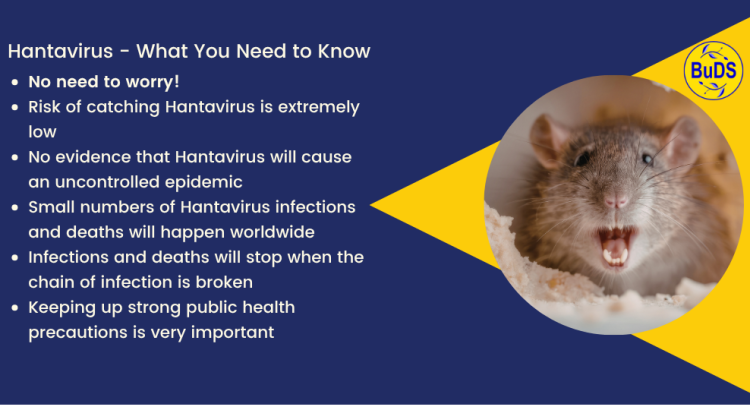
The media are getting very excited about Hantavirus and its possible risk to human health. BuDS researchers have used only high quality scientific and academic sources to cut through the hype and give you the facts that you need to know.
This article is accurate up to 16 May 2026.
Do I need to be worried about Hantavirus?
No. Unless you come into contact with rats, mice or other rodents, or you are a close contact of passengers on the MV Hondius cruise ship, you do not need to worry about Hantavirus.
Read more: Hantavirus OutbreakWhat is Hantavirus?
Hantavirus is a family of animal viruses infecting rats, mice and other rodents. Each species of rodent tends to have its own Hantavirus, which they carry without getting ill.
How Do You Catch Hantavirus?
With the exception of Hantavirus Andes (see below), you can only catch Hantavirus from an animal, specifically a rat, mouse or other rodent, or from its urine or droppings.
There are many hantaviruses but only some of them can be caught by humans.
Humans who have contact with rat, mouse or other rodent’s urine or droppings can sometimes catch Hantavirus from that urine or droppings. If droppings become dry and dusty, the dust can also transmit the virus to humans who breathe it in. Contact with rodents, or being bitten by them, can also pass the virus to humans.
The World Health Organization estimates that 100,000 people globally catch Hantavirus every year from rats, mice and other rodents. In Europe, there are several thousands of cases every year.
Tests
There are reliable laboratory tests for many of the Hantavirus family of viruses, including the Andes variant. These tests can confirm that a person is infected with a Hantavirus. However, the tests may not work in the earlier stages of infection.
How Serious is Hantavirus?
Most people who catch Hantavirus from a rodent will have typical flu-like symptoms such as fever, headache, muscle aches, abdominal pain, nausea or vomiting. With good medical care, most people will make a full recovery.
European hantaviruses can sometimes lead to a serious condition called haemorrhagic fever with renal syndrome (HFRS). This condition affects the kidneys and blood vessels and can lead to low blood pressure, bleeding disorders and kidney failure. However, most people with HFRS will make a good recovery and very few will die.
South American Hantaviruses can sometimes lead to Hantavirus cardiopulmonary syndrome (HCPS). HCPS is a very dangerous and severe respiratory illness, and around half the people who develop it can die. However, many of these deaths occurred in areas without access to advanced medical care, so it isn’t known what percentage of people with HCPS might die if they had first-class medical care.
Treatment & Vaccines
There is no specific treatment or cure for Hantavirus infections. However, advanced medical care and antiviral treatments are often successful. Most deaths from Hantavirus infections occur in areas with limited access to advanced healthcare.
There is currently no vaccine to protect against Hantavirus infections, although some are under development.
Hantavirus Andes
Hantavirus Andes is a small family of variants of a South American Hantavirus (ie, there are several Andes viruses, not just one). It is the only Hantavirus known to pass from human to human, rather than from a rodent to a human. Infection with the Andes variant can develop into Hantavirus cardiopulmonary syndrome (HCPS), which can be fatal.
There have been several small outbreaks of the Andes Hantavirus in recent years, all in South America. None of these outbreaks have spread outside the immediate area of the first cases. The latest outbreak, in Argentina, spread further than any other outbreak but isolating cases brought it to a halt, although not until 11 people had died.
There is no evidence whatsoever to suggest that Andes Hantovirus is a virus which can cause a large-scale epidemic or global public health emergency. All the evidence from this present outbreak and all previous outbreaks shows that simple public health measures like isolation of infected people and their contacts will quickly bring any outbreak to an end.
The MV Hondius
The MV (motor vessel) Hondius is a small cruise liner which mainly operates in and around South America. Passengers on cruise ships are typically crowded together, and conditions are ideal for the spreading of infectious diseases. During the Hondius’ most recent voyage, in April and May 2026, an outbreak of Andes Hantavirus occurred on the ship.
What is the Risk to the Public of the MV Hondius Outbreak?
The risk to the general public is very low. Andes Hantavirus does not spread easily between people (see below). This means that, even when infected passengers or crew have carried the virus to their homes and families, the further spread of the virus can be easily controlled.
The WHO, ECDC and other health authorities across the world are carefully tracing everyone that could possibly have caught Andes Hantavirus from a member of the crew or passenger of the MV Hondius. This includes not just their families and friends, but people sitting near them on aircraft or public transport, medical staff, drivers, etc. All these people will be medically monitored and asked to self-isolate. In this way, the future spread of the Andes virus eventually will be stopped.
We say eventually, because stopping the chain of infections will not happen quickly, but over a period of months. It may be several months before the chain of infections is finally stopped, especially if a few people are missed off the list by mistake. Sadly, because Andes infections can be fatal, there will be more deaths too.
The media will report excitedly about every new case and death, but the important thing to remember is that there will be no uncontrolled epidemic of Andes Hantavirus cases. There will be a linked chain of a limited number of infections over future weeks and months which will eventually stop. That will be the end of this Andes outbreak.
How Long Before People Show Symptoms of Andes Hantavirus?
People do not have symptoms of illness as soon as they catch Andes Hantavirus. Symptoms can appear between 1 and 6 weeks after infection. However, most people show symptoms between 2 and 4 weeks after infection. This means that we will not know until the end of May which passengers on the MV Hondius are going to get ill. Some people may give Andes Hantavirus to family members, friends or work colleagues before they realise they have the virus.
When Are People Contagious for Andes Hantavirus?
With most viruses, people are not actively spreading the virus in their breath and bodily fluids from the moment they are infected. Different viruses have different periods when the person is actively spreading the virus. This is known as the contagious period. For example, people infected with Covid-19 are most contagious in the two-week period before they start to show symptoms.
For Andes Hantavirus, doctors thought until recently that the contagious period was from the day that a person started to show the first symptoms of illness until they died or recovered. Now, doctors think that infected people may be contagious for up to two days before they start to show symptoms. However, the most contagious period is the first week after first starting to show symptoms.
Knowing the period when people are contagious helps with contact tracing and isolation. It is only the contacts of infected people from a few days before they started to show symptoms that are at risk of also developing Andes Hantavirus. People exposed to infected people weeks before they showed symptoms are not at risk. This vital point is not being properly explained by the media.
How Infectious is Andes Hantavirus?
Viruses pass between people in three main ways.
Aerosol. This is where tiny particles of virus are suspended in the air breathed out by infected people. If other people then breathe in enough particles of virus, they can catch the virus too. The risk to other people then depends on how long the virus can live in the air, and how much is needed to trigger an infection. A virus which can live a long time in the air, or which only needs a small amount to trigger an infection if breathed in, will be extremely infectious. One infected person could create a big cloud of virus in a crowded room or hall and everyone in that hall potentially could catch the virus by breathing it in. A virus which lives a shorter time in the air, or which people need to breathe in a lot to catch, would be less infectious. Many common viruses spread by aerosol including measles, influenza and Covid-19. Viruses spread by aerosol are often called airborne viruses.
Droplet. This is where particles of the virus float in tiny droplets of water suspended in the air breathed out by infected people. The droplets remain floating in the air for a short time. If other people then breathe in enough droplets containing the virus, they can catch the virus too. However, because the water droplets breathed out by people cannot travel very far, or last very long in the air, viruses spread by droplet are much harder to catch than those spread by aerosol. Common viruses spread mainly by droplets include RSV (respiratory syncytial virus), adenoviruses, and human metapneumovirus).
Surfaces. This is where particles of the virus float in tiny droplets of water suspended in the air breathed, coughed or sneezed out by infected people, and those droplets then fall out of the air and settle on surfaces. If someone else touches that surface, the virus can get onto their hands, and if the person then touches their mouth, nose or eyes, the virus can get inside their body and cause an infection. Some viruses can survive in water droplets on surfaces for hours or even days. Common viruses mainly spread by surfaces include norovirus and the common cold. Sometimes viruses spread in this way are said to be spread by fomite.
Andes Hantavirus outbreaks in South American before the voyage of the MV Hondius gave the WHO and health authorities an opportunity to study the situations in which people caught the virus from another person. They found that nearly everyone who caught Andes Hantavirus from another person had spent a lot of time near the infected person, often sharing a bed or bathroom, providing personal care, or sharing a small cabin or room. People who did not spend time very close to an infected person did not seem to catch the virus. This strongly suggested that Andes Hantavirus spread mainly by droplet and surface infection.
Since the outbreak on the MV Hondius, health authorities have noted that some people seem to have caught Andes Hantavirus by being in the same indoor space close to an infected person. This does not confirm that Andes Hantavirus is spread by aerosol, because droplet or surface infections might also explain how the infections occurred. However, to be cautious, the WHO, ECDC and UKHSA have upgraded their advice about how Andes Hantavirus might be spread.
The new advice says that anyone who spends more than a brief time within 2 metres of an infected person indoors is at high risk of catching Andes Hantavirus, unless they have taken public health precautions. If a person is indoors and meets an infected & contagious person only briefly, or is more than 2 metres away, or they meet outdoors, their risk of catching the Andes Hantavirus is classed as low.
This advice suggests that WHO and other health authorities feel that droplet or surface infection is still the main way that Andes Hantavirus spreads between people, but they are not ruling out short-range aerosol spread as well. They do not seem to think, based on the evidence so far, that Andes Hantavirus spreads mainly by aerosol, that is to say it is not primarily an airborne virus which can be caught simply by breathing in the exhaled breath of an infected and contagious person.
Importantly, WHO and national public health authorities have said that medical and care staff working with infected people should take precautions in case Andes Hantavirus is spread by aerosol. This mainly means that medical and care staff will wear PPE respiratory masks rather than surgical ones. These masks, when properly worn, filter virus out of the air breathed in by the wearer.
People at High Risk of Catching Andes Hantavirus
The current advice from the WHO and ECDC is that the following groups of people are at high risk of catching Andes Hantavirus. This does not mean that they will catch the virus, only that they are at high risk of doing so.
An important condition is that people taking infection control precautions are not at high risk, even if they have spent time with or cared for contagious patients with Hantavirus, These precautions are wearing a PPE respiratory mask, eye protection, a gown and gloves.
The groups of people at high risk are those who, without having taken these infection-control precautions:
- Were exposed to the saliva, blood, or other bodily fluids of an infected person while they were contagious, or handling their personal items, worn clothes or bed linen (remember, infected people are only contagious from a few days before they show symptoms and while they have symptoms, not all the time)
- Had direct physical contact, including potential exposure to saliva or other bodily fluids, with an infected person while they were contagious. This means giving an infected person personal support and care, such as healthcare, feeding or washing; or sharing a bed space or bathroom; or intimate contact, etc.
- Being in close proximity with an infected person while they were contagious, meaning being indoors within 2 meters for at least 15 minutes, or being indoors with them on multiple occasions. This would include personal face-to-face encounters, sharing meals, social gatherings, sharing a small vehicle like a taxi, and being in the same room, unless the room was very large.
- Being within 2 metres of an infected person while they were contagious on public transport, ie near them on the same plane, bus, coach, or train carriage.
The WHO with national public health authorities, such as UKHSA in the UK, will trace all high-risk contacts of Andes Hantavirus patients and advise them to self-isolate away from their family, in case they may have the virus. They will also have daily medical checks and be regularly tested for the virus. If any of these people do test positive or develop symptoms, their high-risk contacts will also be traced and the same procedure repeated.
The WHO advise that high-risk contacts should self-isolate for 42 days. This period, it is thought, will allow symptoms of Andes Hantavirus to develop if a person is infected. After 42 days without symptoms or a positive test, the person will be regarded as free from the virus.
People at Low Risk of Catching Andes Hantavirus
The WHO and ECDC currently say that people who have had contact with an infected person who is contagious in the following circumstances are at low risk of catching Andes Hantavirus. This does not mean that they will not catch the virus, but that they are at low risk of doing so.
The groups of people at low risk are those who, without having taken infection-control precautions:
- Were onboard the MV Hondius or another ship but didn’t share a cabin or have direct or prolonged indoor contact with an infected person who was contagious.
- Shared public transport, ie a plane, bus, coach, or train carriage, with an infected person who was contagious but were more than 2 metres away from the infected person
- People who briefly met an infected person who was contagious indoors, eg as they passed through an port or airport
- People who only met an infected person who was contagious out of doors, without close or lengthy contact
These low-risk contacts will also be traced and their health monitored, in case they do test positive or develop symptoms. However, they will not need to self-isolate like high risk contacts.
Risk to the UK General Public
The risk to the general public in the United Kingdom from Andes Hantavirus is very low indeed. The risk of meeting someone who is infected and contagious with Andes Hantavirus is extremely small. Nobody needs to take any special precautions against Andes Hantavirus.
This is because the British passengers and crew from the MV Hondius who are high-risk for catching Andes Hantavirus are under medical monitoring. The low-risk passengers and crew and the contacts of all the passengers and crew are also being medically monitored. Anyone who shows signs of Andes Hantavirus will be quickly spotted and isolated. This means that the risk of a member of the public coming across someone with the virus is extremely small.
It is likely that more people in the UK will develop the virus and become ill, and some may die. It is also likely that contacts of the original passengers and crew will develop the virus too, and some may die. Andes Hantavirus is a dangerous virus and sadly there will be casualties.
A Controlled Chain of Infections, not an Epidemic
Coming weeks and months will see a linked chain of a limited number of Andes Hantavirus infections over future weeks and months. These infections will eventually come to an end, as the chain of infection is slowly broken. That will be the end of this Andes outbreak.
The key thing is that there will be no uncontrolled epidemic of Andes Hantavirus cases. The virus will not spread over the world and infect millions of people like Covid did in 2020. Andes Hantavirus is not as infectious as Covid, because Andes is not a mainly airborne virus like Covid. This alone makes a global epidemic of Andes Hantavirus very unlikely. The fact that this outbreak happened on a cruise ship, and so contacts can be easily traced, makes an uncontrolled epidemic extremely unlikely.
Sources
BuDs has used only World Health Organisation (WHO), European Centre for Disease Control (ECDC) and UK Health Security Agency (UKHSA) publications as soyurces of information for his article.
Questions
If you have any questions about Hantavirus, please use the form below to ask them, and we will get back to you as soon as we can.