A jumbled pile of triangular alert road signs. The signs are white with a red border and have a black exclamation mark on them

Weather & Weather Health Warnings

There are lots of weather and weather-related health warnings issued these days. It can be difficult to know which ones are important and need you to do something. To help you, BuDS has decided that it will start posting the most significant weather and weather health warnings on its own website and social media. That way, if you see that BuDS is repeating or endorsing an official warning, you know it really matters to you as a disabled person. We will only do this for warnings affecting England, not Scotland or Wales.

Weather Warnings

Weather warnings are issued by the Met Office. Their scientists forecast how the weather is going to affect the UK and, if severe weather is expected, they issue a warning.  

Yellow ‘Advice’ Warnings – there are two types of yellow weather warning.

  • The first is advice that the weather is likely to cause some low-level problems for some people.
  • The second type of yellow warning is advice that that the weather may cause serious problems for people, but there is only a low risk of this happening.

BuDS has decided that it will not repeat or amplify yellow weather warnings. This is because we want people to always take seriously a weather warning amplified by BuDS, and yellow weather warnings are often not serious or relevant enough to be worth repeating.

Amber ‘Caution’ Warnings – there are two types of amber weather warning.

  • The first is issued when the Met Office feel that there is a strong chance of severe weather that will disrupt everyday life, cause problems for most people, and make people change their plans and activities. There may be some property or landscape damage and emergencies like power cuts of flooding might occur.
  • The second type of amber warning is issued when the Met Office think that very dangerous weather may occur but there is only a low risk of that happening.

BuDS has decided that it will repeat both types of amber weather warnings. This is because disabled people will be most affected by disruptive weather and we want them to have prompt, accurate information to help them manage the period of disruption.

Red ‘Danger’ Warnings – when the Met Office issues a red weather warning, it means that there is a big risk to people’s life, with widespread damage to buildings and the landscape also likely. Power cuts, flooding and other emergencies are also likely and the Government or councils may have to issue guidance for the public or start up emergency plans. People should not travel during a red warning. Red weather warnings will also usually be sent by emergency alert direct to people’s mobile phones in affected areas.

BuDS has decided that it will repeat and amplify red weather warnings. This is because disabled people are most at risk in weather emergencies and we want them to have prompt, accurate information to help them keep safe.

Health Weather Warnings

Health weather warnings are issued in England by the UK Health Security Agency, or UKHSA. If UKHSA thinks that upcoming hot or cold weather may be a risk to people’s health, they issue an alert. These alerts are only sent about hot or cold weather and not any other threat to health, for example a disease outbreak.  

Although the media report UKHSA weather health warnings, they are not really intended for the general public. They are supposed to be warnings for the NHS, councils and other health and social care organisations, to alert them to an expected increase in demand for their services.

The UKHSA take a lot of things into account before issuing a weather health warning. Health weather warnings are not just about whether the temperatures will be particularly hot or cold, but whether hot or cold weather is expected to have particularly bad effects in people’s health and so make them use NHS and care services more.

Hot Weather Health Alerts

UKHSA look at four things when deciding to issue a hot weather heat alert. These are:

  • Whether the hot weather is likely to make people use NHS services more
  • Whether more people will die than usual
  • Whether the expected daytime temperature will be over 27 degrees centigrade (28 in London)
  • Whether the expected nighttime temperature is much higher than expected

If some or all of these things are likely to happen, the NHS will issue a ‘Heat-Health Alert’. These alerts will be graded as Low, Medium or High

Low Heat-Health Alert – this alert, issued when daytime temperatures are above 27 degrees centigrade (28 in London), tells the NHS and care organisations that demand for health and care services is likely to be higher than usual, 10% more people will die than usual (mostly older and vulnerable people), and hospital and other buildings will become ‘very warm’.

BuDS has decided that it will not usually repeat or amplify Low Heat-Health Alerts warnings. This is because summer temperatures are now regularly above 27C and we would end up repeating a lot of alerts which might mean people did not take notice of more serious alerts.

Medium Heat-Health Alert – this alert issued when daytime temperatures are above 30 degrees centigrade (32 in London), tells the NHS and care organisations that demand for health and care services, especially emergency services, will be much greater than normal. 20% more people than usual will die, and mostly older people or those with health conditions but also children or babies. Patients in hospital or care will be at risk of dehydration, and hospital and other buildings will become overheated. Disabled, vulnerable and older people in the community will be at risk from heat. NHS and care staff availability will reduce.

BuDS has decided that it will repeat Medium Heat-Health Alerts. This is because disabled people will be most affected by hotter weather and the reduced health and care services which will happen in hotter weather. We want disabled people to have prompt, accurate information to help them manage the period of very hot weather.

High Heat-Health Alert – this alert, issued when daytime temperatures are above 38 degrees centigrade (40 in London), tells the NHS and care organisations that demand for health and care services, especially emergency services, will be very significantly greater than normal. 50% more people will die than normal, with people of all ages affected, but especially large numbers of older people. Patients in hospital or care will be at risk of heatstroke and dehydration, and hospital and other buildings may become too hot for use. Disabled, vulnerable and older people in the community will be significantly affected from heat. NHS and care staff availability will be significantly reduced.

BuDS has decided that it will repeat and amplify High Heat-Health Alerts. This is because disabled people are most at risk in heat emergencies and we want them to have prompt, accurate information to help them keep safe.

Cold Weather Health Alerts

UKHSA look at three things when deciding to issue a cold weather heat alert. These are:

  • Whether the cold weather is likely to make people use NHS services more
  • Whether more people will die than usual
  • Whether the expected average temperature will be below 2 degrees centigrade

If some or all of these things are likely to happen, the NHS will issue a ‘Cold-Health Alert’. These alerts will be graded as Low, Medium or High

Low Cold-Health Alert – this alert, issued when average temperatures are predicted to be below 2 degrees centigrade for more than 48 hours, tells the NHS and care organisations that demand for health and care services is likely to be higher than usual, More people will die than usual, mostly older and vulnerable people.

BuDS has decided that it will not usually repeat or amplify Low Cold-Health Alerts warnings. This is because winter temperatures are now regularly below 2C and we would end up repeating a lot of alerts which might mean people did not take notice of more serious alerts.

Medium Cold-Health Alert – this alert is issued when average temperatures are predicted to be below 2C for 5 days or under zero for 48 hours. This alert tells the NHS and care organisations that demand for health and care services, especially emergency services, will be much greater than normal. Significantly more people than usual will die, mostly older people or those with health conditions but also children or babies. Disabled, vulnerable and older people in the community, especially those living rough, will be at risk from cold. NHS and care staff availability will reduce.

BuDS has decided that it will repeat Medium Cold-Health Alerts. This is because disabled people will be most affected by colder weather and the reduced health and care services which will happen in colder weather. We want disabled people to have prompt, accurate information to help them manage the period of cold or freezing weather.

High Cold-Health Alert – this alert is issued when average temperatures are predicted to be below zero for 5 days or -2C for 48 hours. This alert tells the NHS and care organisations that demand for health and care services, especially emergency services, will be very significantly greater than normal. Significantly more people will die than normal, with people of all ages affected, but especially large numbers of older people. Patients in hospital or care will be affected by staff shortages and disruption to supplies. Disabled, vulnerable and older people in the community will be significantly affected by cold and the reduction of homecare services. NHS and care staff availability will be significantly reduced.

BuDS has decided that it will repeat and amplify High Cold-Health Alerts. This is because disabled people are most at risk in freezing conditions and we want them to have prompt, accurate information to help them keep safe.

Finally…

BuDS is helping disabled people to be aware of weather and health alerts through our Health & Disability Information, Advice & Guidance (IAG) project. We want disabled people to have prompt access to accurate and honest information and guidance that they most need in their everyday lives. We receive no grant funding for this work. If you’d like to make a donation, or volunteer to help us in this work, use the buttons below.
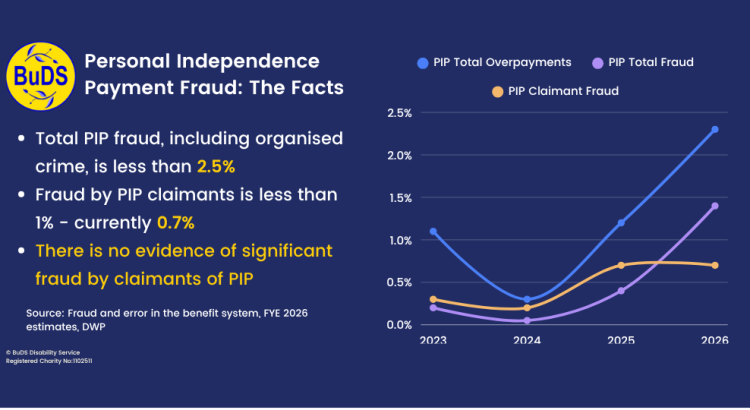
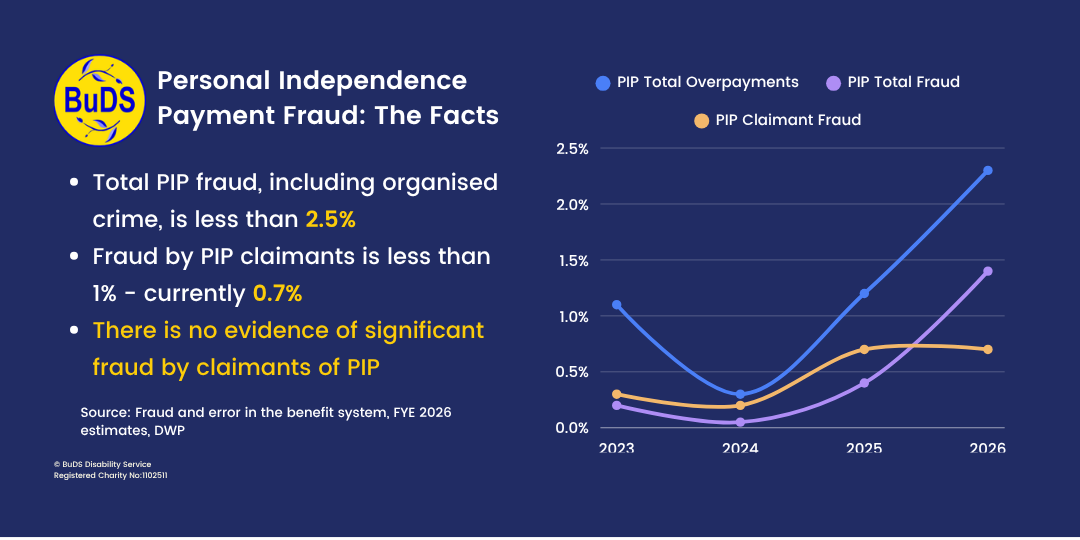
A BuDS Disability Service infographic headed “Personal Independence Payment Fraud: The Facts”. On the right is a line graph with three lines. The blue line shows PIP Total Overpayments climbing from 1% in 2023 to between 2% and 2.5% in 2026. The purple line shows PIP Total Fraud climbing from around 0.7% in 2023 to just under 1.5% in 2026. The gold line shows PIP Claimant Fraud, which climbs from 0.3% in 2023 to 0.7% in 2026. On the left is a bulleted text box with the following text: “Total PIP fraud, including organised crime, is less than 2.5%; Fraud by PIP claimants is less than 1% - currently 0.7%; There is no evidence of significant fraud by claimants of PIP”. Another text box says: “Source: Fraud and error in the benefit system, FYE 2026 estimates, DWP”.

Personal Independence Payment Fraud: The Facts

We’ve produced another handy infographic to help you push back against stories about people fraudulently claiming PIP (Personal Independence Payment). This graphic is free to share or download, and we encourage you to do so. Just use the button below to save the image to your device.

As the infographic shows, the rate of claimant fraud of PIP is less than 1% and there is no evidence of significant fraud by claimants of PIP. Claimant fraud means fraud by individuals, rather than fraud by organised criminals.

Read More
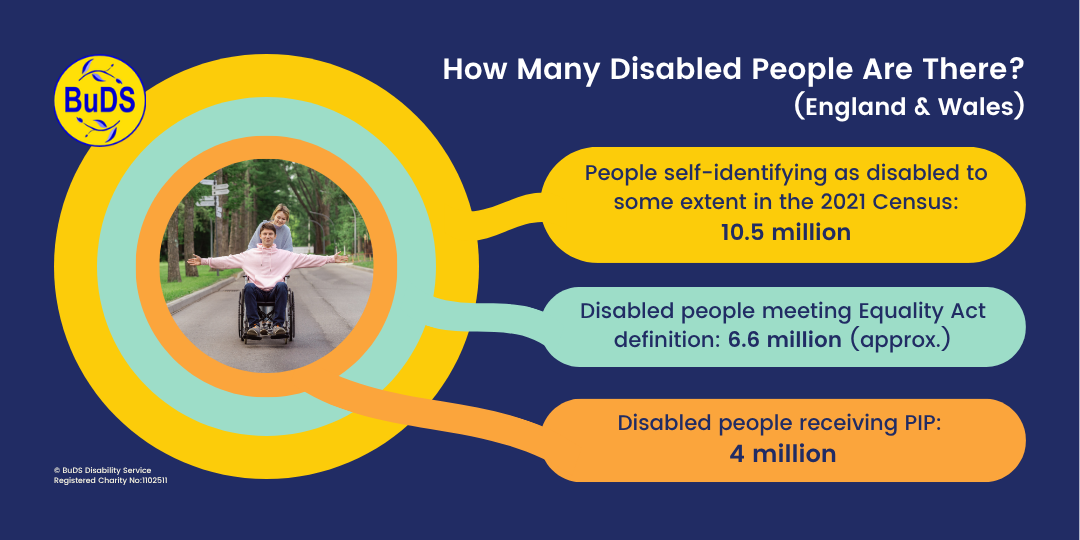
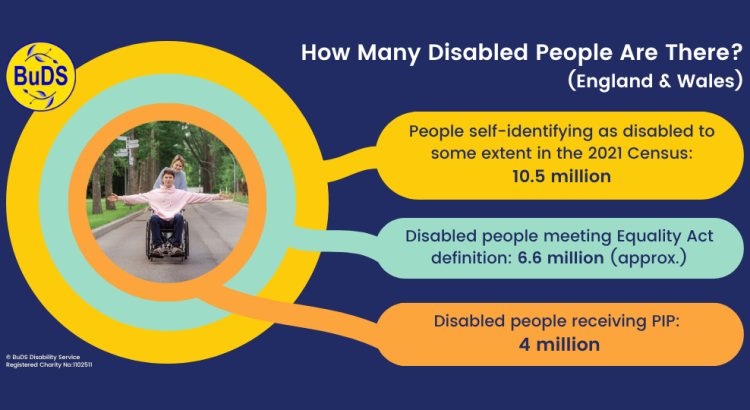
A BuDS infographic headed "How Many Disabled People Are There? (England & Wales)". There are three overlapping coloured circles with labels of the same colour. In the centre of the circles is a picture of a wheelchair-user with his arms spread wide as if in welcome or show. The biggest yellow circle is labelled “People self-identifying as disabled to some extent in the 2021 Census: 10.5 million”. The middle-sized teal green circle is labelled “Disabled people meeting Equality Act definition: 6.6 million (approx.)”. The smallest dull orange circle is labelled “Disabled people receiving PIP: 4 million”.

How Many Disabled People Are There?

This article refers to England & Wales only. Accurate as of August 2026

We’ve produced this handy infographic showing how many disabled people there are in England & Wales. This is free to download and share, and we encourage you to do so. Just use the button below. The public must have access to accurate information when disability is such a hot political topic.

Counting Disabled People

Counting disabled people in England & Wales is much more difficult than it appears. That’s because there are lots of different definitions of ‘a disabled person’.

Census 2021 – 10.5 Million

The Census in 2021 asked people if they had a long-term physical and mental condition and, if they answered yes, asked them whether that condition affected their ability to do everyday activities ‘A lot’, ‘A little’, or ‘Not at all’. The Office for National Statistics count everyone who said their ability was affected ‘a lot’ or ‘a little’ as a disabled person. That’s 10.5 million people in 2021 in England & Wales (this will be larger now).

Equality Act – About 6.6 million

The Equality Act 2010 protects ‘disabled people’ from discrimination. The Act defines a disabled person as someone with a long-term physical or mental condition which substantially limits their day-to-day life. But there is no registration scheme for ‘disabled people under the Equality Act’, so nobody really knows how many disabled people there are according to the Act’s definition.

You can cross-refer the Census 2021 results with the Equality Act. The 4.9 million people who told the Census that their conditions affect their day-to-day life ‘a lot’ certainly also qualify under the Equality Act, which covers people with a ‘substantial’ limit on their day to day life. At least some of the 5.6 million people who told the Census that their conditions affect their day-to-day life ‘a little’ will also qualify under the Equality Act definition. But nobody knows how many. We have assumed a third of those who told the Census that their life was affected ‘a little’ qualify as a disabled person under the Equality Act, but it could be more, or less.

Receiving Personal Independence Payment (PIP) – 4 million

According to the DWP, around 4 million disabled adults in England and Wales currently receive PIP.

PIP is paid not because a person is disabled (whatever definition you use), but if a person is disabled AND their condition affects them in very specific ways. PIP has 12 complicated tests looking at very specific living activities and how people can move around outdoors. Disabled people score points according to how much their conditions affect their ability to do only the activities specified in the tests. An award of benefit is made if the total point score exceeds certain thresholds. This is very different from Disability Living Allowance, which PIP replaced for adults, which looked much more holistically at how much help people needed in their everyday life and when going out.

Because PIP is a very artificial test of disability, people with different impairments and conditions score points very differently under the 12 tests. This is partly deliberate, because PIP was designed to reduce the cost of disability benefits by a fifth. However, the DWP is as incompetent at drafting legislation as it is at administering benefits, and there are a lot of ‘unintended consequences’ arising from the way the tests work. The courts too have decided that some of the PIP tests work differently in fact from the way the DWP hoped they would. 

Compensation, Not Welfare

PIP is supposed to compensate or refund disabled people for the extra costs of being disabled. The charity Scope calculates that disabled people spend on average around £13,140 more than non-disabled people just to live the same lifestyle. The maximum annual award of PIP, which only 37% of claimants receive, is significantly less than this, at £10,120. The average PIP award is only £6900.

Social Security, Not Welfare

If disabled people fall into crisis, the state then pays to help them cope and to get out of crisis. Providing crisis support is far more expensive than making a small payment to stop the crisis occurring. Supporting a single homeless disabled person, for example, costs councils on average £13,000 per annum, plus the cost of temporary housing, additional GP visits, hospital stays, etc. The reason disability benefits were introduced was to save money, because giving disabled people a small ‘social security’ payment was much cheaper than the alternative.

When politicians talk about cutting ‘welfare’, this is just economic incompetence. If you cut the small social security amounts which help disabled people stay independent and out of crisis, the taxpayer will end up paying much more when those disabled people fall into crisis. BuDS looked into this matter in detail when it was suggested that ‘welfare’ could be cut to fund defence – you can find out more by clicking the button.

Are Too Many Disabled People Claiming PIP?

There is no objective evidence of this. The 4 million adults currently claiming PIP matches up quite well with the 4.9 million people who told the Census in 2021 that their conditions affect their day-to-day life ‘a lot’.

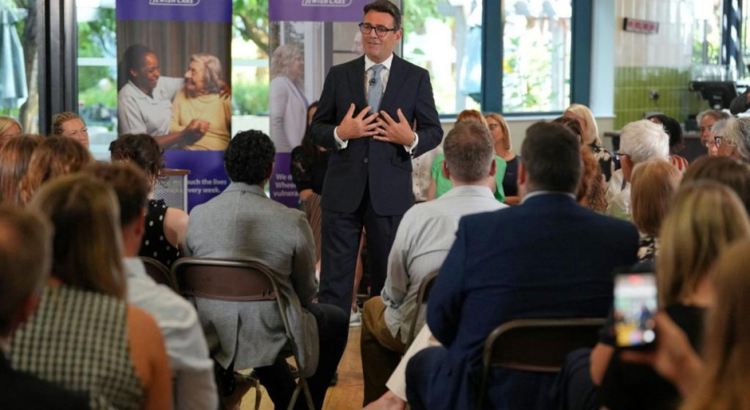
The Prime Minister, Andy Burnham, making a speech. He is a white man with dark hair and glassess dresse in a dark suit. He has his hands spread on his chest. He is standing in a care home with rows of seated people in front of him. Image copyright: BBC

Shelve assisted dying plans until after social and palliative care is fixed, says Andy Burnham

29 July 2026

The Prime Minister, Andy Burnham, has said that the ‘fixing’ of palliative and social care must happen before any steps are taken towards legalising assisted dying or assisted suicide. His comments, made at the launch of the PM’s plans to transform social care for older and disabled people, are widely seen as a rebuke to Lauren Edwards and a handful of other Labour MPs and Peers who are trying to re-introduce a private assisted suicide bill drafted by the lobby group Dignity in Dying.

BuDS Disability Service very much welcomes the PM’s sensible statement. We look to Lauren Edwards to now withdraw her Bill and not to waste the House of Commons’ time on an initiative which is not needed and which will inevitably fail.

The disabled-led charity, which has consistently opposed assisted suicide as a risk to disabled people, said:

“British advocates for assisted suicide claim it is necessary because many people die in pain and distress that could be averted if they took their own life through medically-assisted suicide. It is obvious that this claim relies on NHS and hospice palliative and end-of-life care being inadequate. The PM is perfectly right to say that the first step must be to fix palliative and end-of-life care, and only then to assess whether the claim made by advocates of assisted dying is correct”.

“That said, there are other issues which also need resolving in any future debate about assisted dying. These are:

  • The obvious risks to disabled, older and vulnerable people from any state-sanctioned scheme to help people to take their own life, whether at the end of life or otherwise. BuDS feels that an explicit judicial decision after a full legal process must be required before the state takes anyone’s life, even at their own supposed request. Given that the rights of disabled people are protected in law and that courts are routinely involved in the protection of vulnerable people, it is extraordinary that pro-assisted dying advocates suggested that NHS patients might have their life taken by NHS doctors after a purely administrative process far less rigorous than a DWP assessment for benefits.
  • The risk that assisted suicide is seen by patients, relatives and carers, and the NHS and social care providers, as a legitimate alternative to continued care and support. Once people can ‘choose’ to have their life ended, the pressure – both self-imposed and externally applied – to make that choice will become very strong.
  • British society for hundreds of years has not accepted that suicide is a rational response to life event, Society sees suicide and suicidal ideation as a symptom of distress, fear or mental illness. The NHS, councils, the government and the voluntary sector work to identify suicide risk and reduce it. To legitimise ‘rational suicide’ in some circumstances is to entirely overturn the way British society looks at suicide.
  • The ‘foot in the door’ tactic used by advocates for assisted dying. The ideological policy goal of Dignity in Dying, formerly known as the British Euthanasia Society, of Humanists UK, and of many of the individuals who support assisted dying, is for assisted suicide to be freely available on demand. BuDS thinks that these pro-suicide groups and people are using support for humanitarian assisted dying purely as a stepping stone towards their ideological goal. This is precisely what has happened in many other countries around the world who introduce ‘humanitarian’ assisted dying only for the scope of the suicide scheme to widen later. This issue must also be addressed whenever assisted dying is next debated.”  

(ends)

Date:                29 July 2026

Enquiries:        info@buds.org.uk or message BuDS through social media.

A portrait image of Sir Stephen Timms MP. He is a older white male with short hair, wearing a blue suit and red tie.

Interim Report of the Timms Review of Personal Independence Payment (PIP)

In June 2025, the Government decided to review the main UK disability benefit, Personal Independence Payment or PIP. This review was co-chaired by Sir Stephen Timms, Minister for Social Security and Disability, Sharron Brennan and Dr Clenton Farquharson CBE. The Review is widely known as the ‘Timms Review’.

Before announcing the review, the Government had tried to get Parliament to agree to significant cuts to PIP. These proposed cuts were very unpopular and not supported by many MPs. The Government introduced the Review rather than pressing ahead with the cuts.

On 9 July, the Government published the Interim Report of the Timms Review. The Interim Report is not the final report of the Review. It sets out their thinking so far, and the evidence they are replying on. The Final Report of the Timms Review is due in the autumn of 2026, but may be delayed.

You can use the buttons below to visit the main Government page about the Timms Review and to see the Interim Report.

BuDS’ Response to the Interim Report

BuDS expressed strong concern about the Interim Report, calling it ‘incomplete’, ‘less than honest’ and ‘calculatedly misleading’.

BuDS has engaged with the DWP for nearly 20 years. We think that the Interim Report entirely fails to acknowledge that PIP was designed in 2012 by the then Government primarily to cut the cost of disability benefits by a fifth. This was an objective openly acknowledged by the Government at the time. Many of the faults in PIP noted by the Review, such as the complicated scoring system, the traumatic assessment and re-assessment process, and the use of unaccountable private assessment companies, are not system defects which have arisen over time, but deliberately designed features of PIP. This incomplete and less than honest account of the origins of PIP sets the wrong tone, corrupts the evidence base, and raises concern that the Review is unduly influenced by departmental interests.

BuDS has also noted the repeated references in the Interim Review to overriding cost limits. These include that any recommendations must remain “within the Office for Budget Responsibility’s (OBR) projections for future spending on PIP” (para 4), that “final recommendations must sit within the OBRs projections for future spending on PIP” (para 45) and “The steering group will therefore need to carefully consider how to balance the focus of the Review between rights, fairness, independent living, and sustainability within fixed financial limits” (para 46).

Societal changes are inevitably creating more disabled people. The population is aging, the ongoing Covid pandemic and cost of living crisis are significantly impacting both physical and mental health, and deteriorating health and care services are leading to worsening health. The Review is calculatedly dishonest about these facts.

If the Review has already accepted a fixed ceiling for the amount that the Government is willing to pay to support an increasing number of disabled people, BuDS says, then the Review has no choice but to rob Peter to pay Paul: to cut support from some disabled people to preserve it for others. The Interim Report fails to make this clear, which is another calculated dishonesty.

The Future of PIP

BuDS has also called for ‘meaningful, positive’ reform of PIP so that the benefit helps integrate disabled people into society, rather than exclude them.

Disabled people want to be part of society, but they face barriers which exclude them. Overcoming those barriers costs money, and PIP is supposed to compensate disabled people for the additional cost of simply being a normal member of society. Scope has calculated that households with a disabled person need at least £1100 extra per month just to play a normal role in society. PIP currently contributes less than half that amount on average, so clearly PIP payment levels need to substantially increase.

Alongside payment levels, the PIP application and assessment process needs to be completely replaced. When PIP was designed in 2010-11, the stated intent of the then Government was to cut the cost of disability benefits by a fifth. PIP was designed to achieve that cut, not to meet the legitimate needs of disabled people. The hideously complicated and irrational scoring system, the intrusive and traumatic assessment and re-assessment process, the employment of unaccountable private assessment companies: these all arise from that intention to make disability benefits hard to claim and retain, so as to make cuts.

BuDS thinks that the Timms Review now has the opportunity to sweep away the conscious and deliberate brutality of the past and introduce a positive and life-affirming application and review process for PIP. Disabled people need to be able to freely and easily get the help with the additional costs they face because they are disabled, and to get that support adjusted when their circumstances change. The appalling current system where disabled people fear losing PIP because DWP may arbitrarily change their mind, or make assumptions without evidence, must end.

The new application process for PIP must be streamlined and sensible. So far as possible, disabled people diagnosed with permanent medical conditions with predictable impacts on their daily living and mobility should receive PIP by default. Anyone diagnosed with paranoid schizophrenia or a spinal injury, for example, is likely to face significant additional costs arising from their condition; it is inefficient, wastes taxpayer funds and is brutal and cruel to subject disabled people to a detailed assessment when it is obvious from the nature of their diagnosis that they will face additional costs in living a normal life. And the absurd, costly and harsh DWP practice of making fixed term PIP awards and forcing disabled people into cycles of constant reassessment must end.

Disabled people who work may face extra costs because they are a disabled worker compared to disabled people who do not work, and PIP’s structure should reflect that. The overlapping roles of PIP and Access to Work need to be eliminated. In the same way, disabled people who are students may face extra costs because they are a disabled student compared to disabled people who are not studying, and the overlapping role of Disabled Students Allowance needs to be eliminated. PIP should be a single gateway to the financial compensation for extra costs that disabled people need to support them in their normal lives as normal members of society.

Finally, PIP needs to be seen as an investment by society in disabled people, who make up a fifth of society. With reform of the DWP and with appropriate help, millions of disabled people will be able to stop leading passive, furtive lives, hiding from the DWP, and become productive positive and proud contributors to their society, as workers, volunteers, parents and carers. PIP must become a major driver and enabler of economic and social growth, tapping into a huge latent reservoir of talent, skills and determination.

You can see two press statements from BuDS below.

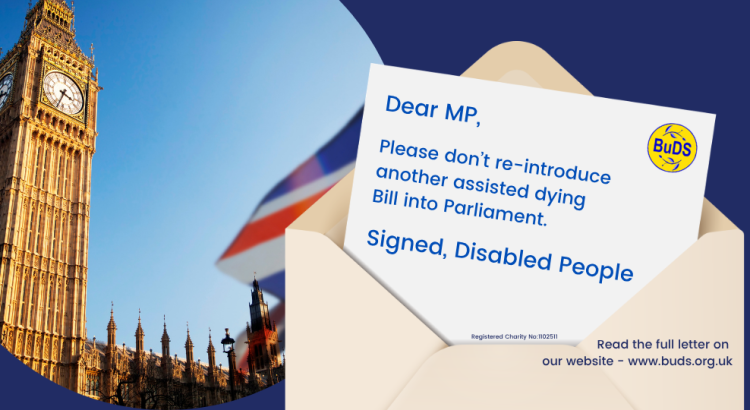
A blue graphic image. On the left is a circle containing a picture of the Palace of Westminster with a Union Flag flying outside it. On the right is a graphic of a letter emerging from an envelope. On the letter is printed: “Dear MP, please don’t re-introduce another assisted dying Bill into Parliament. Signed, Disabled People. The BuDS logo is shown on the letter. On the envelope is written: “Read the full letter on our website – www.buds.org.uk”.

Open Letter to Members of Parliament

Dear Members of Parliament

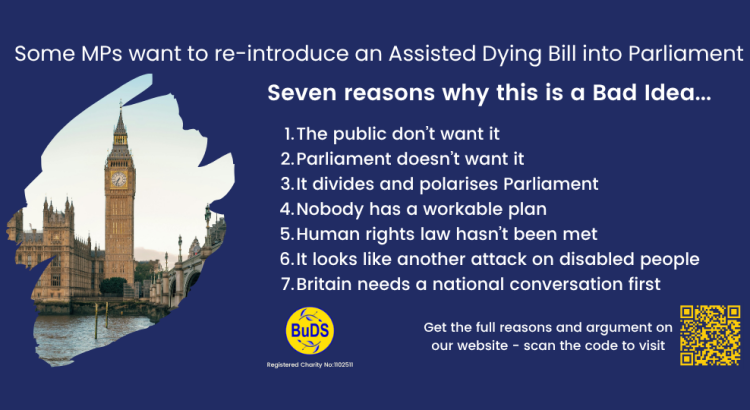
Please don’t re-introduce an assisted dying Bill into Parliament. As disabled people from across England, including many with degenerative and terminal conditions, we urge you to address this highly complex and controversial issue in a mature and measured way. Rushing ahead with badly-drafted and dangerous Bills is not the way to help disabled and dying people.

Read More
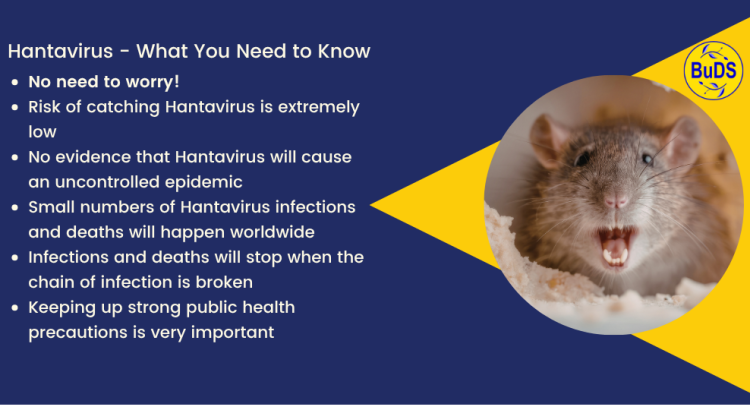
A blue and yellow infographic. On the right is a circle containing a picture of arat with its teeth bared. On the left is a text section reading: "Hantavirus - What You Need to Know • No need to worry! • Risk of catching Hantavirus is extremely low • No evidence that Hantavirus will cause an uncontrolled epidemic • Small numbers of Hantavirus infections and deaths will happen worldwide • Infections and deaths will stop when the chain of infection is broken • Keeping up strong public health precautions is very important". The BuDs logo is also shown.

Hantavirus Outbreak

The media are getting very excited about Hantavirus and its possible risk to human health. BuDS researchers have used only high quality scientific and academic sources to cut through the hype and give you the facts that you need to know.

This article is accurate up to 16 May 2026.

Do I need to be worried about Hantavirus?

No. Unless you come into contact with rats, mice or other rodents, or you are a close contact of passengers on the MV Hondius cruise ship, you do not need to worry about Hantavirus.

Read more: Hantavirus Outbreak

What is Hantavirus?

Hantavirus is a family of animal viruses infecting rats, mice and other rodents. Each species of rodent tends to have its own Hantavirus, which they carry without getting ill.

How Do You Catch Hantavirus?

With the exception of Hantavirus Andes (see below), you can only catch Hantavirus from an animal, specifically a rat, mouse or other rodent, or from its urine or droppings.

There are many hantaviruses but only some of them can be caught by humans.

Humans who have contact with rat, mouse or other rodent’s urine or droppings can sometimes catch Hantavirus from that urine or droppings. If droppings become dry and dusty, the dust can also transmit the virus to humans who breathe it in. Contact with rodents, or being bitten by them, can also pass the virus to humans.

The World Health Organization estimates that 100,000 people globally catch Hantavirus every year from rats, mice and other rodents. In Europe, there are several thousands of cases every year. 

Tests

There are reliable laboratory tests for many of the Hantavirus family of viruses, including the Andes variant. These tests can confirm that a person is infected with a Hantavirus. However, the tests may not work in the earlier stages of infection.

How Serious is Hantavirus?

Most people who catch Hantavirus from a rodent will have typical flu-like symptoms such as fever, headache, muscle aches, abdominal pain, nausea or vomiting. With good medical care, most people will make a full recovery.

European hantaviruses can sometimes lead to a serious condition called haemorrhagic fever with renal syndrome (HFRS). This condition affects the kidneys and blood vessels and can lead to low blood pressure, bleeding disorders and kidney failure. However, most people with HFRS will make a good recovery and very few will die.

South American Hantaviruses can sometimes lead to Hantavirus cardiopulmonary syndrome (HCPS). HCPS is a very dangerous and severe respiratory illness, and around half the people who develop it can die. However, many of these deaths occurred in areas without access to advanced medical care, so it isn’t known what percentage of people with HCPS might die if they had first-class medical care.

Treatment & Vaccines

There is no specific treatment or cure for Hantavirus infections. However, advanced medical care and antiviral treatments are often successful. Most deaths from Hantavirus infections occur in areas with limited access to advanced healthcare.

There is currently no vaccine to protect against Hantavirus infections, although some are under development.

Hantavirus Andes

Hantavirus Andes is a small family of variants of a South American Hantavirus (ie, there are several Andes viruses, not just one). It is the only Hantavirus known to pass from human to human, rather than from a rodent to a human. Infection with the Andes variant can develop into Hantavirus cardiopulmonary syndrome (HCPS), which can be fatal.

There have been several small outbreaks of the Andes Hantavirus in recent years, all in South America.  None of these outbreaks have spread outside the immediate area of the first cases. The latest outbreak, in Argentina, spread further than any other outbreak but isolating cases brought it to a halt, although not until 11 people had died.

There is no evidence whatsoever to suggest that Andes Hantovirus is a virus which can cause a large-scale epidemic or global public health emergency.  All the evidence from this present outbreak and all previous outbreaks shows that simple public health measures like isolation of infected people and their contacts will quickly bring any outbreak to an end.

The MV Hondius

The MV (motor vessel) Hondius is a small cruise liner which mainly operates in and around South America. Passengers on cruise ships are typically crowded together, and conditions are ideal for the spreading of infectious diseases. During the Hondius’ most recent voyage, in April and May 2026, an outbreak of Andes Hantavirus occurred on the ship.

What is the Risk to the Public of the MV Hondius Outbreak?

The risk to the general public is very low. Andes Hantavirus does not spread easily between people (see below). This means that, even when infected passengers or crew have carried the virus to their homes and families, the further spread of the virus can be easily controlled.

The WHO, ECDC and other health authorities across the world are carefully tracing everyone that could possibly have caught Andes Hantavirus from a member of the crew or passenger of the MV Hondius. This includes not just their families and friends, but people sitting near them on aircraft or public transport, medical staff, drivers, etc. All these people will be medically monitored and asked to self-isolate. In this way, the future spread of the Andes virus eventually will be stopped.

We say eventually, because stopping the chain of infections will not happen quickly, but over a period of months. It may be several months before the chain of infections is finally stopped, especially if a few people are missed off the list by mistake. Sadly, because Andes infections can be fatal, there will be more deaths too.

The media will report excitedly about every new case and death, but the important thing to remember is that there will be no uncontrolled epidemic of Andes Hantavirus cases. There will be a linked chain of a limited number of infections over future weeks and months which will eventually stop. That will be the end of this Andes outbreak.

How Long Before People Show Symptoms of Andes Hantavirus?

People do not have symptoms of illness as soon as they catch Andes Hantavirus. Symptoms can appear between 1 and 6 weeks after infection. However, most people show symptoms between 2 and 4 weeks after infection. This means that we will not know until the end of May which passengers on the MV Hondius are going to get ill. Some people may give Andes Hantavirus to family members, friends or work colleagues before they realise they have the virus.

When Are People Contagious for Andes Hantavirus?

With most viruses, people are not actively spreading the virus in their breath and bodily fluids from the moment they are infected. Different viruses have different periods when the person is actively spreading the virus. This is known as the contagious period. For example, people infected with Covid-19 are most contagious in the two-week period before they start to show symptoms.

For Andes Hantavirus, doctors thought until recently that the contagious period was from the day that a person started to show the first symptoms of illness until they died or recovered. Now, doctors think that infected people may be contagious for up to two days before they start to show symptoms. However, the most contagious period is the first week after first starting to show symptoms.

Knowing the period when people are contagious helps with contact tracing and isolation. It is only the contacts of infected people from a few days before they started to show symptoms that are at risk of also developing Andes Hantavirus. People exposed to infected people weeks before they showed symptoms are not at risk. This vital point is not being properly explained by the media.

How Infectious is Andes Hantavirus?

Viruses pass between people in three main ways.

Aerosol. This is where tiny particles of virus are suspended in the air breathed out by infected people. If other people then breathe in enough particles of virus, they can catch the virus too. The risk to other people then depends on how long the virus can live in the air, and how much is needed to trigger an infection. A virus which can live a long time in the air, or which only needs a small amount to trigger an infection if breathed in, will be extremely infectious. One infected person could create a big cloud of virus in a crowded room or hall and everyone in that hall potentially could catch the virus by breathing it in. A virus which lives a shorter time in the air, or which people need to breathe in a lot to catch, would be less infectious. Many common viruses spread by aerosol including measles, influenza and Covid-19. Viruses spread by aerosol are often called airborne viruses.

Droplet. This is where particles of the virus float in tiny droplets of water suspended in the air breathed out by infected people. The droplets remain floating in the air for a short time. If other people then breathe in enough droplets containing the virus, they can catch the virus too. However, because the water droplets breathed out by people cannot travel very far, or last very long in the air, viruses spread by droplet are much harder to catch than those spread by aerosol. Common viruses spread mainly by droplets include RSV (respiratory syncytial virus), adenoviruses, and human metapneumovirus).

Surfaces. This is where particles of the virus float in tiny droplets of water suspended in the air breathed, coughed or sneezed out by infected people, and those droplets then fall out of the air and settle on surfaces. If someone else touches that surface, the virus can get onto their hands, and if the person then touches their mouth, nose or eyes, the virus can get inside their body and cause an infection. Some viruses can survive in water droplets on surfaces for hours or even days. Common viruses mainly spread by surfaces include norovirus and the common cold. Sometimes viruses spread in this way are said to be spread by fomite.

Andes Hantavirus outbreaks in South American before the voyage of the MV Hondius gave the WHO and health authorities an opportunity to study the situations in which people caught the virus from another person. They found that nearly everyone who caught Andes Hantavirus from another person had spent a lot of time near the infected person, often sharing a bed or bathroom, providing personal care, or sharing a small cabin or room. People who did not spend time very close to an infected person did not seem to catch the virus. This strongly suggested that Andes Hantavirus spread mainly by droplet and surface infection.

Since the outbreak on the MV Hondius, health authorities have noted that some people seem to have caught Andes Hantavirus by being in the same indoor space close to an infected person. This does not confirm that Andes Hantavirus is spread by aerosol, because droplet or surface infections might also explain how the infections occurred. However, to be cautious, the WHO, ECDC and UKHSA have upgraded their advice about how Andes Hantavirus might be spread.

The new advice says that anyone who spends more than a brief time within 2 metres of an infected person indoors is at high risk of catching Andes Hantavirus, unless they have taken public health precautions. If a person is indoors and meets an infected & contagious person only briefly, or is more than 2 metres away, or they meet outdoors, their risk of catching the Andes Hantavirus is classed as low.

This advice suggests that WHO and other health authorities feel that droplet or surface infection is still the main way that Andes Hantavirus spreads between people, but they are not ruling out short-range aerosol spread as well. They do not seem to think, based on the evidence so far, that Andes Hantavirus spreads mainly by aerosol, that is to say it is not primarily an airborne virus which can be caught simply by breathing in the exhaled breath of an infected and contagious person.

Importantly, WHO and national public health authorities have said that medical and care staff working with infected people should take precautions in case Andes Hantavirus is spread by aerosol. This mainly means that medical and care staff will wear PPE respiratory masks rather than surgical ones. These masks, when properly worn, filter virus out of the air breathed in by the wearer.

People at High Risk of Catching Andes Hantavirus

The current advice from the WHO and ECDC is that the following groups of people are at high risk of catching Andes Hantavirus. This does not mean that they will catch the virus, only that they are at high risk of doing so.

An important condition is that people taking infection control precautions are not at high risk, even if they have spent time with or cared for contagious patients with   Hantavirus, These precautions are wearing a PPE respiratory mask, eye protection, a gown and gloves.

The groups of people at high risk are those who, without having taken these infection-control precautions:

  • Were exposed to the saliva, blood, or other bodily fluids of an infected person while they were contagious, or handling their personal items, worn clothes or bed linen (remember, infected people are only contagious from a few days before they show symptoms and while they have symptoms, not all the time)
  • Had direct physical contact, including potential exposure to saliva or other bodily fluids, with an infected person while they were contagious. This means giving an infected person personal support and care, such as healthcare, feeding or washing; or sharing a bed space or bathroom; or intimate contact, etc.
  • Being in close proximity with an infected person while they were contagious, meaning being indoors within 2 meters for at least 15 minutes, or being indoors with them on multiple occasions. This would include personal face-to-face encounters, sharing meals, social gatherings, sharing a small vehicle like a taxi, and being in the same room, unless the room was very large.
  • Being within 2 metres of an infected person while they were contagious on public transport, ie near them on the same plane, bus, coach, or train carriage.

The WHO with national public health authorities, such as UKHSA in the UK, will trace all high-risk contacts of Andes Hantavirus patients and advise them to self-isolate away from their family, in case they may have the virus. They will also have daily medical checks and be regularly tested for the virus. If any of these people do test positive or develop symptoms, their high-risk contacts will also be traced and the same procedure repeated. 

The WHO advise that high-risk contacts should self-isolate for 42 days. This period, it is thought, will allow symptoms of Andes Hantavirus to develop if a person is infected. After 42 days without symptoms or a positive test, the person will be regarded as free from the virus.

People at Low Risk of Catching Andes Hantavirus

The WHO and ECDC currently say that people who have had contact with an infected person who is contagious in the following circumstances are at low risk of catching Andes Hantavirus. This does not mean that they will not catch the virus, but that they are at low risk of doing so.

The groups of people at low risk are those who, without having taken infection-control precautions:

  • Were onboard the MV Hondius or another ship but didn’t share a cabin or have direct or prolonged indoor contact with an infected person who was contagious.
  • Shared public transport, ie a plane, bus, coach, or train carriage, with an infected person who was contagious but were more than 2 metres away from the infected person
  • People who briefly met an infected person who was contagious indoors, eg as they passed through an port or airport
  • People who only met an infected person who was contagious out of doors, without close or lengthy contact

These low-risk contacts will also be traced and their health monitored, in case they do test positive or develop symptoms. However, they will not need to self-isolate like high risk contacts.

Risk to the UK General Public

The risk to the general public in the United Kingdom from Andes Hantavirus is very low indeed. The risk of meeting someone who is infected and contagious with Andes Hantavirus is extremely small. Nobody needs to take any special precautions against Andes Hantavirus.

This is because the British passengers and crew from the MV Hondius who are high-risk for catching Andes Hantavirus are under medical monitoring. The low-risk passengers and crew and the contacts of all the passengers and crew are also being medically monitored. Anyone who shows signs of Andes Hantavirus will be quickly spotted and isolated. This means that the risk of a member of the public coming across someone with the virus is extremely small.

It is likely that more people in the UK will develop the virus and become ill, and some may die. It is also likely that contacts of the original passengers and crew will develop the virus too, and some may die. Andes Hantavirus is a dangerous virus and sadly there will be casualties.

A Controlled Chain of Infections, not an Epidemic

Coming weeks and months will see a linked chain of a limited number of Andes Hantavirus infections over future weeks and months. These infections will eventually come to an end, as the chain of infection is slowly broken. That will be the end of this Andes outbreak.

The key thing is that there will be no uncontrolled epidemic of Andes Hantavirus cases. The virus will not spread over the world and infect millions of people like Covid did in 2020. Andes Hantavirus is not as infectious as Covid, because Andes is not a mainly airborne virus like Covid. This alone makes a global epidemic of Andes Hantavirus very unlikely. The fact that this outbreak happened on a cruise ship, and so contacts can be easily traced, makes an uncontrolled epidemic extremely unlikely.

Sources

BuDs has used only World Health Organisation (WHO), European Centre for Disease Control (ECDC) and UK Health Security Agency (UKHSA) publications as soyurces of information for his article.

Questions

If you have any questions about Hantavirus, please use the form below to ask them, and we will get back to you as soon as we can.

    Please answer this anti-spam quiz: 

    How many legs does a duck have?

     By using this form you agree with the storage and handling of your data by this website. See our Privacy Policy

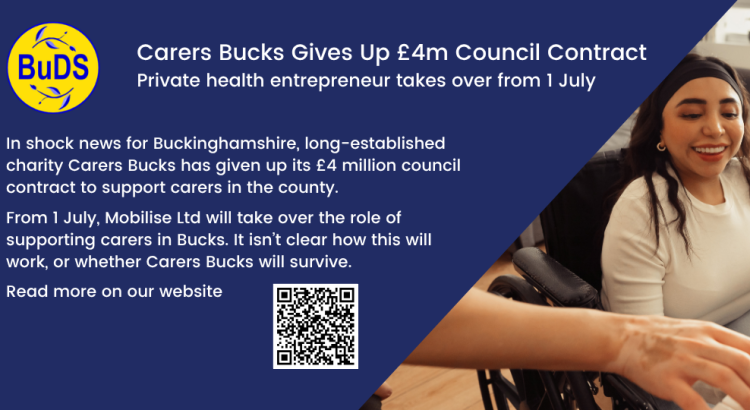
    An infographic with the BuDS logo, a blue background and a picture of a wheelchair-user. Text reads “Carers Bucks Gives Up £4m Council Contract. Private health entrepreneur takes over from 1 July. In shock news for Buckinghamshire, long-established charity Carers Bucks has given up its £4 million council contract to support carers in the county. From 1 July, Mobilise Ltd will take over the role of supporting carers in Bucks. It isn’t clear how this will work, or whether Carers Bucks will survive. Read more on our website.

    Carers Bucks Gives Up Bucks Council Contract

    Carers Bucks has given up its £4 million council-funded contract to support carers in Buckinghamshire. In a shock move, Carers Bucks decided not to re-apply for the contract, which has been awarded to Mobilise Ltd instead. While no formal announcement has yet been made, many observers fear that the Carers Bucks charity may now close later in the year.

    Read more: Carers Bucks Gives Up Bucks Council Contract

    All main councils in England are funded by the Government to commission services to support carers in their area. For many years, Buckinghamshire Council has given a contract to Carers Bucks, a local registered charity, to provide those services. From 1 July 2026, however, a private health entrepreneur, Mobilise Ltd, will be supporting Bucks carers instead.

    Details of the service that Mobilise will provide in Bucks is not yet clear. However, Mobilise has the carers support contract for many councils, including Milton Keynes, Luton & Bedford, and the service provided there is primarily online. Carers in those areas can apply online for ‘dynamic digital carers’ assessments’ which creates an online ‘personalised support plan’. This is claimed to allow social workers to ‘proactively track a carer’s needs’ and help them to receive ‘continuous tailored support’. This digital, online, model, if rolled out in Bucks, would be very different from that provided by Carers Bucks, which is based on more traditional face-to-face and group support for carers.

    Under contract and employment law, Carers Bucks will transfer information, paid staff and some resources to Mobilise Ltd when they take over. However, it is not clear whether activities, groups and volunteers provided by Carers Bucks outside their council contract will survive after 30 June.

    Carers Bucks have said that its CareFest events in June will go ahead as planned. Billed as a celebration of carer friendly communities, the events may now be a bittersweet marking of the end of Carers Bucks’ long history in the voluntary sector in Bucks.

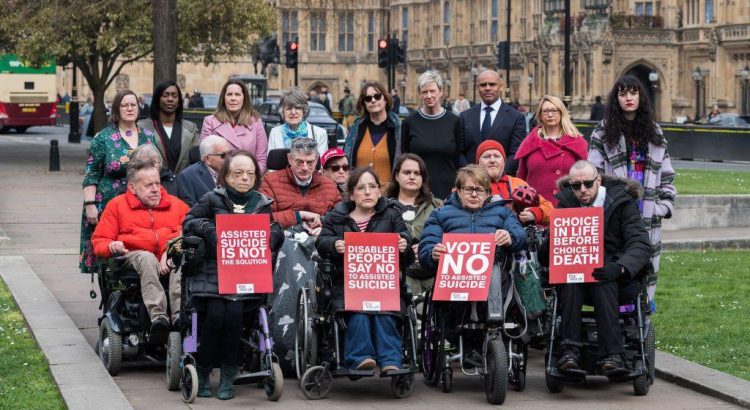
    A group of disabled people protesting outside the Houses of Parliament against the Assisted Dying Bill

    BuDS Welcomes Failure of Assisted Suicide Bill

    BuDS Disability Service has welcomed the Parliamentary failure of the Terminally Ill Adults (End of Life) Bill today, Friday 24 April. This Bill is commonly known as the Assisted Dying or Assisted Suicide Bill. This failure at Westminster marked the defeat of all the Suicide Bills attempted to be rushed through British parliaments by lobbyists in the last two years.

    Welcoming the Parliamentary failure, BuDS said:

    “The failure of the Bill is good news for dying people, for the NHS and for Britain. We say this for two main reasons:

    1. This Bill would have done nothing to address the humanitarian concerns that many people have about end-of-life care. It was a lobbyist Bill designed to introduce suicide on demand for NHS patients, something which no political party or politician had ever even mentioned before this Bill was introduced.
    2. The Bill was dangerous because it did not protect the basic human rights of British people. This was said from the start by disability and human rights groups like BuDS but was dramatically proven when the Lord Chancellor had to prevent a similar Bill, in the Isle of Man Parliament, from becoming law on these exact grounds”.

    Much has been said about how this Bill has been ‘blocked’ by unscrupulous Parliamentary tactics, especially by ‘unelected Lords’. The reality is rather different. This Bill was not Government legislation, but a Private Members Bill (PMB). PMBs cannot be used to make complex and controversial legal reforms because they do not have enough Parliamentary time, even in the best of circumstances, to make such broad changes. The Terminally Ill Adults Bill was doomed to fail from the start by the incompetence of its sponsors and multimillionaire lobbyist backers, not by any Parliamentary blocking.

    The passage of this Bill through Parliament has proved that the welfare of dying people and the protection of vulnerable people cannot be left to opaquely-funded, multimillionaire lobbying groups, especially those ideologically committed to suicide and euthanasia. A properly informed national conversation about end-of-life care and assisted suicide must happen before there is any future attempt at legislation. A Royal Commission or similar independent official body must now look at all the issues, consult widely, gather objective evidence and make recommendations. BuDS and other disabled-led organisations are ready to play their part in that conversation.