
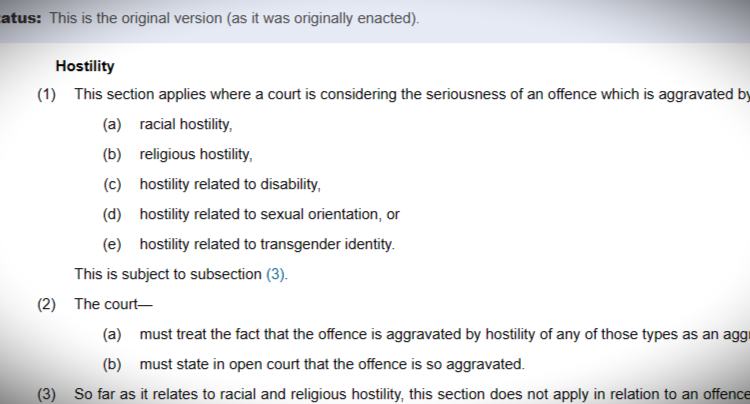
Crown Prosecution Service (CPS) guidance about whether an offence was aggravated within the meaning of s.66 of the Sentencing Act 2020 can be found below. This article was written by Olivia Hopwood, a law student, and verified and approved by a leading criminal law solicitor on behalf of BuDS. It is written mainly for professionals and practitioners, and some may find the language difficult to follow. If you need any help with this article, please contact us.
This article is intended as a supplement to a main article – read it here.
Demonstrating Hostility
- The offence to be sentenced has one or more identifiable victims.
- The victim (or one of them) has a disability (i.e. some physical or mental impairment) or there is evidence that the offender presumed that he or she did so at the time of the offence.
- The offender, by words or deeds or other indication, demonstrated (i.e. actually manifested or indicated) some hostility towards the victim based on the actual or presumed disability. Where the offence itself involves some hostile act towards the victim (i.e. an offence of assault) there must additionally be some evidence of a demonstration of hostility on grounds of the actual or perceived disability. It need not be proved that the offender was actually motivated by any malevolence on grounds of the disability but it must be shown that, viewed objectively, he did in fact make some outward indication of hostility on that ground. Verbal abuse, referring to the disability or a feature of it, will suffice provided it actually demonstrates hostility towards the victim’s disability. Expressions of, or behaviour consistent with, contempt for the individual victim is unlikely alone to suffice, unless it can be shown to amount to the necessary demonstration of hostility based on the actual or presumed disability.
- The demonstration of hostility must have occurred at the time of or immediately before or after the conduct element of the substantive offence.
- In any case involving multiple offenders, consider first whether there is evidence that each offender, by his behaviour in committing the conduct element of the substantive offence, associated himself with the demonstration of hostility proved (in which case all will be liable for the aggravating feature). If there is no such evidence, can it be shown that the individual offender was himself responsible for the demonstration of hostility relied upon?
Evidence Necessary To Demonstrating Hostility
- Evidence of the utterance, doing or showing of any indication of hostility towards the victim. The evidence should be as particular as possible as to the terms of the indication of hostility.
- Evidence that the victim is disabled.
- Alternatively and/or additionally, evidence that the offender either knew or presumed that the victim had a disability.
- Evidence that the hostility referred to in (1) was based on the actual, known or presumed disability of the victim.
- Evidence that the demonstration of hostility relied upon was more or less contemporaneous with the conduct element of the offence, or that it can immediately be related to it in time.
Motivated By Hostility
- The offender can be shown to harbour a hostility towards a person or persons who have a disability or a particular disability (some actual physical or mental impairment) or are presumed to.
- At least one reason why the offender committed the offence was his hostility towards that person or such persons who have or are perceived to have a disability i.e. his purpose or incentive for committing the substantive offence included that hostility, even if it was also motivated by other reasons. It need not be shown that it was his sole or main motivation.
- It need not necessarily be the case that the immediate victim of the offence has a disability or the particular disability. Indeed, it is not necessary that there is one, or more than one, victim of the offence, provided that the directed hostility is one of the motivations. For example, an offence may be directed at:
- someone collecting for a disabled charity;
- the premises of such a charity; or
- the partner, child or friend of a disabled person.
Evidence Necessary For Proving Motivation Of Hostility
- Primary evidence, whether direct or circumstantial, from which it can be deduced or inferred that the offender has a hostility towards people (or one person) with a disability or a particular disability. The kind of evidence will vary from case to case but may well include, for instance:
- words, whether contemporaneous or not;
- writings;
- social media postings;
- insignia;
- presence with others promoting such hostility or association with them;
- previous incidents of hostility, e.g. targeting only disabled persons as the victims of criminal attacks or forms of abuse, such as a disabled person’s house for criminal damage but no other houses in the same street; and
- previous convictions for offences directed at similar victims.
- Evidence from which it can be inferred that the current offence is motivated by the hostility referred to. In some cases the existence of the hostility and the fact of its contribution to motivation may derive from the same evidence and may be direct and simple: for example, the words accompanying the conduct element of the offence, as reported by the victim, may make clear the hostility of the offender for disabled people and the association of the feeling with the commission of the offence. In other cases a more determined search for such evidence will be necessary.