
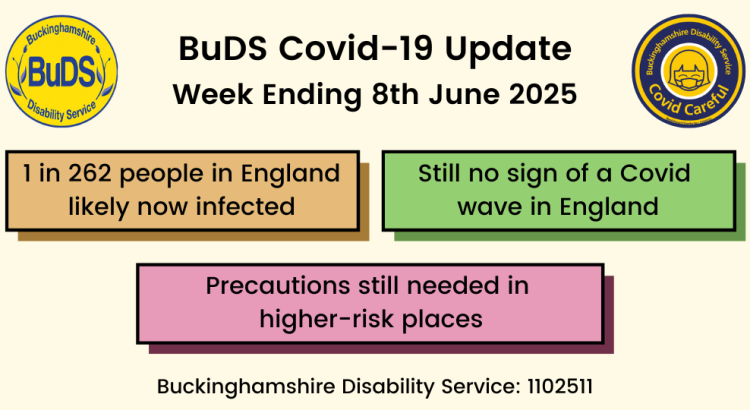
There is still no sign yet of a Covid wave in England. Covid infection levels in England have remained static in the week to 8 June. Around 1 in every 262 people in England were infected, and the overall Covid risk remained Moderately High.
You will have seen a lot of social media chat about new variant NB.1.8.1, nicknamed Nimbus, and also another variant called XFG. It is said that these new variants are driving another wave of Covid in England. However, as we say above, Covid infection levels in England have actually remained static.
We think that the reason for this apparent contradiction is that, at the moment, the new Covid variants are simply replacing existing Covid variants. To be more precise, we think the numbers of people infected by the current variants are likely falling at about the same rate as the number of people infected by the new variants is growing.
BuDS continues to carefully monitor the situation. It is possible that the growth of the new variants will continue and drive a significant wave in England. However, it is also possible that the new variants themselves will start to decline and be replaced by future variants. We have seen a similar “churn” of variants throughout 2025 so far. We will of course inform you as soon as anything changes.
There is no evidence that NB.1.8.1 (‘Nimbus’) or XFG are any more contagious than existing variants, or that they lead to significantly worse symptoms or post-Covid conditions. For these reasons, while Covid infections in England remain at historically lower levels, we are leaving our risk advice unchanged.
As we say every week, it is important to recognise that ‘historically lower levels’ does not mean ‘safe’. With 1 in 262 people infected with Covid, the risk of meeting an infected person in your everyday life is still moderately high. This is why we still recommend Covid precautions are taken in higher risk areas, as explained below.
BuDS continues to encourage everyone to take the level of Covid and other precautions that feels right for them, bearing in mind their own personal circumstances and the need to protect others. Our role is to give you the information to help you make informed decisions, and we will do so in this post. Remember, precautions against Covid will also help protect against all respiratory viruses including flu, norovirus, bird flu and measles.
Some indoor places remain high risk for catching Covid, regardless of the general infection level, because they are typically poorly ventilated and used by large numbers of people who are not taking any Covid precautions but who have a higher-than-average chance of having Covid. We continue to strongly recommend Covid precautions including a respiratory mask in these high-risk places or if meeting people who use them. High risk places include: buses, trains, taxis, transit systems like the London Underground, hospitals, GP practices, dentists, vaccination clinics, pharmacies, schools, universities and colleges.
Indoor places with large numbers of users remain medium-high risk for Covid because, even if the general level of Covid is lower, there are still enough people using those places that some of those users will be infected and breathing out virus. We continue to strongly recommend Covid precautions including a respiratory mask in these medium-high risk places. These include: bars and clubs, large supermarkets, indoor shopping centres, large office buildings, and most cinemas and theatres.
Indoor places with smaller numbers of users, such as medium-sized restaurants, supermarkets, smaller offices and individual larger shops, are currently medium risk places. In an average busy medium-sized supermarket, for example, statistically there will be at least 1 infected person every time you visit. We therefore continue to recommend Covid precautions including a respiratory mask for all clinically-vulnerable people using these spaces, but other people may feel it is safe enough for them to relax some precautions. This is very much an individual choice, as it has been throughout the pandemic.
Indoor places with small numbers of users, such as small cafes and shops, are currently lower risk for catching Covid. Again, we continue to recommend Covid precautions including a respiratory mask for acutely clinically-vulnerable people using these spaces, but other people may feel it is currently safe enough for them to relax some precautions. This is very much an individual choice, as it has been throughout the pandemic. Again, we say this is because, statistically, it is currently unlikely that an infected person will be using that space at the same time as you. In a local café, which has maybe a dozen seats, statistically speaking you would have to visit a full café around 22 times before you encountered a Covid-infected person. Remember, however, you might be unlucky and sit next to the one Covid-infected person on your first visit.
Covid, flu, norovirus, bird flu and measles are all airborne. An infected person in an unventilated place creates an invisible cloud of virus which hangs in the air like smoke for you to breathe in. Dispersing the virus cloud through fresh air ventilation – e.g. opening a window or door – or clearing the virus from the air through HEPA filtration should be the first ways used to make the space safer. PPE respiratory masks should be the last line of defence if other means cannot be used, although clinically-vulnerable people may wish to use multiple layers of defence to suit their own vulnerability.
Remember too that Covid is not just dangerous for clinically-vulnerable people. The virus has been proven to have an adverse health impact on most people who catch Covid. No-one should be relaxed about catching Covid.
This is BuDS’ 231st Covid risk assessment since the beginning of the pandemic, and we are still the only organisation publishing free risk data for disabled and clinically vulnerable people. We will update you on the situation again next week.
If you’d like to get our weekly Covid risk assessments direct to your email inbox, completely free of charge, you can subscribe here: https://budscovidinfo.substack.com/
To understand more about our Covid risk levels and what they mean, use this link: https://buds.org.uk/covid-19-risk-levels-in-bucks/
For more Covid information and help, please contact BuDS and we will be happy to help.