
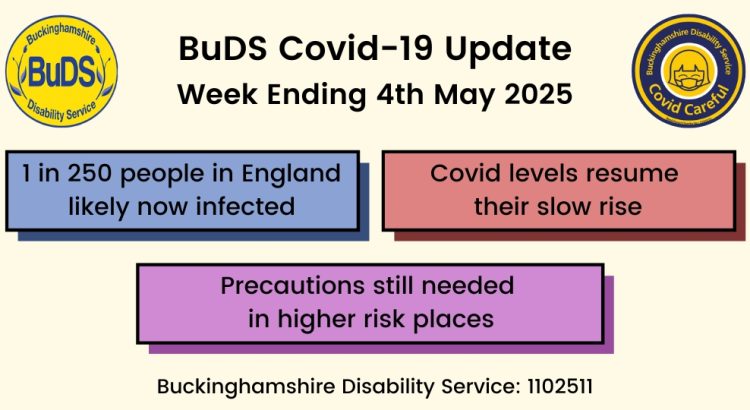
Covid infection levels in England have resumed their slow increase. In the week to 4 May, around 1 in every 250 people in England were infected, and the overall Covid risk remains Moderately High.
Covid infection levels in England have remained at historically lower levels since January 2025, the longest period of lower levels since the pandemic began. It is important to recognise that ‘historically lower levels’ does not mean ‘safe’. With 1 in 250 people infected with Covid, the risk of meeting an infected person in your everyday life is still moderately high. This is why we still recommend Covid precautions are taken in higher risk areas. This is explained fully below.
Why is England experiencing this long period of lower Covid levels? It is not because Covid has gone away. The Covid virus is always present and circulating in the population, mutating naturally into new variants as it circulates. What’s happening is that, for the moment, the partial population immunity from vaccination and prior infections in England is preventing the virus from ‘taking off’ and infecting large numbers of people at once.
Five years into the Covid pandemic, nearly everyone in the English population has caught Covid at least once, and 90% have had at least one Covid vaccination dose. A huge wave of Covid infected millions of people in England as recently as autumn 2024. That means that there is considerable partial population immunity against Covid in England at the moment. Until a new variant of Covid comes along which can decisively cut through that population immunity, Covid infection levels will remain suppressed at historically lower levels. This was the case in England from January to March 2025.
From mid-March 2025, however, Covid infection levels in England have shown a consistent slow rise, although the overall level remained historically lower. This rise is associated with the slow growth of new Covid variants in England. These new variants do not seem to be able to easily evade the existing population immunity in England, so they are not spreading quickly and causing a big wave of new infections as we saw in 2023 and 2024. Rather, the new variants are mostly replacing the older variants in circulation in England, driving a slow rise in overall infection levels rather than a spike. This situation may continue for weeks or months.
It is only a matter of time, however, before a new variant of Covid comes along which can cut through England’s population immunity. At that point, we will see another wave of new infections as we did in 2023 and 2024. How much acute (immediate) illness is caused by that wave is hard to predict. A big wave of hospitalisations and deaths is less likely as vaccination gives good protection against severe illness, and 90% of people in England are thankfully vaccinated, with the most clinically vulnerable people boosted twice per year. But another wave of mass illness like those in 2024, which made millions of people too ill for their normal activities for two or more weeks, is only a matter of time.
In this uneasy period ‘before the next wave’, BuDS continues to encourage everyone to take the level of Covid precautions that feels right for them, bearing in mind their own personal circumstances and the need to protect others. Our role is to give you the information to help you make informed decisions, and we will do so in this post. Remember, precautions against Covid will also help protect against all respiratory viruses including flu, norovirus, bird flu and measles.
Some indoor places remain high risk for catching Covid, regardless of the general infection level, because they are typically poorly ventilated and used by large numbers of people who are not taking any Covid precautions but who have a higher-than-average chance of having Covid. We continue to strongly recommend Covid precautions including a respiratory mask in these high-risk places or if meeting people who use them. High risk places include: buses, trains, taxis, transit systems like the London Underground, hospitals, GP practices, dentists, vaccination clinics, pharmacies, schools, universities and colleges.
Indoor places with large numbers of users remain medium-high risk for Covid because, even if the general level of Covid is lower, there are still enough people using those places that some of those users will be infected and breathing out virus. We continue to strongly recommend Covid precautions including a respiratory mask in these medium-high risk places. These include: bars and clubs, large supermarkets, indoor shopping centres, large office buildings, and most cinemas and theatres.
Indoor places with smaller numbers of users, such as medium-sized restaurants, supermarkets, smaller offices and individual larger shops, are currently medium risk places. In an average busy medium-sized supermarket, for example, statistically there will be at least 1 infected person every time you visit. We therefore continue to recommend Covid precautions including a respiratory mask for all clinically-vulnerable people using these spaces, but other people may feel it is safe enough for them to relax some precautions. This is very much an individual choice, as it has been throughout the pandemic.
Indoor places with small numbers of users, such as small cafes and shops, are currently lower risk for catching Covid. Again, we continue to recommend Covid precautions including a respiratory mask for acutely clinically-vulnerable people using these spaces, but other people may feel it is currently safe enough for them to relax some precautions. This is very much an individual choice, as it has been throughout the pandemic. Again, we say this is because, statistically, it is currently unlikely that an infected person will be using that space at the same time as you. In a local café, which has maybe a dozen seats, statistically speaking you would have to visit a full café 21 times before you encountered a Covid-infected person. Remember, however, you might be unlucky and sit next to the one Covid-infected person on your first visit.
Covid, flu, norovirus, bird flu and measles are all airborne. An infected person in an unventilated place creates an invisible cloud of virus which hangs in the air like smoke for you to breathe in. Dispersing the virus cloud through fresh air ventilation – e.g. opening a window or door – or clearing the virus from the air through HEPA filtration should be the first ways used to make the space safer. PPE respiratory masks should be the last line of defence if other means cannot be used, although clinically-vulnerable people may wish to use multiple layers of defence to suit their own vulnerability.
Remember too that Covid is not just dangerous for clinically-vulnerable people. The virus has been proven to have an adverse health impact on most people who catch Covid. No-one should be relaxed about catching Covid.
This is BuDS’ 226th Covid risk assessment since the beginning of the pandemic, and we are still the only organisation publishing free risk data for disabled and clinically vulnerable people. We will update you on the situation again next week.
If you’d like to get our weekly Covid risk assessments direct to your email inbox, completely free of charge, you can subscribe here: https://budscovidinfo.substack.com/
To understand more about our Covid risk levels and what they mean, use this link: https://buds.org.uk/covid-19-risk-levels-in-bucks/
For more Covid information and help, please contact BuDS and we will be happy to help.