
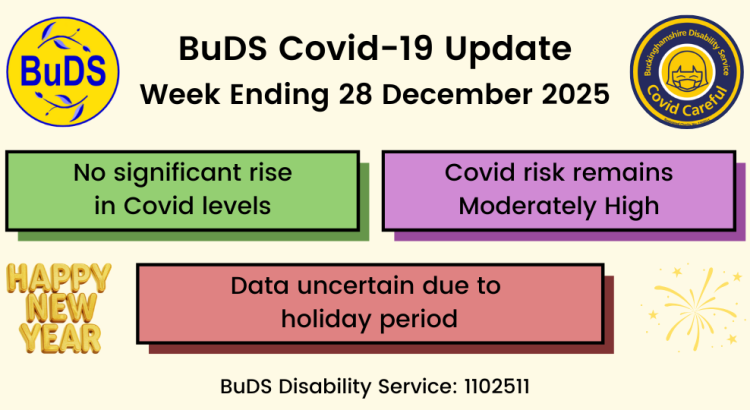
While data issues make the picture uncertain, Covid infection levels in England do not seem to have significantly increased since 14 December, and they may have fallen. For the present, we are maintaining our Covid risk level at Moderately High.
Reported influenza (flu) levels have also fallen significantly, although again there are data issues.
An Uncertain Covid Picture
The Christmas and New Year period is usually one where data collection can be challenging. Seasonal pressures on primary and secondary healthcare, and delays in statistical processes, can often give misleading impressions. It is safer to wait until the middle of January to get a more balanced picture. However, we are aware that many people rely on our risk assessments, and we have therefore done our best to give you evidence-based conclusions, however tentative.
During early December, we saw the rapid rise of a new Covid variant, designated by the WHO as B.A.3.2. (or ‘Cicada’), in England. There is no recent genomic data about this variant, but it will not have gone away. As it can evade prior immunity from vaccination or recent infection, we still expect Covid infection levels generally to increase, although we don’t know whether that will happen slowly or quickly.
The NOIDS diagnostic and test data on which we rely cannot be fully relied upon over the Christmas and New Year period, because of delays and disruption to normal procedures. The raw NOIDS data suggests a significant fall in Covid infection levels in England. However, similar falls in the data were seen last Christmas and New Year, only to be corrected in January. For this reason, we are not reducing our risk level from Moderately High, meaning a prevalence greater than 1 in 500.
At the same time, we cannot ignore the arrival of ‘Cicada’ and the upward pressure this will place on Covid infection levels. However, there is no suggestion in the NOIDS data that Covid infection levels have significantly increased, and so we do not feel able to draw any conclusions at this point about the impact of ‘Cicada’.
We will report back next week, when hopefully there will be greater clarity.
Flu Wave Peaked?
Reported influenza (flu) levels have also fallen significantly since 14 December, although again there are data issues. It is probably more likely than not that flu levels have fallen in real terms, but of course that is not to say that they will continue to do so during January. Even with the reported fall, flu levels remain objectively high, and precautions against catching flu remain necessary.
Risk Analysis
In accordance with the precautionary principle, we continue to recommend that precautions should be taken in all high, medium-high, and medium risk indoor places. In lower risk indoor places, most people (who are not acutely clinically vulnerable to Covid and/or flu) should consider whether precautions can be relaxed. We continue to not recommend precautions outdoors, unless you are in a dense crowd of people.
We recognise the uncertain risk posed by incomplete data. However, the precautions which we recommend remain appropriate and proportionate for even the highest likely level of risk.
The risk mitigations (things you can do to protect yourself) include wearing a PPE respiratory mask indoors, improving fresh air ventilation, using a HEPA filter, and avoiding higher-risk areas.
Detailed Risk Analysis
| Risk | Places | Risk factors | Likely number of infected people on a single visit/journey this week | Risk mitigations (things you can do to protect yourself) |
| High | Buses, trains, taxis, transit systems like the London Underground, hospitals, GP practices, dentists, vaccination clinics, pharmacies, schools, universities and colleges | Used by very large numbers of people, who are not taking precautions. Typically poorly ventilated. Risk on journeys is calculated assuming that people visit several places in one trip, e.g. railway station, train, railway station is assessed as one “journey” | Minimum 2, potentially 9+ | Minimise visits. Wear a PPE respiratory mask (FFP2/3 rated) on every visit. Maximise fresh air ventilation (open windows if possible, etc). |
| Medium-high | Bars and clubs, large supermarkets, indoor shopping centres, large office buildings, most cinemas and theatres. | Used by large numbers of people, who are not taking precautions. Typically poorly ventilated. | Minimum 1, potentially 3+ | Minimise visits. Wear a PPE respiratory mask (FFP2/3 rated) on every visit. Maximise fresh air ventilation (open windows if possible, etc). |
| Medium | Medium-sized restaurants (200 seats or more), smaller supermarkets, smaller offices, individual larger shops | Used by medium numbers of people, who are not taking precautions. Typically poorly ventilated. | Minimum 1, potentially 1+ | Minimise visits. Wear a PPE respiratory mask (FFP2/3 rated) on every visit. Maximise fresh air ventilation (open windows if possible, etc). |
| Lower | Small cafes (around 25 seats), small shops, infrequently used buildings e.g. churches (outside of services), buildings which, at the time of visit, have very few people inside them | Used by small numbers of people, who are not taking precautions. Can be poorly ventilated. | You are statistically unlikely to encounter an infected person, even on multiple visits, although this risk cannot be excluded. After 11 to 22 visits, statistically you are likely to encounter one infected person over all of those visits. | Minimise visits. Maximise fresh air ventilation (open windows if possible, etc). We continue to recommend Covid precautions including a respiratory mask for acutely clinically-vulnerable people using these spaces, but other people may feel it is currently safe enough for them to relax some precautions. This is very much an individual choice, as it has been throughout the pandemic. |
| Low | Outdoors (except when in a dense crowd) | The moving fresh air makes transmission of Covid from one person to another unlikely, except where two people are very close together. | The number of infected people is less relevant because the risk of transmission of Covid from one person to another outdoors is unlikely. | Avoid very close contact (under 1m) with potentially infected people. For complete peace of mind, remain 2m from potentially infected people. |
| Covid, flu, norovirus, bird flu and measles are all airborne. An infected person in an unventilated indoor place creates an invisible cloud of virus which hangs in the air like smoke for you to breathe in. The virus cloud can be dispersed and made less harmful, or harmless, using fresh air ventilation – e.g. opening a window or door. Fresh air is the enemy of Covid and the friend of Covid-cautious people. Another way to deal with an indoor cloud of Covid is to use a HEPA filter. These filters suck in the air, remove the viruses, and blow out virus-free clean air. HEPA filters are essential when an indoor space cannot be ventilated with fresh air, e.g. no (or little) opening windows. PPE respiratory masks filter viruses out of the air you personally breathe, if they are fitted and used correctly. PPE masks are the last line of defence against airborne viruses. As we explain in the table above, Covid-cautious people can use one or a combination of these precautions to help make indoor spaces safer for them. | ||||
More Information
This is BuDS’ 255th Covid risk assessment since the beginning of the pandemic, and we are still the only organisation publishing free risk data for disabled and clinically vulnerable people. We will update you on the situation again next week.
If you’d like to get our weekly Covid risk assessments direct to your email inbox, completely free of charge, you can subscribe here: https://budscovidinfo.substack.com/
To understand more about our Covid risk levels and what they mean, use this link: https://buds.org.uk/covid-19-risk-levels-in-bucks/
To make a donation and help us continue these risk assessments into 2026, use this link: https://www.peoplesfundraising.com/fundraising/buds-covid-information-project-2026
For more Covid information and help, or if you’d like to know more about how we calculate risk, please contact BuDS and we will be happy to help.