
Really alarming Covid-19 news for Buckinghamshire this week! The reliable ONS Infection Survey shows a steep INCREASE in the number of people with Covid in Bucks. An astonishing 1 in 17 people in Bucks have Covid. The number of people in hospital with Covid is also UP again. And yet people are NOT coming forward to get vaccinated in large numbers. Today, BuDS is warning everyone that the pandemic in Bucks is NOT OVER and that you still need to protect yourself against Covid, whatever the Government may say. Read on for more.
YOU’RE BEING TOLD A FALSE STORY!
The Government is constantly saying that ‘cases of Covid-19 are falling’, that precautions can be safely removed and that ‘everyone can go back to normal’. This is factually UNTRUE and BuDS has no choice now but to call it out.
There are two ways of working out how many people are infected with Covid-19. One is to use the number of people who test positive for Covid-19 and then report that test result to the UK Health Security Agency (UKHSA). These statistics are published every day by the Government and in all the media. The other way, done by the Office for National Statistics every week, is to randomly sample a very large number of people all over the country and see how many people test positive. The second way is much more reliable, because it doesn’t rely on people choosing to get tested or report their positive result.
The graph shows the number of infected people in Bucks worked out using these two different sets of data – the UKHSA test results (blue line) and the ONS Infection Survey (red line). As you can see, the two sets of data generally agree but, since the end of January, the ONS data is showing an increase while the UKHSA is showing a fall.
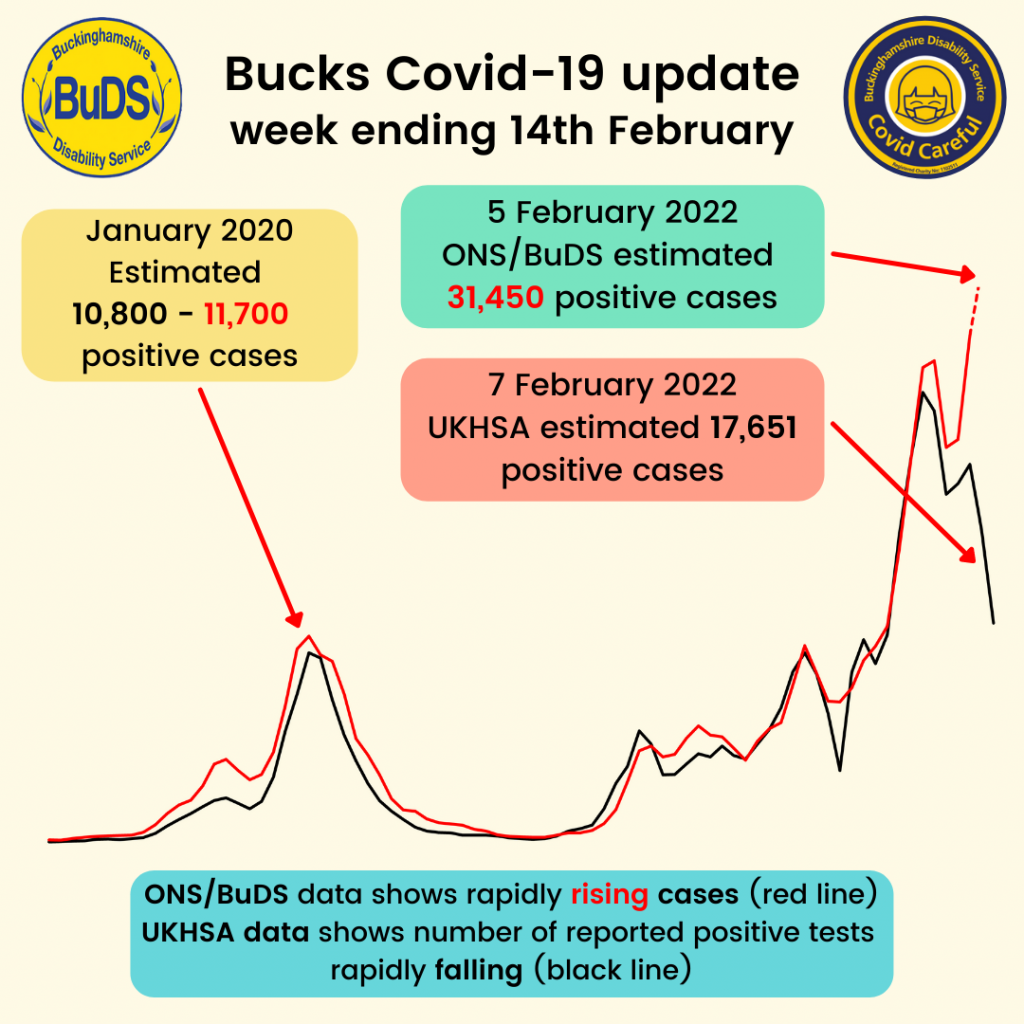
What seems to be happening is that a lot of people are now not getting tested for Covid-19 and/or not reporting their positive tests. But people are still CATCHING Covid in larger and larger numbers. It is only the number of reported positive tests which is going down, not the number of people who actually have Covid.
So, BuDS is taking the view that the most reliable data says that the number of infected people in Bucks is RISING. This means that your risk of catching Covid-19 when you are out and about is also increasing.
At least 1 in every 17 people in Bucks is infected with Covid-19 and so, if you don’t take strict precautions, it is very likely that you will catch Covid-19 from someone while out and about.
YOU CAN CATCH COVID MORE THAN ONCE!
Remember, you can catch Covid-19 more than once, so having had Covid-19 before is no protection against catching it again this year. We already knew that people who caught the Delta variant last year could catch the latest Omicron variant. Now, there is growing evidence that people who catch Omicron can catch Omicron again, raising the possibility of repeated re-infections over the year. BuDS is publishing a separate article on this soon.
THE RISK IN BUCKS
BuDS normally uses 3 separate sets of official data to give you the best idea of the risk of catching Covid-19 from an infected person in Bucks. However, because the UKHSA reported test data is now proven to be very inaccurate, we are unable to use either reported test case data or R-Rate data which is based on test numbers. We are therefore going to use the most up to date 5-day rolling average ONS Infection Survey data covering the period to 5 February. This is of course 9 days ago but it is the most reliable data available.
Using this data, we calculate that 1 in 17 people in Bucks have Covid, which is 31,453 people. This is the highest number ever recorded.
You can see how current numbers compare to the other waves of Covid-19 in Bucks by looking at the graph.
HOW LIKELY ARE YOU TO MEET AN INFECTED PERSON?
Your chance of meeting an infected person when you are out and about in Bucks remains CRITICALLY HIGH.
If we assume that every infected person is active in their local community, these figures will help you understand the risk of meeting one.
- How many infected people in every 1000?1 – 58
- How many infected people in Aylesbury?2 – 3,467
- How many infected people in High Wycombe?3 – 6,935
- How many infected people in Amersham?4 – 1,565
- How many infected people in Chesham?5 – 1,544
- How many infected people in Buckingham?6 – 867
- How many infected people in Burnham?7 – 656
- How many infected people (adults or children) in a large school?8 – 87
- How many infected people in a busy town centre?9 – 578
- How many infected people at a large public event?10 – 1,156
- How many infected people in a busy shopping centre?11 – 58
- How many infected people in a busy supermarket?12 – 17
HOW IS THE NHS COPING?
NHS data is always about a week behind. On 30 January there were 425 people infected with Covid-19 in Bucks hospitals. On 6 February, there were 427, 5.2% more. So, the demand on the NHS in Bucks from Covid-19-infected patients on 6 February (not now) is now higher than it was in the week before. However, we don’t yet know if this rise is just a weekly ‘blip’ or a return to the trend of increases we saw up to last week. More next week.
Keeping Covid-19 under control is vitally important for the NHS and for everyone. If the number of Covid-19 patients gets too high, or high numbers of NHS staff are off sick or self-isolating, or both, hospitals cannot keep patients safe, and care is threatened for all patients.
COVID-19 DEATHS IN BUCKS
We use death statistics for the last two weeks rather than just the last week, so you get a more accurate figure. Over all three counting measures, the number of deaths in Bucks is sadly remaining high as Omicron claims more victims.
There are three ways of counting the number of Covid-related deaths in Bucks.
- 13 February, 10 people died within 28 days of testing positive for Covid-19, bringing the total number of deaths to 1,149. Because people are increasingly living longer even with severe Covid illness, this is the least accurate total.
- Between 30 January and 13 February, 16 people died within 60 days of testing positive for Covid-19, bringing the total number of deaths to 1,380. This total is the most clinically appropriate because of the length of time people now live with severe Covid illness.
- Between 14 and 28 February, 30 people died with Covid as a cause of death as recorded by doctors on their death certificates, bringing the total to 1,360. This is the most reliable total, but the data is always two weeks old.
There has been a welcome drop in the number of Covid deaths in Bucks in the last two weeks. We don’t know if this is a ‘blip’ or the start of a trend. But, even after the fall, at least one person died of Covid in Bucks every single day in the last two weeks.
HOW MANY PEOPLE ARE VACCINATED IN BUCKS?
Here are the latest vaccination figures for 16 January:
- Secondary-age children (aged 12 to 15) – 66.5% have had 1 dose; 33.9% have had two doses and 0.1% have had three doses. 99.9% (29,791) are not fully vaccinated and vulnerable to Omicron
- Older Teenagers (aged 16 to 17) – 77.2% have had 1 dose; 59.9% have had two doses and 8.2% have had three doses. 91.8% (13,095) are not fully vaccinated and vulnerable to Omicron
- Adults (aged 18 to 70) 86.2% have had 1 dose; 83.5% have had two doses and 67.0% have had three doses. 33.0% (124,403) are not fully vaccinated and vulnerable to Omicron
- Older Adults (aged over 70) – 96.9% have had 1 dose; 96.3% have had two doses and 92.9% have had three doses. 7.1% (5,425) are not fully vaccinated and vulnerable to Omicron
Because 2 doses of vaccine only give low protection against Omicron, what matters now is how many people in Bucks have had 3 doses – double vaccinated plus booster. As the figures above show, nearly all children and young people in Bucks have very low protection against Omicron. A third of adults also have very low protection against Omicron, and most worryingly, thousands of older adults still have very low protection against Omicron.
Last week, vaccination in Bucks remained at a standstill across nearly all age groups. Only the percentage of secondary-school children (12-15) getting their second dose showed any sign of increase again, going from 30% to 34%. But the percentage of unvaccinated children, teenagers and adults getting their first dose hardly changed. This continuing vaccination failure not only means tens of thousands of people in Bucks have low protection against Omicron, but also means that the virus can continue to circulate freely.
Remember, those who received their booster jab before 19 December 2021 are, week by week, becoming less protected against Omicron. While their protection against being severely ill and being admitted to hospital is still quite high, their resistance to catching Omicron and being ill at home is shrinking.
OMICRON FACTS
- While Omicron sends fewer people into hospital with the most severe illness, it still makes people very ill at home. People catching Omicron are often unable to work or do everyday things for weeks. People should not assume Omicron will cause only mild illness like a cold – this is simply not true for many people.
- Omicron spreads frighteningly easily between people, especially indoors. Only a tiny amount of virus floating in the air is enough to make you infected. This means that the precautions which might have kept you safe in the past from Delta will NOT keep you safe from catching Omicron. People need to use much tougher precautions to avoid catching Omicron.
- Omicron isn’t stopped by two doses of vaccine, like Delta was. Being ‘double jabbed’ meant that you had a lower chance of catching Delta and a much lower chance of being seriously ill if you caught Delta. But two doses of vaccine does very little to stop you catching Omicron and your chance of being seriously ill if you catch Omicron is much higher.
- Even if you have three doses of vaccine (i.e. you’ve been boosted), there is still a risk that you will get ill if you catch Omicron and that could be a serious illness. 3 or 4 ‘triple-jabbed’ people in every 10 will get ill after catching Omicron.
- It is now proven by multiple reliable studies that children and young people are at much higher risk of being ill and needing hospital treatment if they catch Omicron versus Delta. The number of children and teenagers going into hospital with Covid, and sadly dying of Covid, has sharply increased since Omicron has started to spread.
Remember, so many people in the community now have Omicron, and it is so easy to catch, that it is HIGHLY LIKELY that you will catch Omicron sooner or later if you or members of your household are active in the community, including children attending school.
WHAT TO DO NOW
This is BuDS’ advice:
- If you are not double vaccinated, get vaccinated as soon as possible. Double vaccination may not provide complete protection against illness, but it is a great deal better than nothing. Vaccines are safe and proven, so don’t delay.
- If you are double vaccinated, get a third booster dose as soon as possible. Boosting doesn’t give complete protection against illness, but does provide high protection against severe illness which would put you in hospital.
- Make sure children and teenagers have two or three doses of vaccine as well. Omicron is causing more severe illness in children and young people than Delta, so vaccination of these age groups is even more vital. Remember, the vaccine is as safe as any other medicine given to children.
- Clinically-vulnerable people should go back to shielding, or as near shielding as they can manage. This means not seeing people outside your household or bubble unless you take strict precautions to keep safe, such as asking visitors to get tested, wearing a protective face mask, and meeting in places where you can be sure of breathing only fresh air.
- If there are children in a clinically-vulnerable household, we recommend you give very serious thought to home-schooling the children until the Omicron wave has reduced. With no real precautions against Covid in schools, particularly primary schools, children will inevitably bring Covid home to their parents and relatives.
- Everyone should be limiting their contact with other people as much as possible, and taking strict precautions when they have to meet other people. This means working from home or changing your working arrangements temporarily if you can, not going to big social gatherings like parties, theatres and pubs, meeting people in the safest possible circumstances, and taking thorough precautions against getting infected like wearing a face covering and washing hands.
- We strongly advise everyone to get and wear a N95 or FFPE2 personal protective face mask which filters viruses out of the air you breathe. Get one from a reliable branded supplier, not an anonymous Amazon shop. Remember to make sure it is tightly-fitted so that air does not leak around the edges. BuDs will soon be able to offer a manufacturer discount on these masks – more news soon.
- Anyone who is not shielding should test regularly to see if they have caught Omicron. Lateral flow tests are not reliable so, if you feel ill or have any symptoms of illness, self-isolate immediately and get a PCR test to confirm whether you have Omicron or not.
You can have Omicron for several days before showing any symptoms, so test yourself before you meet anyone else or go anywhere. In particular, do not go anywhere near older and clinically-vulnerable people until you have tested negative on a PCR test. Do not risk your vulnerable loved one’s lives on an unreliable lateral flow home test kit.
MORE INFORMATION
If you’d like to know more about the issues below, use the appropriate link.
How we calculate our figures and how we check them for accuracy – https://buds.org.uk/risk-post-statistical-methods-explanation/
All our Covid-19 articles – https://buds.org.uk/category/our-work/iag-covid-19/
Sources of Help – https://buds.org.uk/category/help-in-a-crisis/
WE ARE HERE TO HELP
BuDS can help you by answering questions, providing information, helping you find practical support or help in a crisis or being a friendly voice if you’re lonely or isolated. If you’d like any help or support from us, message us through social media, e-mail buds-support@buds.org.uk or leave us a voicemail on 01494 211179. We’ll do our very best to help you.
REFERENCES
[1] Population of approx. 543973 based on 2018 survey data, https://www.bbc.co.uk/news/uk-51768274
[2] Population of approx. 60,000 people, from https://www.aylesburytowncouncil.gov.uk/about-aylesbury/#:~:text=Aylesbury%2C%20the%20County%20Town%20of%20Buckinghamshire%2C%20is%20a,of%20over%2060%2C000%2C%20the%20largest%20in%20Aylesbury%20Vale.
[3] Population of approx. 120,000 people, from https://www.wycombe.gov.uk/pages/About-the-council/Transparency-and-open-government/Open-data/Statistics-and-census-information.aspx
[4] Population of 27,077 as of the 2011 Census, from http://old.buckscc.gov.uk/media/1000352/Local-Community-Area-Data.xls
[5] Population of 26,718 as of the 2011 Census, from http://old.buckscc.gov.uk/media/1000352/Local-Community-Area-Data.xls
[6] Population of approx. 15,000 people, from https://www.buckingham-tc.gov.uk/
[7] Population of approx. 11360 as of the 2011 census, from https://wikishire.co.uk/wiki/Burnham,_Buckinghamshire#cite_note-ons-1
[8] Assuming pupils plus staff equals 1500 people in total
[9] Assuming 10,000 people present at any one time
[10] Assuming 20,000 people present at any one time
[11] Assuming 1000 people present at any one time
[12] Assuming 300 people present at any one time