
New Study Gives Better Understanding
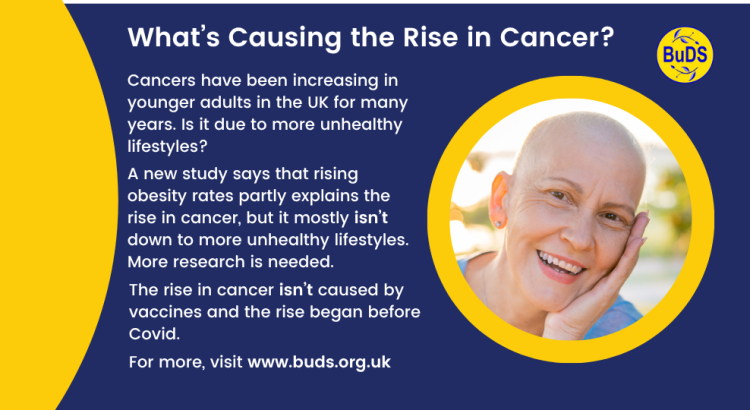
A major new research study has given scientists and doctors a better understanding of why cancers have been on the increase in the UK and many other countries for many years.
Cancers On The Rise
Cancers of all kinds have been increasing in adults in the UK and in other countries for many years. The reasons for this rise are unclear and there are many different theories among scientists and doctors.
It is well-known and proven that lifestyle risk factors like smoking, diet, alcohol use, exercise and obesity increase the risk of developing cancer. One theory is that people are simply becoming unhealthier, that is to say they are exposed to more of these lifestyle risk factors. If that is the case, say some scientists, growing un-healthiness might be a simple reason why cancer rates have gone up.
The Study
Published in the British Medical Journal for Oncology, the study tested the theory that growing un-healthiness explains why cancer rates are going up. The study looked specifically at younger (20 – 49 years old) adults in the UK between 2001 and 2019. It asked whether increases in lifestyle risk factors in these adults over this period explained why cancer rates increased in this group in that period. In other words, were these younger adults living less healthy lives over that period and that was why they were getting more cancers?
The researchers first worked out which cancers had become more common in adults aged 20 to 49 years old in the period from 2001 to 2019 – there were eleven. They then looked at how lifestyle risk factors were affecting this age group over the same period, and whether lifestyle risk factors affected more people or less. They then ran a statistical analysis to see if the rate of increase in cancers in matched up to the changes in lifestyle risk factors, taking into account other factors which might confuse the comparison.
The study showed that, apart from obesity, lifestyle risk factors were affecting the same number or fewer younger adults from 2001 to 2019. In other words, younger adults were not living un-healthier lives and exposing themselves to more lifestyle risks over that period, except that more of them were seriously overweight.
Cancers related to obesity did increase as expected. There was a clear link between more younger people being overweight and more younger adults getting cancer.
However, cancers not linked to obesity also increased in younger adults between 2001 to 2019, even though lifestyle risk factors affecting those adults did not increase in that period. This shows, according to the researchers, that changes in lifestyle risk factors do not explain most of the rise in cancers in younger adults between 2001 to 2019, although some of the rise was due to more younger adults being obese.
The study recommends that more research is done to explain why cancer rates are increasing in younger (20 – 49 years old) adults in the UK and in many other countries. The study also recommends that people should be encouraged and helped to avoid cancer lifestyle risk factors and in particular to maintain a healthy weight, to reduce their risk of developing cancer.
What Does This Mean For You?
Whatever your age, your lifestyle has a lot to do with your risk of developing cancer. This study has identified obesity, or being seriously overweight, as having a proven link to being at higher risk of developing cancer. So, keeping your weight in a healthy range is important. You can find resources to help you manage your weight below.
While this study has shown that there is not such a clear connection between other lifestyle risks and the causes of cancer, it is an established medical fact that reducing your lifestyle risks will reduce your risk of developing cancer. You can find resources to help you reduce your cancer risks below.
Covid & Cancer
This study looked at adults between 2001 and 2019, before the Covid pandemic, and therefore does not say anything about any link between Covid & cancer. Covid is still a new virus, and time is needed to assess and prove its effects. It will not be possible for some years to look back on the health records of people who caught Covid and show whether they experienced higher rates of cancer than people who did not catch Covid.
It is known that there are several biological means by which Covid might cause cancer, and it is not unusual for viruses to cause or be linked to cancers. For example, one study showed that Covid causes inflammation inside the body which can cause dormant cancers to become active and spread to other parts of the body. This study proved that cancer relapse rates were 1.5 times higher in cancer survivors who caught Covid compared to cancer survivors who did not catch Covid.
It is not yet possible to say that Covid causes cancer or affects cancer survival rates. However, avoiding Covid infections is a good thing to do in any case, as the virus is well-known to have many damaging impacts beyond the immediate acute symptoms.
Resources
Here are some resources and information which may help you. Click the button to visit them.