
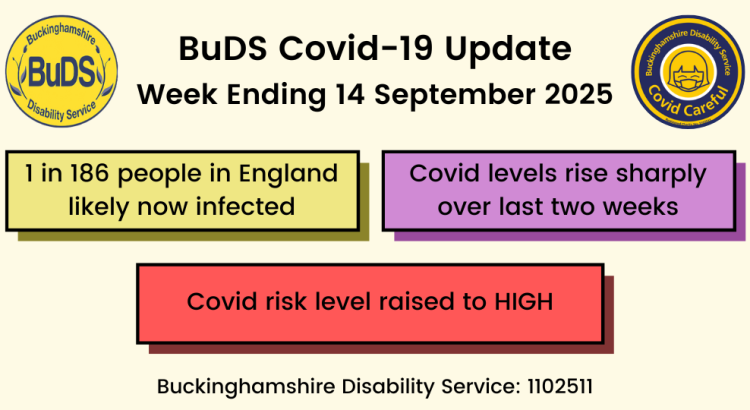
Covid infection levels in England have risen sharply over the last 2 weeks, as have other Covid measures. The overall risk level has risen from moderately high to High. It is clear that the next Covid wave is building fast, and we urge everyone to resume or continue precautions against catching this dangerous virus. Now is also the time to get your Covid boosters (if available to you) as quickly as possible.
As of 14 September, around 1 in every 186 people in England were infected. This means that the risk of encountering an infected person in most indoor places is now significant. Unless the indoor air is fresh, or filtered/purified, good quality PPE respiratory masks are needed to protect yourself. If you need any advice about this, please do ask.
BuDS monitors all available data relating to Covid in England. Most of this data is published too late to be of any use in a weekly risk assessment, but it is used to validate our previous assessments. All the Covid data points to the next wave building fast. This is due to a combination of new variants in circulation, the return of schools, universities, and workplaces after the summer break, and the autumn weather bringing people back indoors.
It is not possible at this stage to predict how large this Covid wave will be. However, one of the main factors in the size of a wave is the extent of protective immunity in the community from vaccination and prior infections with Covid. The last vaccination round in England was in Spring 2025, and Covid infections have been at historically lower levels throughout the year. This suggests that the extent of protective immunity against new infections in the community could be at very low levels. If so, a large Covid reinfection wave is more likely than not. If UKHSA were doing its job properly, we would not have to guess!
The NHS has begun its 2025 Autumn Covid booster campaign. If you are eligible, you can book an appointment online now, or you can wait to be called by your GP surgery. We strongly recommend that you book an appointment as soon as possible, so that you can boost your immunity before the wave grows further. Remember, vaccination boosters are essential to reduce your risk of serious illness and hospitalisation when you catch Covid. They do not significantly reduce your risk of catching the virus altogether. Also, boosters do not prevent you from becoming quite significantly ill at home. Taking precautions against catching Covid is still sensible, even once you are fully boosted.
The NHS has decided to severely restrict the people who are eligible for Covid booster vaccines this autumn. Those who are eligible are: people aged 75 years and over, those in older adult care homes, and those aged 6 months and over who are clinically immunosuppressed. Ridiculously, health and care staff, and relatives and/or household members of eligible people are not eligible themselves. Private Covid boosters are widely available, but the cost is typically around £100 per person.
BuDS continues to encourage everyone to take the level of Covid and other precautions that feels right for them, bearing in mind their own personal circumstances and the need to protect others. Our role is to give you the information to help you make informed decisions, and we will do so in this post. Remember, precautions against Covid will also help protect against all respiratory viruses including flu, norovirus, bird flu and measles.
| Risk | Places | Risk factors | Likely number of infected people on a single visit/journey this week | Risk mitigations (things you can do to protect yourself) |
| High | Buses, trains, taxis, transit systems like the London Underground, hospitals, GP practices, dentists, vaccination clinics, pharmacies, schools, universities and colleges | Used by very large numbers of people, who are not taking precautions. Typically poorly ventilated. Risk on journeys is calculated assuming that people visit several places in one trip, e.g. railway station, train, railway station is assessed as one “journey” | Minimum 5-6, potentially 27+ | Minimise visits. Wear a PPE respiratory mask (FFP2/3 rated) on every visit. Maximise fresh air ventilation (open windows if possible, etc). |
| Medium-high | Bars and clubs, large supermarkets, indoor shopping centres, large office buildings, most cinemas and theatres. | Used by large numbers of people, who are not taking precautions. Typically poorly ventilated. | Minimum 4, potentially 8+ | Minimise visits. Wear a PPE respiratory mask (FFP2/3 rated) on every visit. Maximise fresh air ventilation (open windows if possible, etc). |
| Medium | Medium-sized restaurants (200 seats or more), smaller supermarkets, smaller offices, individual larger shops | Used by medium numbers of people, who are not taking precautions. Typically poorly ventilated. | Minimum 1-2, potentially 3+ | Minimise visits. Wear a PPE respiratory mask (FFP2/3 rated) on every visit. Maximise fresh air ventilation (open windows if possible, etc). |
| Lower | Small cafes (around 25 seats), small shops, infrequently used buildings e.g. churches (outside of services), buildings which, at the time of visit, have very few people inside them | Used by small numbers of people, who are not taking precautions. Can be poorly ventilated. | You are statistically unlikely to encounter an infected person on a single visit, although this risk cannot be excluded. After 4 to 7 visits, statistically you are likely to encounter one infected person over all of those visits. Remember, however, especially with rising infection levels, you may well be unlucky and meet a Covid-infected person on your first visit. | Minimise visits. Maximise fresh air ventilation (open windows if possible, etc). The Covid risk is rising. While statistically the risk remains lower, we encourage a cautious approach to taking risks. Not wearing a PPE respiratory mask (FFP2/3 rated) should be exceptional when the risk is clearly lower, for example in a nearly empty building. |
| Low | Outdoors (except when in a dense crowd) | The moving fresh air makes transmission of Covid from one person to another unlikely, except where two people are very close together. | The number of infected people is less relevant because the risk of transmission of Covid from one person to another is unlikely. | Avoid very close contact (under 1m) with potentially infected people. For complete peace of mind, remain 2m from potentially infected people. |
| Covid, flu, norovirus, bird flu and measles are all airborne. An infected person in an unventilated indoor place creates an invisible cloud of virus which hangs in the air like smoke for you to breathe in. The virus cloud can be dispersed and made less harmful, or harmless, using fresh air ventilation – e.g. opening a window or door. Fresh air is the enemy of Covid and the friend of Covid-cautious people. Another way to deal with an indoor cloud of Covid is to use a HEPA filter. These filters suck in the air, remove the viruses, and blow out virus-free clean air. HEPA filters are essential when an indoor space cannot be ventilated with fresh air, e.g. no (or little) opening windows. PPE respiratory masks filter viruses out of the air you personally breathe, if they are fitted and used correctly. PPE masks are the last line of defence against airborne viruses. As we explain in the table above, Covid-cautious people can use one or a combination of these precautions to help make indoor spaces safer for them. | ||||
Covid is not just dangerous for clinically-vulnerable people. The virus has been proven to have an adverse health impact on most people who catch Covid. No-one should be relaxed about catching Covid.
This is BuDS’ 242nd Covid risk assessment since the beginning of the pandemic, and we are still the only organisation publishing free risk data for disabled and clinically vulnerable people. We will update you on the situation again next week.
If you’d like to get our weekly Covid risk assessments direct to your email inbox, completely free of charge, you can subscribe here: https://budscovidinfo.substack.com/
To understand more about our Covid risk levels and what they mean, use this link: https://buds.org.uk/covid-19-risk-levels-in-bucks/
For more Covid information and help, please contact BuDS and we will be happy to help.