
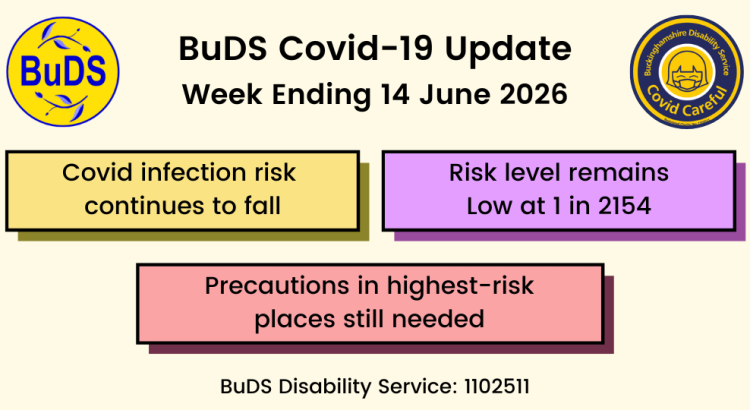
Covid infection levels in England have continued to fall. The Covid risk level remains Low, with 1 in every 2334 people in England now infected.
What Does This Mean For Me?
With Covid infection levels at historically very low levels, our advice remains that precautions against Covid are still necessary, but only in the highest-risk indoor places. These places include hospitals & other medical buildings, on public transport, and in large indoor stadiums or theatres. In all other places, even big buildings like shopping centres or universities, you are now statistically unlikely to encounter a person with Covid on a single visit. Obviously, if you work or regularly visit one of these highest-risk indoor places, your risk of encountering a person with Covid is much higher, and you should take precautions accordingly.
While Covid virus does hang in the air like smoke in unventilated indoor places, the source of that Covid virus is the air breathed out by infected people. When the number of infected people using the space is low, the risk of Covid remaining in the air from their breath is also low. High traffic places, like public transport and hospitals, are much more likely to have residual virus in the air, which is why we continue to advise precautions in these areas.
Remember, these are only our recommendations, and everyone is free to choose the level of Covid precaution that feels right for them. We only advise on infection risk (how likely it is that you will meet someone with Covid), not on how serious a Covid infection might be for you.
The table below gives full information and explains what we mean by highest, high, medium-high, medium, and lower-risk indoor places.
Covid Spring Boosters – Last Opportunity to Book
Covid vaccine boosters are still available on the NHS but only until the end of June. BuDS very strongly recommends that everyone eligible for a booster takes up the offer. Even though Covid infection levels are low now, the booster will give you important protection against future Covid waves. If you are not eligible for the Covid vaccine booster on the NHS, BuDS recommends that you consider a private vaccination.
Managing Your Risk
Covid is an airborne virus. This means that it mainly spreads in the air that you breathe.
Things you can do to protect yourself against Covid infection include:
- Wearing a PPE respiratory mask indoors. Worn correctly, respiratory masks (rated FFP2/FFP3 or N95/99) filter airborne viruses out of the air that you breathe.
- Improving fresh air ventilation. Fresh air, especially moving fresh air, very effectively dilutes and breaks up the clouds of Covid virus in the air, making it less likely that you will inhale enough virus to catch Covid.
- Using a HEPA filter. HEPA filters suck in the air, filter out viruses like Covid (and other particles), and blow out clean air. HEPA filters are very useful in cleaning the air in rooms with poor fresh air ventilation.
- Avoiding higher-risk areas. If you don’t go to areas where there is likely to be a lot of virus, you won’t catch it.
- Enjoy the outdoors. It is extremely difficult to catch Covid outside, because the fresh moving air immediately disrupts and dilutes the Covid virus which other people may breathe out. As long as you are not in a dense crowd of people who are breathing directly into your face, you do not need to take precautions against catching Covid outdoors.
Even if you are relaxing some precautions because Covid infection levels are currently low, you may wish to still use other precautions. For example, you may decide not to mask in a café, but to still sit near an open window, or to use a HEPA filter at your place of work.
Detailed Covid Infection Risk Analysis
| Infection Risk | Places | Infection Risk factors | Likely number of Covid infected people on a single visit/journey this week | Risk mitigations (things you can do to protect yourself) |
| Highest | Hospitals & other medical buildings, on buses and trains and other public transport, and in large indoor stadiums or theatres. | Used by very large numbers of people who are not taking precautions, and/or used by sick people who are much more likely to have Covid. Typically, poorly ventilated spaces. Journeys typically involve several stages and venues, widening infection risk | The risk of encountering a Covid infected person on a single visit is low but cannot be excluded. Multiple visits increase risk. | Minimise visits. Maximise fresh air ventilation (open windows if possible, etc). We continue to recommend that everyone wears a PPE respiratory mask (FFP2/3 rated) on every visit to these highest-risk places in view of the continuing infection risk in those areas. |
| High | Schools, universities and colleges, cinemas, theatres, indoor performing arts venues, large indoor shopping centres | Used by very large numbers of people who are not taking precautions. Typically poorly ventilated. | You are statistically unlikely to encounter an infected person on a single visit, although this risk cannot be excluded. You will probably encounter an infected person if you visit twice or more. | Everyone should take sensible precautions such as minimising visits and maximising fresh air ventilation, such as opening windows and doors or being near them. We continue to recommend that everyone wears a PPE respiratory mask (FFP2/3 rated) on every visit to these highest-risk places in view of the continuing infection risk in those areas. |
| Medium-high | Large bars and clubs, large supermarkets, local indoor shopping centres, large office buildings | Used by large numbers of people, who are not taking precautions. Typically poorly ventilated. | You are statistically unlikely to encounter an infected person over a few visits although this risk cannot be excluded. After 2 to 3 visits, statistically you are likely to encounter one infected person over all of those visits. | Minimise visits. Maximise fresh air ventilation (open windows if possible, etc). We continue to recommend Covid precautions including a respiratory mask for highly Covid-cautious people using these spaces, but other people may feel it is currently safe enough for them to relax some precautions in view of the lower infection risk. |
| Medium | Medium-sized bars, clubs, and restaurants (200 seats or more), smaller supermarkets, smaller offices, individual larger shops | Used by medium numbers of people, who are not taking precautions. Typically poorly ventilated. | You are statistically unlikely to encounter an infected person, even on multiple visits, although this risk cannot be excluded. After 4 to 8 visits, statistically you are likely to encounter one infected person over all of those visits. | Minimise visits. Maximise fresh air ventilation (open windows if possible, etc). Most people may feel it is currently safe enough for them to remain unmasked in these spaces in view of the very low infection risk. However, highly Covid-cautious people using these spaces may wish to maintain use of a PPE respiratory mask. |
| Lower | Small cafes (around 25 seats), small shops, infrequently used buildings e.g. churches (outside of services), buildings which, at the time of visit, have very few people inside them | Used by small numbers of people, who are not taking precautions. Can be poorly ventilated. | You are statistically unlikely to encounter an infected person, even on multiple visits, although this risk cannot be excluded. After 47 to 93 visits, statistically you are likely to encounter one infected person over all of those visits. | Minimise visits. Maximise fresh air ventilation (open windows if possible, etc). Most people may feel it is currently safe enough for them to remain unmasked in these spaces in view of the very low infection risk. However, highly Covid-cautious people using these spaces may wish to maintain use of a PPE respiratory mask. |
| Low | Outdoors (except when in a dense crowd) | The moving fresh air makes transmission of Covid from one person to another unlikely, except where two people are very close together. | The number of infected people is less relevant because the risk of transmission of Covid from one person to another outdoors is unlikely. | No precautions needed but avoid very close contact (under 1m) with potentially infected people. For complete peace of mind, remain 2m from potentially infected people. |
More Information
This is BuDS’ 276th Covid risk assessment since the beginning of the pandemic, and we are still the only organisation publishing free risk data for disabled and Covid-cautious people. We will update you on the situation again next week.
If you’d like to get our weekly Covid risk assessments direct to your email inbox, completely free of charge, you can subscribe here: https://budscovidinfo.substack.com/
To understand more about our Covid risk levels and what they mean, use this link: https://buds.org.uk/covid-19-risk-levels-in-bucks/
To make a donation and help us continue these risk assessments into 2026, use this link: https://www.peoplesfundraising.com/fundraising/buds-covid-information-project-2026
For more Covid information and help, or if you’d like to know more about how we calculate risk, please contact BuDS and we will be happy to help.