
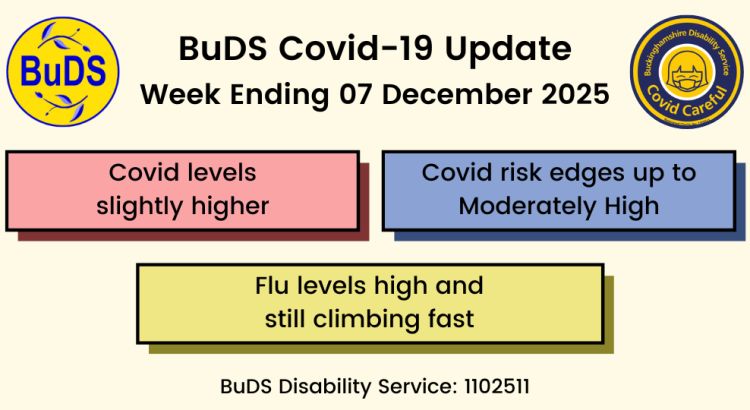
Covid infection levels in England rose slightly last week, after falling previously to their lowest level since 2021. With around 1 in every 386 people in England infected as of 7 December, we have reverted to a Moderately High risk level.
Flu Wave Worsens
Influenza (flu) cases continue to sharply increase. Broadly speaking, flu is as bad in England this winter (so far) as it was last winter, but not significantly worse. However, unlike last year, the NHS is emphasising public health precautions against flu, such as wearing face masks if symptomatic, better ventilation, and avoiding crowded places. We welcome this new emphasis on prevention, and urge the NHS to go further, including the use of PPE respiratory masks in healthcare premises.
Remember, the same precautions we recommend for Covid will keep you safe from flu. It is still not too late to get vaccinated against flu, and we strongly recommend that you do so if you haven’t already. Flu vaccinations are available privately from most pharmacies for around £10-£15 if you cannot get one through the NHS.
Risk Analysis
Even though Covid levels have risen this week, the overall amount of Covid circulating in the community remains historically lower. As such, BuDS has decided not to change our recommendations against catching Covid from last week. If this rise continues, we will act accordingly.
We continue to recommend that Covid precautions should be taken in all high and medium-high risk indoor places. In medium and lower risk indoor places, most people (who are not acutely clinically vulnerable to Covid) should consider whether Covid precautions can be relaxed. We continue to not recommend Covid precautions outdoors, unless you are in a dense crowd of people.
Remember, however, that flu levels are high and rising. Influenza is not as contagious as Covid, but the risk of catching it is still high in crowded or unventilated indoor spaces. Precautions against catching Covid will also protect you from catching flu. If you are concerned about catching flu, wearing a respiratory mask in high and medium-high risk places will help protect you.
| Risk | Places | Risk factors | Likely number of infected people on a single visit/journey this week | Risk mitigations (things you can do to protect yourself) |
| High | Buses, trains, taxis, transit systems like the London Underground, hospitals, GP practices, dentists, vaccination clinics, pharmacies, schools, universities and colleges | Used by very large numbers of people, who are not taking precautions. Typically poorly ventilated. Risk on journeys is calculated assuming that people visit several places in one trip, e.g. railway station, train, railway station is assessed as one “journey” | Minimum 3, potentially 13+ | Minimise visits. Wear a PPE respiratory mask (FFP2/3 rated) on every visit. Maximise fresh air ventilation (open windows if possible, etc). |
| Medium-high | Bars and clubs, large supermarkets, indoor shopping centres, large office buildings, most cinemas and theatres. | Used by large numbers of people, who are not taking precautions. Typically poorly ventilated. | Minimum 2, potentially 4+ | Minimise visits. Wear a PPE respiratory mask (FFP2/3 rated) on every visit. Maximise fresh air ventilation (open windows if possible, etc). |
| Medium | Medium-sized restaurants (200 seats or more), smaller supermarkets, smaller offices, individual larger shops | Used by medium numbers of people, who are not taking precautions. Typically poorly ventilated. | Minimum 1, potentially 2 | Minimise visits. Maximise fresh air ventilation (open windows if possible, etc). Most people may feel it is currently safe enough for them to relax Covid precautions. This is very much an individual choice, as it has been throughout the pandemic. Acutely clinically-vulnerable people may wish to continue precautions. |
| Lower | Small cafes (around 25 seats), small shops, infrequently used buildings e.g. churches (outside of services), buildings which, at the time of visit, have very few people inside them | Used by small numbers of people, who are not taking precautions. Can be poorly ventilated. | You are statistically unlikely to encounter an infected person, even on multiple visits, although this risk cannot be excluded. After 7 to 15 visits, statistically you are likely to encounter one infected person over all of those visits. | Minimise visits. Maximise fresh air ventilation (open windows if possible, etc). Most people may feel it is currently safe enough for them to relax Covid precautions. This is very much an individual choice, as it has been throughout the pandemic. Acutely clinically-vulnerable people may wish to continue precautions. |
| Low | Outdoors (except when in a dense crowd) | The moving fresh air makes transmission of Covid from one person to another unlikely, except where two people are very close together. | The number of infected people is less relevant because the risk of transmission of Covid from one person to another outdoors is unlikely. | Avoid very close contact (under 1m) with potentially infected people. For complete peace of mind, remain 2m from potentially infected people. |
| Covid, flu, norovirus, bird flu and measles are all airborne. An infected person in an unventilated indoor place creates an invisible cloud of virus which hangs in the air like smoke for you to breathe in. The virus cloud can be dispersed and made less harmful, or harmless, using fresh air ventilation – e.g. opening a window or door. Fresh air is the enemy of Covid and the friend of Covid-cautious people. Another way to deal with an indoor cloud of Covid is to use a HEPA filter. These filters suck in the air, remove the viruses, and blow out virus-free clean air. HEPA filters are essential when an indoor space cannot be ventilated with fresh air, e.g. no (or little) opening windows. PPE respiratory masks filter viruses out of the air you personally breathe, if they are fitted and used correctly. PPE masks are the last line of defence against airborne viruses. As we explain in the table above, Covid-cautious people can use one or a combination of these precautions to help make indoor spaces safer for them. | ||||
More Information
This is BuDS’ 253rd Covid risk assessment since the beginning of the pandemic, and we are still the only organisation publishing free risk data for disabled and clinically vulnerable people. We will update you on the situation again next week.
If you’d like to get our weekly Covid risk assessments direct to your email inbox, completely free of charge, you can subscribe here: https://budscovidinfo.substack.com/
To understand more about our Covid risk levels and what they mean, use this link: https://buds.org.uk/covid-19-risk-levels-in-bucks/
To make a donation and help us continue these risk assessments into 2026, use this link: https://www.peoplesfundraising.com/fundraising/buds-covid-information-project-2026
For more Covid information and help, or if you’d like to know more about how we calculate risk, please contact BuDS and we will be happy to help.