

There has been a lot of discussion in the media recently about the new ‘Arcturus’ variant of Covid-19, technically known as XBB.1.16. BuDS has been through the available scientific publications, Government analysis, and more, to bring you a brief summary of what you need to know about this new variant. Read on for more.
Read MoreArticles in Covid-19
Articles about our IAG Covid project
Articles in Covid-19
- Covid-19 Risk Assessment: Week Ending 26 April 2026
- Covid-19 Risk Assessment: Week Ending 19 April 2026
- Covid-19 Risk Assessment: Week Ending 12 April 2026
- Covid-19 Risk Assessment: Week Ending 5 April 2026
- Covid-19 Risk Assessment: Week Ending 29 March 2026
- Covid-19 Risk Assessment: Week Ending 22 March 2026
- Covid-19 Risk Assessment: Week Ending 15 March 2026
- Covid-19 Risk Assessment: Week Ending 1 March 2026
- Covid-19 Risk Assessment: Week Ending 22 February 2026
- Covid-19 Risk Assessment: Week Ending 18 February 2026
- Bird Flu
- BucksWorkability
- BuDDies
- Card Only Payments
- Comms and Social Media
- Covid-19
- Enquiries
- Fair4All Attitudes and Hate Crimes
- Fair4All Card
- Fair4All Education
- Fair4All Events
- Fair4All Public Spaces
- Fair4All Services
- Fair4All Visitors
- Neurodiversity and Learning Disability
- Offers and Discounts
- Reach4Work

Spring Covid-19 Booster Vaccination Campaign
The Government have today released details of the Spring 2023 Covid booster programme. This includes who is eligible for the booster, when people will be offered a dose, and future booster doses. Read on for more.
This article was updated on 11 April to include new information stating that clinically vulnerable children will be offered 2 doses of vaccine.
Read More

Covid-19 Risk Assessment: Week Ending 10 April 2023
The risk of meeting a Covid-infected person in your everyday life this week is now Extremely High, as we pass the peak of the latest wave. Around 1 in every 45 people in Bucks have Covid.
As an example of the risk of catching Covid, a typical busy supermarket will have between 7 and 12 infected people breathing out virus which you could catch.
The current wave of infection has now passed its peak, and will probably continue to decline over the next few weeks. However, the risk of meeting a Covid-infected person will probably remain Extremely High for the rest of April.
BuDS continues to recommend that disabled and clinically vulnerable people avoid indoor spaces unless they are wearing a filter mask (FFP2/3). For more advice on how to avoid catching Covid, use this link.
This data is based on the Zoe Health Study for Covid-19, adjusted to take account of its limited coverage. To learn more about this, use this link.
For more Covid information and help, please contact BuDS and we will be happy to help.
Covid & How To Avoid Catching It
This page is under construction. Come back later for the finished version. (September 2025)
About Covid
Covid is a very infectious virus. If enough of the virus reaches your nose, mouth, and lungs, the virus will enter the body and cause an infection.
Covid spreads mainly in the air. Tiny particles of the virus float in the air like invisible smoke. If you breathe in enough of these tiny particles, you will catch the virus.
Covid gets into the air when it is breathed out by infected people.
Covid does not survive well in fresh, moving air. Even if an infected person breathes out Covid outdoors, the natural movement of the air will disperse the virus, and there is a very low risk that you will breathe in enough to get infected. Being outdoors is a safe place for not catching Covid.
Indoors, Covid can hang in the air for up to an hour. This means that if you go into a room where an infected person has been, you may still be able to breathe in enough virus to get infected, even though the infected person has left.
The way to make indoor air safer is to introduce fresh, moving air by opening windows and doors, or to filter the air using a HEPA filter which removes the virus from the air. When Covid infection levels are high (as they are now), it is safest to assume that all indoor places may contain infected air, unless they are well ventilated with fresh moving air and/or HEPA filters are being used.
If you cannot make indoor air safer with ventilation and/or filtration, you need to prevent the virus entering your nose and mouth. You do this by wearing a tight fitting personal protective equipment (PPE) mask certified FFP2/FFP3. These masks are scientifically designed to prevent viruses and bacteria from passing through the mask, but they do not prevent normal breathing. Athletes regularly train wearing these masks without any problems.
The Covid virus also lives inside the tiny water droplets that people breathe out. These droplets very quickly dry up and the virus falls onto the ground and surfaces. However, scientific studies have conclusively proven that it is very rare for people to catch Covid by touching a surface and then putting their hand in their mouth. It is theoretically possible, but in practice hardly ever happens. It is important to wash your hands regularly for lots of reasons, but washing your hands or using hand sanitiser will not protect you from catching Covid. Covid is in the air, and only precautions that reduce the airborne risk are effective.
Get Vaccinated!
Being fully vaccinated and boosted is your best protection against death or serious illness. The autumn 2022 booster programme has now ended, but a very limited number of people may be able to get a spring 2023 booster. Learn more here.
Currently, adults and teenagers can still get free vaccination if you haven’t had your first three ‘primary’ doses. If this is you, please ask your GP or book a vaccination online through the NHS app now. The latest research suggests that having your three primary doses of vaccine reduces your risk of developing Long Covid.
Wear A Protective Mask!
Wearing a protective face mask which filters the virus out of the air you breathe is another of the best ways to protect yourself from Covid. Wearing an FFP2 or N95 filter mask means that the air in your lungs is clean, even if there is lots of Covid in the air around you. BuDS recommends Cambridge Masks Co. If you can’t afford a mask, please contact us and we will see if we can help.

Covid-19 Risk Assessment: Week Ending 4 April 2023
The risk of meeting a Covid-infected person in your everyday life this week remains Critically High. Around 1 in every 23 people in Bucks has Covid.
As an example of the risk of catching Covid, a typical busy supermarket will have between 9 and 13 infected people breathing out virus which you could catch.
There are early signs that the current wave of infection has passed its peak, and will decline over the next few weeks. However, the risk of meeting a Covid-infected person will probably stay Extremely High for the rest of April.
BuDS continues to recommend that disabled and clinically vulnerable people avoid indoor spaces unless they are wearing a filter mask (FFP2/3). For more advice on how to avoid catching Covid, use this link.
This data is based on the Zoe Health Study for Covid-19, adjusted to take account of its limited coverage. To learn more about this, use this link.
For more Covid information and help, please contact BuDS and we will be happy to help.

The Thinking Behind The New BuDS Covid-19 Risk Assessment – April 2023
Introduction
BuDS have produced 141 weekly Covid-19 risk assessments using data from the Office for National Statistics (ONS) Covid-19 Infection Survey. However, the Government have withdrawn funding for the Infection Survey, and the last weekly data was published on 24 March, covering the period up to 13 March.
BuDS have carried out an options appraisal on what to do now, and have decided to continue to publish a short weekly risk assessment using the best available Covid-19 data. We will also publish a monthly Covid-19 bulletin with full weekly deaths, hospitalisations, and vaccinations data.
This paper explains how BuDS have decided to use the Zoe Study as the basis for our weekly Covid-19 risk assessments from April 2023 onwards. It also explains the mathematical methodology we use and how we present the data.
Read More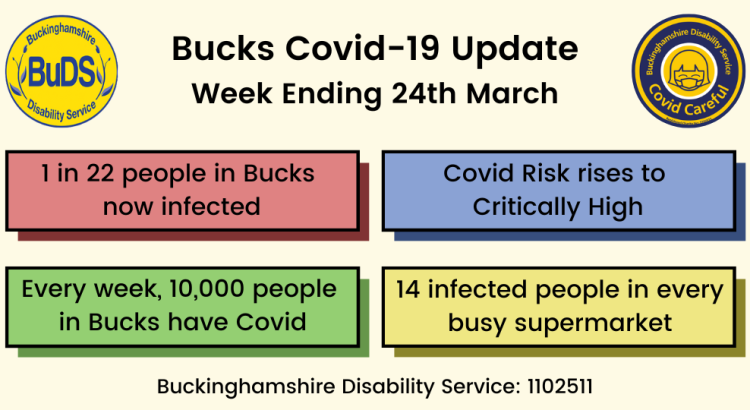
Covid-19 Risk Assessment: Week Ending 24 March 2023
Covid infections in Bucks nearly doubled last week. The Covid risk has been raised to Critically High, with more people with Covid going into hospital.
This is the last risk post in this format, as the Government have deliberately closed the Office for National Statistics’ Coronavirus Infection Survey, which measures how many people have Covid in the UK. However, we will continue publishing risk assessments using other data – more on this next week.
Read More
Covid-19 Risk Assessment: Week Ending 17 March 2023
Covid infections in Bucks remained constant last week. The Covid risk remains Extremely High, with more people with Covid going into hospital.
The Government have made several changes recently to hide the true extent of Covid in the UK. One of these changes is that they are stopping the ONS Infection Survey, which is the most reliable way of finding out how many people have Covid in the UK. Because of this, next week’s risk post will be the last in this format. To find out more about these changes, and BuDS’ reaction to them, use the link below.
Read More
Covid-19 Risk Assessment: Week Ending 10 March 2023
Covid infections in Bucks increased last week, with no sign yet that the current wave has peaked. The Covid risk remains Extremely High. It is unclear whether the current wave, driven mainly by XBB variants, will continue to build.
People are asking why we still issue Covid risk assessments when so many people have stopped taking notice of Covid. The reality is that over 10,000 people have Covid every week in Bucks, and their health is getting worse all the time. Nearly all doctors now believe that Covid causes serious long-term effects for many people who catch it, even if they are not very ill immediately. Covid is destroying the health of Buckinghamshire, one infection at a time.
Read MoreCovid Pandemic – UK Government Officially Gives Up

The Government have abandoned any attempt at controlling Covid in the UK. That’s the only conclusion that can be drawn from their recent announcements about Covid vaccination and boosters.
In background documents1 slipped out on 7th March during the high profile debate about asylum seekers, the Government have made some extraordinary statements and decisions:
- Covid cannot be eliminated, and the population’s immunity to Covid is expected to reduce.
- Because vaccines cannot stop the spread of Covid, or prevent non-severe illness, the Government have decided to abandon all future Covid vaccinations for the general public. Only those over 50 or clinically vulnerable groups will be offered primary vaccination in the future, and only at certain times.
- Only people at the very highest clinical risk from Covid will be boosted in the future – not to protect their health, but to reduce demand on the NHS. Although this has not yet been confirmed, it appears that only over 75s, care home residents, and severely immunosuppressed people will be eligible for the Spring 2023 booster.
- Catching Covid in hospital, when you are there for another reason, is almost inevitable and cannot be prevented by vaccination.
Taken together, these decisions amount to the Government abandoning the people of the UK to a cycle of repeated Covid infections and illnesses.
Read More