
This article refers to England & Wales only. Accurate as of August 2026
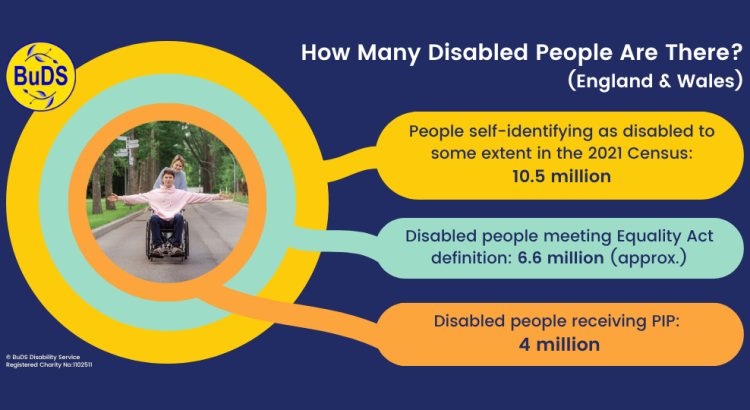
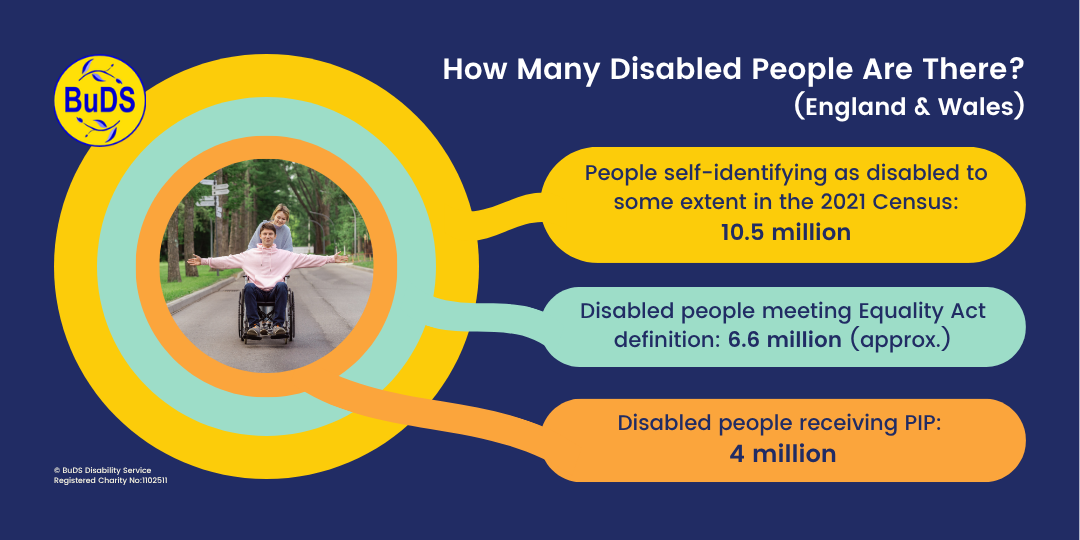
We’ve produced this handy infographic showing how many disabled people there are in England & Wales. This is free to download and share, and we encourage you to do so. Just use the button below. The public must have access to accurate information when disability is such a hot political topic.
Counting Disabled People
Counting disabled people in England & Wales is much more difficult than it appears. That’s because there are lots of different definitions of ‘a disabled person’.
Census 2021 – 10.5 Million
The Census in 2021 asked people if they had a long-term physical and mental condition and, if they answered yes, asked them whether that condition affected their ability to do everyday activities ‘A lot’, ‘A little’, or ‘Not at all’. The Office for National Statistics count everyone who said their ability was affected ‘a lot’ or ‘a little’ as a disabled person. That’s 10.5 million people in 2021 in England & Wales (this will be larger now).
Equality Act – About 6.6 million
The Equality Act 2010 protects ‘disabled people’ from discrimination. The Act defines a disabled person as someone with a long-term physical or mental condition which substantially limits their day-to-day life. But there is no registration scheme for ‘disabled people under the Equality Act’, so nobody really knows how many disabled people there are according to the Act’s definition.
You can cross-refer the Census 2021 results with the Equality Act. The 4.9 million people who told the Census that their conditions affect their day-to-day life ‘a lot’ certainly also qualify under the Equality Act, which covers people with a ‘substantial’ limit on their day to day life. At least some of the 5.6 million people who told the Census that their conditions affect their day-to-day life ‘a little’ will also qualify under the Equality Act definition. But nobody knows how many. We have assumed a third of those who told the Census that their life was affected ‘a little’ qualify as a disabled person under the Equality Act, but it could be more, or less.
Receiving Personal Independence Payment (PIP) – 4 million
According to the DWP, around 4 million disabled adults in England and Wales currently receive PIP.
PIP is paid not because a person is disabled (whatever definition you use), but if a person is disabled AND their condition affects them in very specific ways. PIP has 12 complicated tests looking at very specific living activities and how people can move around outdoors. Disabled people score points according to how much their conditions affect their ability to do only the activities specified in the tests. An award of benefit is made if the total point score exceeds certain thresholds. This is very different from Disability Living Allowance, which PIP replaced for adults, which looked much more holistically at how much help people needed in their everyday life and when going out.
Because PIP is a very artificial test of disability, people with different impairments and conditions score points very differently under the 12 tests. This is partly deliberate, because PIP was designed to reduce the cost of disability benefits by a fifth. However, the DWP is as incompetent at drafting legislation as it is at administering benefits, and there are a lot of ‘unintended consequences’ arising from the way the tests work. The courts too have decided that some of the PIP tests work differently in fact from the way the DWP hoped they would.
Compensation, Not Welfare
PIP is supposed to compensate or refund disabled people for the extra costs of being disabled. The charity Scope calculates that disabled people spend on average around £13,140 more than non-disabled people just to live the same lifestyle. The maximum annual award of PIP, which only 37% of claimants receive, is significantly less than this, at £10,120. The average PIP award is only £6900.
Social Security, Not Welfare
If disabled people fall into crisis, the state then pays to help them cope and to get out of crisis. Providing crisis support is far more expensive than making a small payment to stop the crisis occurring. Supporting a single homeless disabled person, for example, costs councils on average £13,000 per annum, plus the cost of temporary housing, additional GP visits, hospital stays, etc. The reason disability benefits were introduced was to save money, because giving disabled people a small ‘social security’ payment was much cheaper than the alternative.
When politicians talk about cutting ‘welfare’, this is just economic incompetence. If you cut the small social security amounts which help disabled people stay independent and out of crisis, the taxpayer will end up paying much more when those disabled people fall into crisis. BuDS looked into this matter in detail when it was suggested that ‘welfare’ could be cut to fund defence – you can find out more by clicking the button.
Are Too Many Disabled People Claiming PIP?
There is no objective evidence of this. The 4 million adults currently claiming PIP matches up quite well with the 4.9 million people who told the Census in 2021 that their conditions affect their day-to-day life ‘a lot’.