
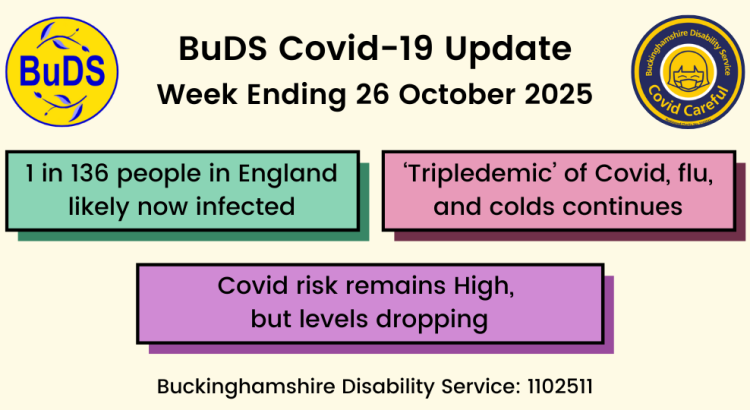
There has been a welcome fall in Covid infection levels in England. However, the risk level remains HIGH, and people should not even think of relaxing precautions. Around 1 in every 136 people in England were infected as of 26 October. Flu (influenza) levels in England are still rapidly increasing. The influenza vaccine is much more widely available than the Covid vaccine, and we recommend everyone entitled to a flu vaccine gets one as quickly as possible. Remember, influenza is also a serious illness.
Past The Peak?
While it is now clear that current Covid infection levels are dropping, it is less clear whether this fall will continue, or whether we will see a further rise (a ‘twin peak’) in the future. Covid remains a pandemic virus driven primarily by new variants and community immunity levels, which makes it very difficult to predict the future. The key message for this week is that Covid infection levels remain High, and precautions should not be relaxed. Remember, Covid precautions will also protect against influenza and other respiratory viruses.
Tripledemic In England
Despite the recent drop in Covid infection levels, England remains in the middle of a ‘tripledemic’ of airborne respiratory viruses. Covid, influenza, and the common cold (rhinovirus) are all surging at the same time. Unlike previous winters, the NHS is not publicising the extreme stress that it is under, presumably for political reasons. However, a number of hospitals across England have declared critical incidents, and waits in A&E are very long in many places. The cost of not providing clean air in hospitals is huge.
Infection Etiquette
If you or someone you have met does have symptoms of Covid (or of a respiratory virus which might be Covid), please do the decent, patriotic, thing and keep it to yourself. Unless you are unable to do so, please isolate until your symptoms have been gone for a couple of days. If you can’t isolate, wear a tight-fitting non-valved PPE respiratory mask (FFP2/FFP3) whenever you are in contact with other people indoors. You can buy these masks at pharmacies or online. They both protect you against viruses in the air and protect others if you are infected. We recommend everyone stocks up on them now.
BuDS recommends that anyone with symptoms of a respiratory virus tests themselves for Covid using lateral flow home test kits (about £2 each from pharmacies or online). If the test is positive, do self-isolate or wear a mask to protect others, even if you don’t feel particularly ill yourself. Do also tell your GP surgery that you have had a positive home test and ask them to note the fact on your medical records (they are obliged to do so under NHS Standard Operating Procedures). Knowing that you had Covid might be very important in the future if you develop a post-Covid condition or ‘Long Covid’. Remember, lateral flow home rest kits are very accurate if showing that you do have Covid, but much less accurate when they show you do not have Covid. If you have symptoms of Covid, but test negative, it is always worth testing again at a later date to be sure.
If you have a condition which makes you extremely clinically vulnerable to Covid, you are entitled to free NHS lateral flow test kits and, if you test positive, you may be eligible for antiviral treatments to help you survive the infection. More information is available on the NHS website.
Risk Analysis
BuDS strongly recommends that everyone takes precautions against catching Covid. These precautions should be taken in all indoor places, unless you are sure that the space is very well ventilated or has HEPA filtration in place. We continue to not recommend Covid precautions outdoors, unless you are in a dense crowd of people.
| Risk | Places | Risk factors | Likely number of infected people on a single visit/journey this week | Risk mitigations (things you can do to protect yourself) |
| High | Buses, trains, taxis, transit systems like the London Underground, hospitals, GP practices, dentists, vaccination clinics, pharmacies, schools, universities and colleges | Used by very large numbers of people, who are not taking precautions. Typically poorly ventilated. Risk on journeys is calculated assuming that people visit several places in one trip, e.g. railway station, train, railway station is assessed as one “journey” | Minimum 7, potentially 37+ | Minimise visits. Wear a PPE respiratory mask (FFP2/3 rated) on every visit. Maximise fresh air ventilation (open windows if possible, etc). |
| Medium-high | Bars and clubs, large supermarkets, indoor shopping centres, large office buildings, most cinemas and theatres. | Used by large numbers of people, who are not taking precautions. Typically poorly ventilated. | Minimum 6, potentially 11+ | Minimise visits. Wear a PPE respiratory mask (FFP2/3 rated) on every visit. Maximise fresh air ventilation (open windows if possible, etc). |
| Medium | Medium-sized restaurants (200 seats or more), smaller supermarkets, smaller offices, individual larger shops | Used by medium numbers of people, who are not taking precautions. Typically poorly ventilated. | Minimum 2, potentially 4+ | Minimise visits. Wear a PPE respiratory mask (FFP2/3 rated) on every visit. Maximise fresh air ventilation (open windows if possible, etc). |
| Lower | Small cafes (around 25 seats), small shops, infrequently used buildings e.g. churches (outside of services), buildings which, at the time of visit, have very few people inside them | Used by small numbers of people, who are not taking precautions. Can be poorly ventilated. | You are statistically unlikely to encounter an infected person on a single visit, although this risk cannot be excluded. After 3 to 5 visits, statistically you are likely to encounter one infected person over all of those visits. Remember, however, especially with rising infection levels, you may well be unlucky and meet a Covid-infected person on your first visit. | Minimise visits. Maximise fresh air ventilation (open windows if possible, etc). While statistically the risk remains lower, we encourage a cautious approach to taking risks. Not wearing a PPE respiratory mask (FFP2/3 rated) should be exceptional when the risk is clearly lower, for example in a nearly empty building. |
| Low | Outdoors (except when in a dense crowd) | The moving fresh air makes transmission of Covid from one person to another unlikely, except where two people are very close together. | The number of infected people is less relevant because the risk of transmission of Covid from one person to another is unlikely. | Avoid very close contact (under 1m) with potentially infected people. For complete peace of mind, remain 2m from potentially infected people. |
| Covid, flu, norovirus, bird flu and measles are all airborne. An infected person in an unventilated indoor place creates an invisible cloud of virus which hangs in the air like smoke for you to breathe in. The virus cloud can be dispersed and made less harmful, or harmless, using fresh air ventilation – e.g. opening a window or door. Fresh air is the enemy of Covid and the friend of Covid-cautious people. Another way to deal with an indoor cloud of Covid is to use a HEPA filter. These filters suck in the air, remove the viruses, and blow out virus-free clean air. HEPA filters are essential when an indoor space cannot be ventilated with fresh air, e.g. no (or little) opening windows. PPE respiratory masks filter viruses out of the air you personally breathe, if they are fitted and used correctly. PPE masks are the last line of defence against airborne viruses. As we explain in the table above, Covid-cautious people can use one or a combination of these precautions to help make indoor spaces safer for them. | ||||
Covid is not just dangerous for clinically vulnerable people. The virus has been proven to have an adverse health impact on most people who catch Covid. No-one should be relaxed about catching Covid.
More Information
This is BuDS’ 248th Covid risk assessment since the beginning of the pandemic, and we are still the only organisation publishing free risk data for disabled and clinically vulnerable people. We will update you on the situation again next week.
If you’d like to get our weekly Covid risk assessments direct to your email inbox, completely free of charge, you can subscribe here: https://budscovidinfo.substack.com/
To understand more about our Covid risk levels and what they mean, use this link: https://buds.org.uk/covid-19-risk-levels-in-bucks/
For more Covid information and help, or if you’d like to know more about how we calculate risk, please contact BuDS and we will be happy to help.