
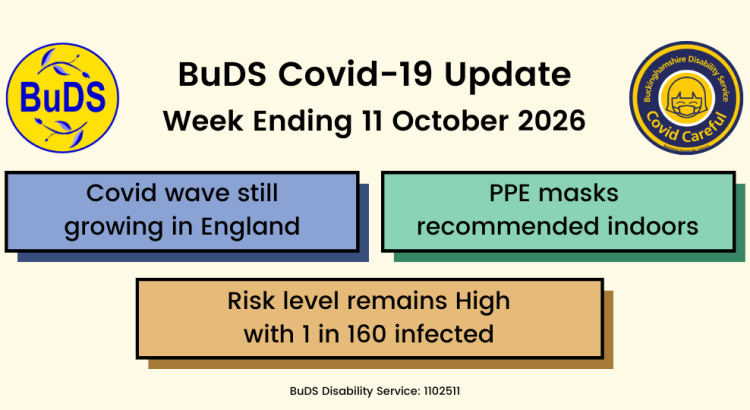
Covid infections in England have increased again, but at a slower rate. The overall Covid risk level has remains High. As of 11 October, 1 in every 160 people were infected, up 5% on last week. We continue to recommend that Covid-Cautious people take full precautions, including a PPE mask, in ALL indoor places.
Influenza (flu) levels in England are also still increasing as the winter flu wave continues to build.
Analysis
Covid infection levels in England continue to rise, but this week’s data shows the rate of increase has slowed. This may be a data error, which may be corrected later, or simply a bump in the growing wave of Covid cases. We do not think that England has seen the peak of the Covid wave yet, sadly.
The same applies to flu, where it is obvious that we are nowhere near the peak of cases yet.
Mask Up!
The BuDS Covid risk level is High. Accordingly, we recommend that Covid-Cautious people take full precautions, including a PPE mask, in ALL indoor places. Everyone should be taking full precautions, including a PPE mask, in all but the least busy indoor places. Full details can be found in the table below.
‘American’ Covid?
Many media outlets are still saying that the current Covid wave in England is connected to the recent Covid wave in the US or driven by the XFG (‘Stratus’) variant, crossing from America. None of this is accurate. XFG has been the most frequently seen (‘dominant’) variant in England for many months. People are catching Covid now (whether the XFG variants or one of the other variants in circulation) because 1. they are inside breathing virus-laden air and 2. their temporary immunity to catching Covid has faded away over time. This means that the current wave will continue until most people have caught Covid and so have short-lived protection from catching it again. This infection cycle usually takes a month or two and causes huge amounts of sickness, disability and pressure on employers and the NHS.
Endless Covid – Until We Clean the Air
Covid mutates to avoid the immunity which people get from being vaccinated or catching a previous variant of Covid. This means that people will continue to catch Covid without ever becoming immune to new infections. The only way to stop the illness and disability that follows a Covid infection wave is to have clean indoor air, with the virus removed. This is technically entirely possible, but the government seems to prefer an ever-sicker workforce and higher benefit bills to introducing basic public hygiene regulations for indoor air. Why not ask your MP what they think about this?
BuDS Has Your Back
Our aim is to help Covid-Cautious people continue to engage safely in society while Covid levels are high. Obviously, these are only our recommendations, and everyone is free to choose the level of Covid precaution that feels right for them. We only advise on infection risk (how likely it is that you will meet someone with Covid), not on how serious a Covid infection might be for you.
Managing Your Risk
Covid is an airborne virus. This means that it mainly spreads in the air that you breathe.
Things you can do to protect yourself against Covid infection include:
- Wearing a PPE respiratory mask indoors. Worn correctly, respiratory masks (rated FFP2/FFP3 or N95/99) filter airborne viruses out of the air that you breathe.
- Improving fresh air ventilation. Fresh air, especially moving fresh air, very effectively dilutes and breaks up the clouds of Covid virus in the air, making it less likely that you will inhale enough virus to catch Covid. A CO2 monitor will help you understand how fresh or recirculated indoor air is – the lower the CO2, the better.
- Using a HEPA filter. HEPA filters suck in the air, filter out viruses like Covid (and other particles), and blow out clean air. HEPA filters are very useful in cleaning the air in rooms with poor fresh air ventilation.
- Avoiding higher-risk areas. If you don’t go to areas where there is likely to be a lot of virus, you won’t catch it.
- Enjoy the outdoors. It is extremely difficult to catch Covid outside, because the fresh moving air immediately disrupts and dilutes the Covid virus which other people may breathe out. As long as you are not in a dense crowd of people who are breathing directly into your face, you do not need to take precautions against catching Covid outdoors.
Detailed Covid Infection Risk Analysis
| Infection Risk | Places | Infection Risk factors | Likely number of Covid infected people on a single visit/journey this week | Risk mitigations (things you can do to protect yourself) |
| Highest | Hospitals & other healthcare buildings. Education settings such as schools and colleges. Public transport including buses and trains and the London Underground. Very large indoor stadiums or theatres. | Used by people who are much more likely to have Covid. Used by very large numbers of people. | In healthcare and education settings, the risk of encountering a Covid-infected person is high, even if there are not large numbers of users. In very large indoor spaces, you are statistically likely to encounter 19 to 31 infected people every time you visit. | Minimise visits. Maximise fresh air ventilation (open windows if possible, etc). DANGER: We strongly recommend that everyone wears a PPE respiratory mask (FFP2/3 rated) on every visit to these places in view of the higher infection risk. |
| High | Large cinemas & theatres. Large indoor performing arts venues. Large indoor shopping centres | Used by large numbers of people. | You are statistically likely to encounter 6 to 19 infected people every time you visit. | Minimise visits. Maximise fresh air ventilation (open windows if possible, etc). DANGER: We strongly recommend that everyone wears a PPE respiratory mask (FFP2/3 rated) on every visit to these places in view of the higher infection risk. |
| Medium-High | Larger bars and clubs, Larger supermarkets. Local indoor shopping centres. Large office buildings. | Used by large numbers of people | You are statistically likely to encounter 5 to 9 infected people every time you visit. | Minimise visits. Maximise fresh air ventilation (open windows if possible, etc). DANGER: We recommend that everyone wears a PPE respiratory mask (FFP2/3 rated) on every visit to these places in view of the higher infection risk. |
| Medium | Medium-sized pubs, bars, clubs, and restaurants Average sized supermarkets. Smaller offices. Individual larger shops Large indoor heritage or tourism destinations. | Used by medium numbers of people | You are statistically likely to encounter 2 to 4 infected people every time you visit. | Minimise visits. Maximise fresh air ventilation (open windows if possible, etc). DANGER: We recommend that everyone wears a PPE respiratory mask (FFP2/3 rated) on every visit to these places in view of the higher infection risk. |
| Medium-Low | Smaller cinemas, theatres, & performing arts venues. Smaller hotels. Larger individual restaurants. Smaller supermarkets. town Most heritage destinations, eg museums, galleries etc | Used by lower numbers of people. | You are statistically likely to encounter 1 infected person every time you visit. | Minimise visits. Maximise fresh air ventilation (open windows if possible, etc). DANGER: We recommend that everyone wears a PPE respiratory mask (FFP2/3 rated) on every visit to these places in view of the higher infection risk. |
| Lower | Small pubs, bars & cafes. Small individual shops. Infrequently used buildings e.g. churches (outside of services). Buildings which, at the time of visit, have few people inside them. | Used by small numbers of people. | You are statistically unlikely to encounter an infected person, even on multiple visits (although this risk cannot be excluded). After 3 to 6 visits, statistically you are likely to encounter one infected person over all of those visits. | Minimise visits. Maximise fresh air ventilation (open windows if possible, etc). CAUTION: Covid-cautious people using these spaces will wish to use a PPE respiratory mask. Some people may feel it is still safe enough for them to remain unmasked in these small spaces However, remember that Covid may hang in the air in unventilated indoor places and cause an infection even if there is only a few, or even nobody, present. |
| Lowest | Outdoors (except when in a dense crowd) | The moving fresh air makes transmission of Covid from one person to another unlikely, except where two people are very close together. | The number of infected people is less relevant because the risk of transmission of Covid from one person to another outdoors is unlikely. | SAFEST: No precautions needed but avoid very close contact (under 1m) with potentially infected people. For complete peace of mind, remain 2m from potentially infected people. |
More Information
This is BuDS’ 293rd Covid risk assessment since the beginning of the pandemic. BuDS is the only organisation publishing free risk data for disabled and Covid-cautious people in England. We will update you on the situation again next week.
If you’d like to get our weekly Covid risk assessments direct to your email inbox, you can subscribe here: https://budscovidinfo.substack.com/. (The paid and free subscriptions are exactly the same, but choosing a paid one gives us a small, regular donation to support our work.)
To understand more about our Covid risk levels and what they mean, use this link: https://buds.org.uk/covid-19-risk-levels-in-bucks/
BuDS is not funded by grants to publish these weekly reports. To make a donation to help us continue these risk assessments, use this link: https://www.peoplesfundraising.com/fundraising/buds-covid-information-project-2026
For more Covid information and help, or if you’d like to know more about how we calculate risk, please contact BuDS and we will be happy to help.